
Treating the Cause, Not the Symptom: The Mitochondrial Thread in Chronic Disease
With thanks to Romilly Hodges CNS for her assistance in researching and writing this article.
This blog offers a clinician’s guide to our new EWAS analysis of the Methylation Diet & Lifestyle Study, the dietary and lifestyle pattern behind Dr. Fitzgerald’s Younger You Program.
It’s funny how things eventually come full circle. Way back in 2016, when we first presented our thoughts on the potential hazards of high-dose methyl donor supplements to the Institute for Functional Medicine audience, and later when we started our original clinical study, we weren’t thinking about bioage clocks. In fact, the prevailing view at the time was that biological age (as measured by epigenetic age) wasn’t changeable.
Our original concern stemmed in part from epigenetic data on tumor suppressor genes – that hypermethylation of the promoter region of such genes could “silence” genes, much like a genetic mutation. In fact, this 2013 blog from the DrKF archives is where we considered how, before 1940, the risk of cancer for those with a BRCA mutation was 24%, compared with 82% then, and how our environment, through epigenetics, appeared to be shaping that risk. It was this perspective that led us to design the Methylation Diet & Lifestyle Study, to try to safely optimize the epigenome using a very specifically designed protocol to “sweet talk” DNA methylation broadly, allowing protective genes to be expressed and genes that drive disease and inflammation forward to be inhibited.
Then we got a little side-tracked, though not in a bad way. Partway through our study, a couple of landmark reports, including the small, uncontrolled TRIIM trial (growth hormone, DHEA, and metformin) and supplemental vitamin D research, began suggesting that epigenetic age might, under the right conditions, actually reverse. That reframing pulled our own attention toward biological age for several years: we published our pilot trial’s headline finding in Aging (a 3.2-year reduction in DNAmAge after 8 weeks on a polyphenol-dense, methylation-supportive diet and lifestyle program), followed by a case series in women and a secondary analysis identifying which intervention components, principally the polyphenol-rich “methyl adaptogen” foods like green tea, oolong tea, turmeric, garlic, and berries, most predicted that effect.
Why the Younger You Study Looked Beyond Epigenetic Age
But a biological age number, however striking and useful a data point, is a summary statistic. It doesn’t tell you what changed underneath it. So, at last, we’ve circled back to our original question: if we instead look across the entire methylome, what actually moved? That’s what our new analysis, an epigenome-wide association study, or EWAS, set out to answer.
What Is an Epigenome-Wide Association Study (EWAS)?
An epigenome-wide association study (EWAS) is the epigenetic equivalent of a genome-wide association study (GWAS) – except instead of scanning the genome for DNA sequence variants associated with a trait, it scans the epigenome for DNA methylation differences associated with an exposure or outcome.
DNA methylation is the process of adding a small chemical tag directly onto DNA, at sites called CpGs, that doesn’t change the genetic code itself but can change how easily a gene is switched on or off. A methylation array like the one used here tests ~866,000 CpG sites simultaneously across the genome.
Key Findings From the Younger You EWAS
Here are the highlights of what we found:
1. More DNA Methylation Changes Appeared in the Intervention Group
Comparing baseline to Week 8, the intervention group (n=18) showed differential methylation at far more CpG sites than the control group (n=20) at every threshold we examined: 676 sites versus 286 at a nominal P<0.001, and 50 versus 13 at a stricter P<0.0001. (Note that P values in EWAS studies must be interpreted differently, in the context of multiple test corrections – see below).
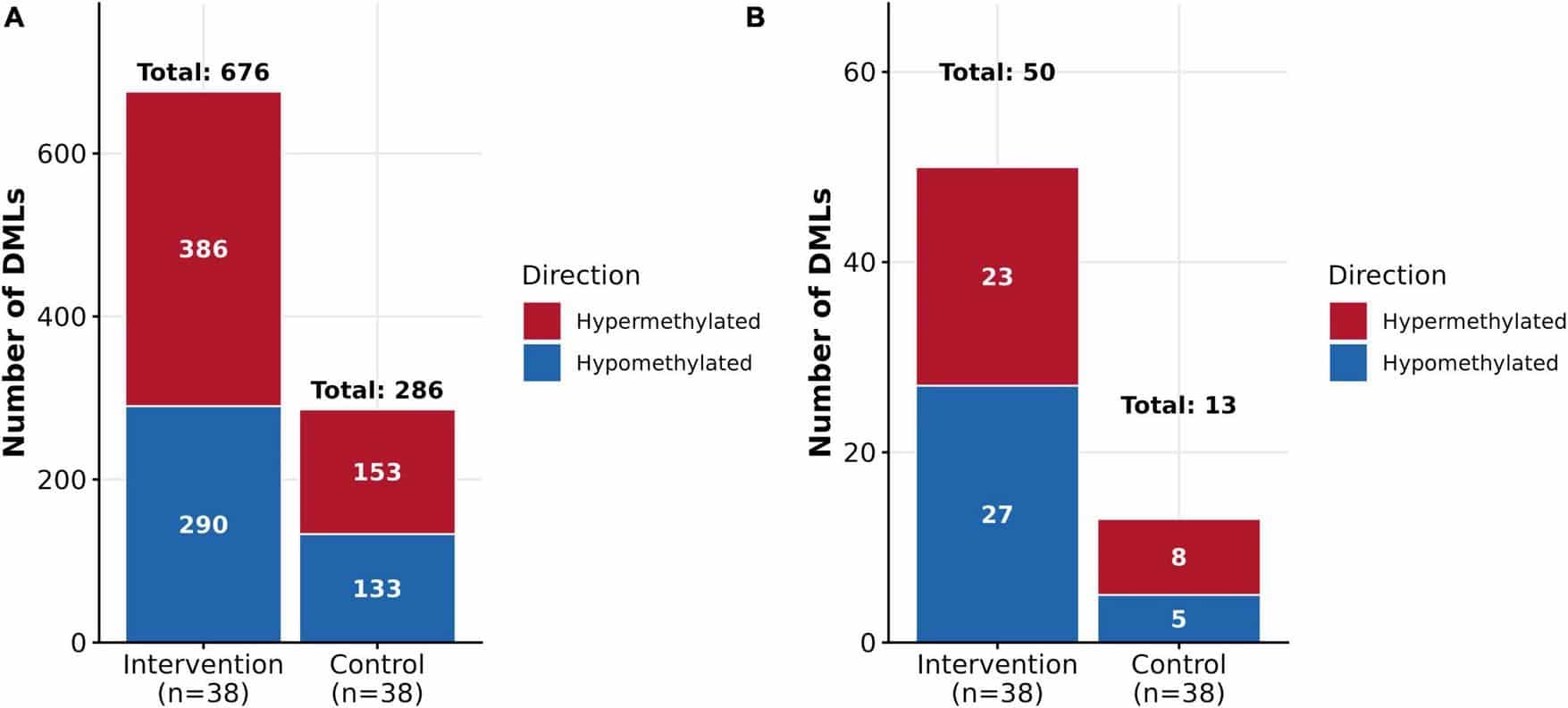
Within-individual differentially methylated loci between baseline and week 8. (A)P < 0.001 (unadjusted), FDR > 0.05. (B)P < 0.0001 (unadjusted), FDR > 0.05.
In addition to the within-group comparison, we compared the methylation differences between the treatment and control groups. Differential methylation occurred at 694 sites at the nominal P<0.001 and 70 sites at P<0.0001.
2. DNA Methylation Changes Mapped to 11 Hallmarks of Aging
Our original trial indicated the potential for movement in epigenetic age. This new EWAS shows that DNA methylation also shifted in several genes and biological pathways associated with 11 of the 12 Hallmarks of Aging: genome stability, epigenetic alterations, proteostasis, autophagy, nutrient sensing, mitochondrial function, senescence, stem cells, intercellular communication, inflammation, and dysbiosis.
Nutrient sensing, the processes by which our bodies detect and process macronutrients, stands out for the high share of everything we found. Perhaps not surprising given how directly diet intersects with nutrient-sensing biology. Within that pathway, differential methylation touched on fatty acid metabolism, glucose metabolism, PPAR signaling, bile acid metabolism, mTOR signaling and more. Folate transport and metabolism also moved (noted below in the “epigenetic alterations” category)—the diet was deliberately high in food-based folates, and included a folate-producing probiotic. We increased circulating methylfolate significantly in the treatment group through diet alone.
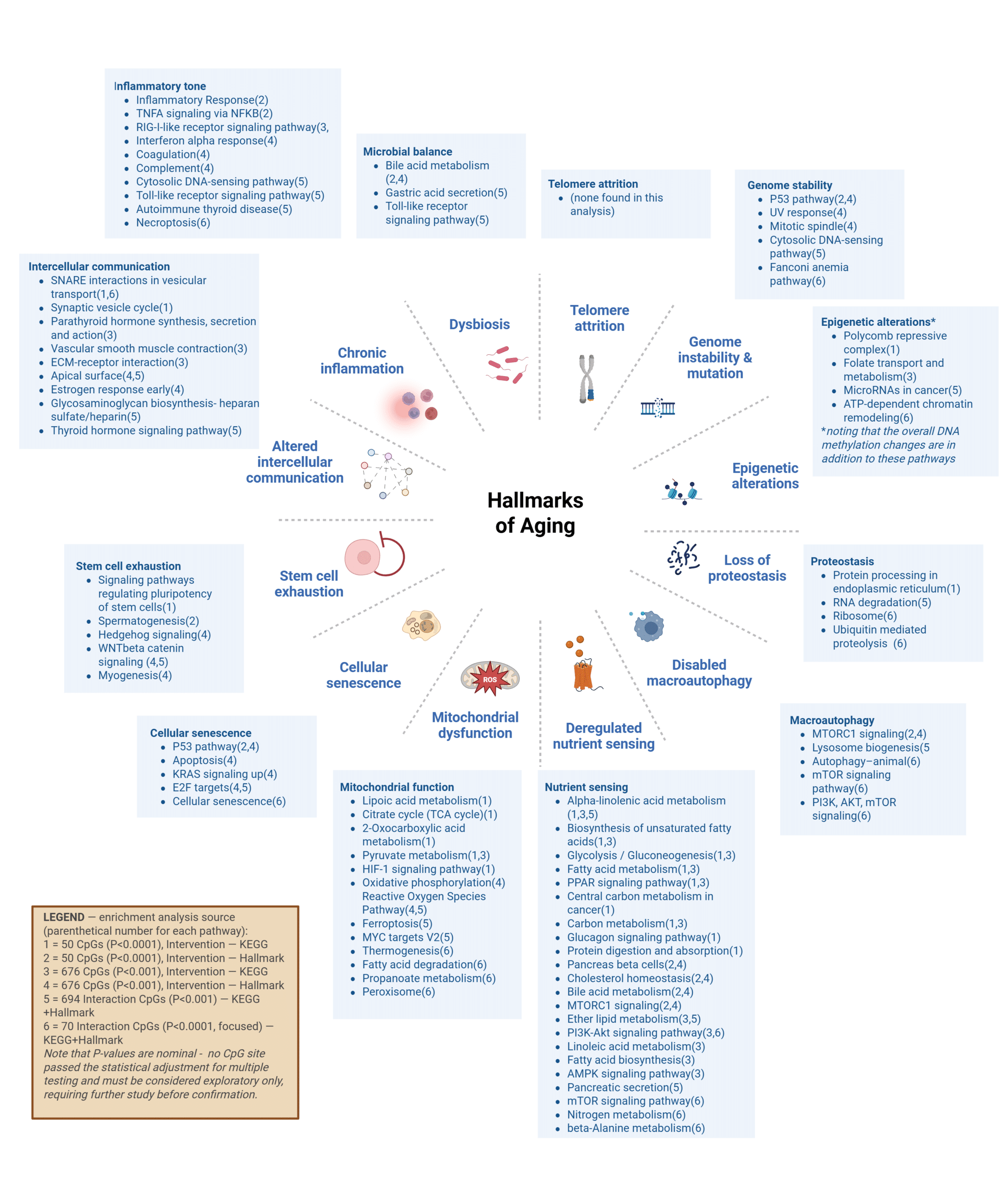
How the Younger You diet and lifestyle pattern influenced the Hallmarks of Aging (image created with BioRender)
3. DNA Methylation Changed Within the Stem Cell Pluripotency Network
We were intrigued to find that some of the genes touched by this intervention sit inside the stem cell pluripotency network (the pathway that includes the core Yamanaka factors: OCT4, SOX2, KLF4, and c-MYC). c-MYC and JARID2 showed differentially methylated sites post-intervention. JARID2 helps drive the chromatin remodeling that PRC2 needs to silence developmental genes and is a documented partner of SOX2, KLF4, and MYC during experimental reprogramming. In JARID2, hypomethylation occurred at the transcription start site, suggesting that gene expression may increase.
So, could polyphenol-rich nutrition act as a partial, gentle “Yamanaka mimetic”? It’s an exciting hypothesis that we’re eager to keep exploring, and these data are consistent with it touching the edges of that network (though, to be clear, this is not evidence that this diet reprograms cells toward pluripotency).
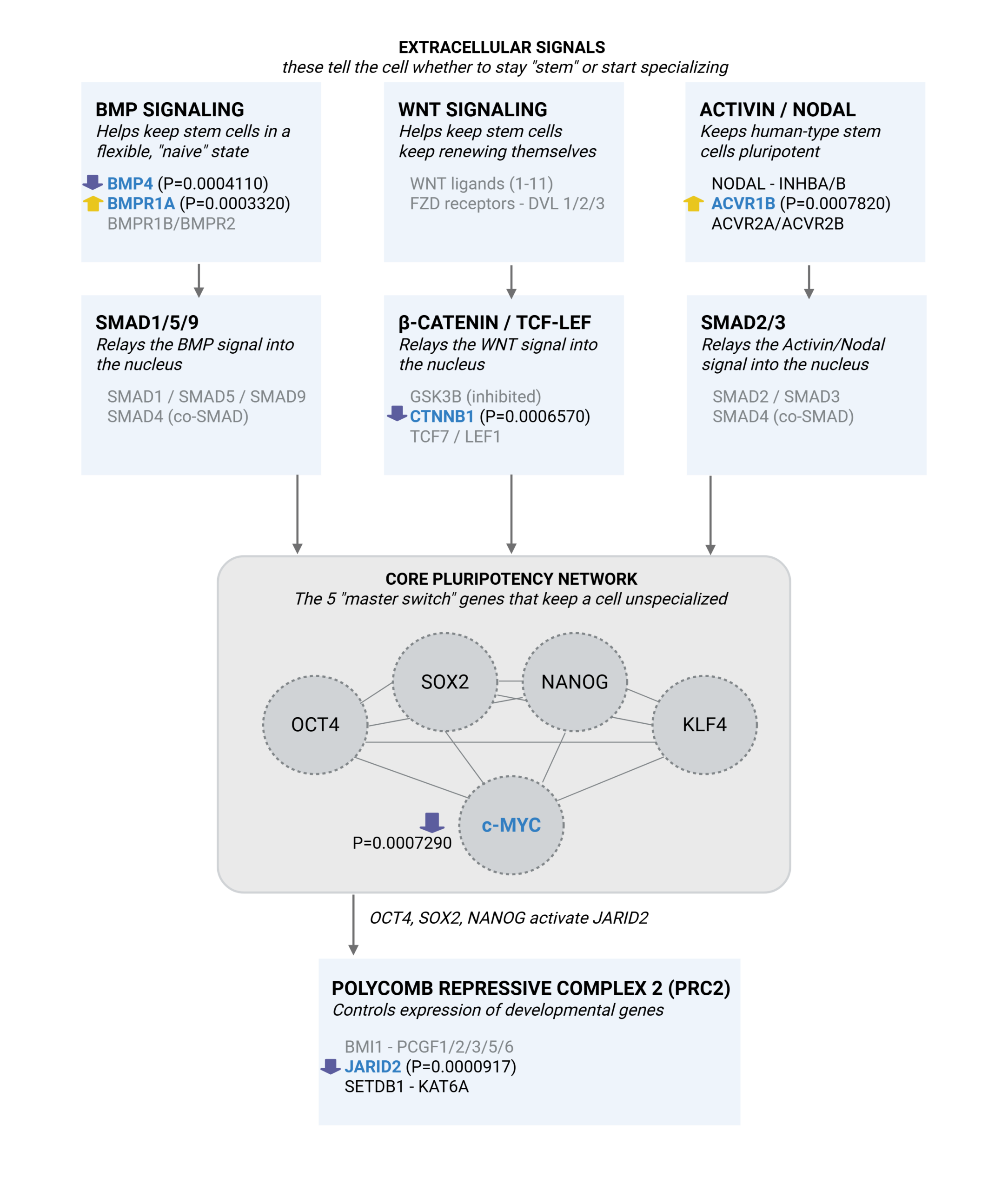
How the Younger You diet and lifestyle pattern influenced the Stem-Cell Pluripotency Pathway
Genes with differentially methylated CpG sites are indicated in BLUE, with yellow arrows indicating hypermethylation and purple arrows indicating hypomethylation. See the paper full text and supplementary materials for further breakdown by analysis type.
(image created with BioRender)
4. DNA Methylation Changed Across 74 Tumor Suppressor Genes
This is where the analysis closes the loop back to where our interest in this field began. Cross-referencing every gene touched by a DNA methylation change in this study against a curated database of known tumor suppressor genes (TSGene 2.0), 74 came back as documented tumor suppressors (click the link if you’d like to see the full list). Of particular interest because of their repeated appearance across the analysis methods we applied: TSC2, a central brake on mTOR signaling (“deregulated nutrient sensing hallmark”); SSBP2, independently reported as silenced in prostate and blood cancers; SMARCA4 and TP53BP1, both tied to chromatin remodeling (“epigenetic alterations” hallmark) and DNA-damage response (“genomic instability” hallmark).
How to Interpret the Younger You EWAS Results
FDR stands for “false discovery rate.” Testing methylation across ~866,000 CpG sites, and then testing enrichment across hundreds of biological pathways on top of that, creates what is known as a multiple-testing burden. To find a signal that survives formal correction for that burden (an FDR-adjusted P-value), you generally need either a very large effect or a very large sample, which we did not have in our pilot study. As a result, none of the single-CpG or pathway-level findings in this analysis reached FDR significance. This means that, although the findings have biological coherence, they have to be interpreted as exploratory and hypothesis-generating, requiring further study to confirm them. This is, indeed, what we hope to do going forward.
How Diet and Lifestyle May Influence the Epigenome and Healthy Aging
Nutritional epigenetics has often been treated as a kind of “dark matter” in the field. The complexity of nutrient combinations and their far-reaching influence on physiology is just starting to be examined. This analysis, pulling back some of that curtain across the nutritional dark matter, is one more piece of evidence that a consistent dietary and lifestyle pattern can influence the epigenome across the deep biological architecture of aging and age-related disease. Together with other EWAS analyses of observational polyphenol intake data (DIRECT PLUS, for example), these provide ongoing evidence supporting a varied, polyphenol-dense diet as a foundational prescription. We’re looking forward to the next chapter as the next study takes shape.
AI use statement: Assistance with cross-referencing of genes/enrichment pathways from our EWAS study with the Hallmarks of Aging, the KEGG STEM cell pluripotency pathway, and TSGene 2.0 database was provided via Claude Code (Anthropic). Each finding was reviewed for accuracy, and DrKaraFitzglerald.com takes responsibility for its scientific accuracy and interpretation.

Related posts