
What the Science Says About Sauna for Longevity: Infrared vs. Traditional

Don’t forget to Become a DUTCH Provider today to gain access to free educational resources about the DUTCH Test, expert clinical support, comprehensive patient reports, and peer-reviewed and validated research! Learn more at dutchtest.com/for-providers.

For 50 years, Biotics Research Corporation has utilized “The Best of Science and Nature” to create superior nutritional supplements, available exclusively to healthcare professionals.

Timeline is a Swiss-born longevity brand founded by scientists, doctors and innovators on a mission to extend healthspan through clinically proven science. At the core is Mitopure®, a pure and patented form of Urolithin A, shown to improve mitochondrial function — a key hallmark of aging.

A modern patient lab testing experience, powered by provider expertise.

The Mira Hormone Monitor transforms episodic lab draws into continuous hormone trends.

Fuel your longevity with Solaray’s UNLIMIT line—targeted, daily support for muscle, bone, and cellular energy to build vitality into every year.
What Actually Slows Aging? The Science vs. Hype | Dr. David Barzilai
In this episode of New Frontiers, Dr. Kara Fitzgerald sits down with longevity physician Dr. David Barzilai to separate promising science from hype and explore where the field of longevity medicine is headed.
They discuss the evolution of biological age testing, including DunedinPACE and other aging clocks, and why these tools can provide useful information without telling the whole story. They also explore how AI and emerging technologies could transform personalized medicine, helping clinicians better identify which interventions may actually benefit an individual.
You’ll also hear why the fundamentals still matter, how to think critically about the growing number of supplements and longevity “hacks,” and which emerging interventions deserve attention as the science evolves.
In this episode of New Frontiers, learn about:
- What biological age and aging clocks can, and can’t, tell us
- How to distinguish promising longevity science from hype
- Why slowing the rate of aging may matter more than chasing a biological age number
- How AI could change personalized longevity medicine
- Why individualized diet, exercise, sleep, and other foundational interventions still come first
- How clinicians can evaluate emerging longevity therapies without getting ahead of the evidence
- Where longevity and geroscience may be headed next
If you’re interested in biological aging, healthspan, precision medicine, or the future of longevity science, this conversation offers a practical look at what we know today, and what may be coming next.
Dr. Kara Fitzgerald: Hi, everybody. Welcome to New Frontiers in Functional Medicine, where we are interviewing the best minds in functional medicine. And of course, today is no exception. You know, I have been following this man on Twitter forever. He posts always the latest and really some of the most interesting science happening in the longevity space. His name is Dr. David Barzilai. He’s a longevity medicine physician and a Harvard Medical School lecturer.
Dr. Kara Fitzgerald: He’s got a remarkable ability to track the science, to pay attention, to post it, to keep a critical eye and to kind of synergize it and bring it into his own clinical practice. In my conversation today, we’ll be talking about what’s new to use, to be thinking about, bringing into practice. We’re going to be talking about the clocks, including the Dunedin Pace of Aging. Actually, he does a great breakdown of what that actually is. AI in practice, is it ready? Future of geroscience, just loads and loads of stuff. Take a listen.
Dr. Kara Fitzgerald: Dr. Barzilai, it is great to be chatting with you today. I’ve wanted for a very long time to have an opportunity to pick your brain. Of course I’ve been following you on X and I’ll link that in the chat folks if anybody’s not following Dr. Barzilai on X, you really need to be for to just stay current in the rapidly evolving longevity science. He’s one of my top go to’s. Is it okay if I call you David, Dr. Barzilai?
David Barzilai MD PhD MBA: Of course, Kara. It’s okay I call you Kara.
Dr. Kara Fitzgerald: Yes, absolutely. You know, you probably, I honestly [think], almost more than anyone puts a good deal of effort into staying current and actually as a service to all of us posting many of your findings. And I know you by design don’t do an evaluation of the literature, so you post lots of studies coming out in the longevity space, a wide variety of investigations. But again it’s up to us. You know, we’re driving the car of whether we think that study was quality or not, but it’s there. So I’ve been paying attention to your work a long time.
Dr. Kara Fitzgerald: Probably I became aware of it because you posted on our study back in I think 2021 and I checked you out and have been following you and we dialogue periodically. So thank you so much for making time. I know you’re a busy guy. You wear a lot of hats. Let me just do a little more, let me yammer here a little bit more and then I’m gonna turn it over to you with some questions.
Dr. Kara Fitzgerald: But you’re a clinician, so you’re an MD PhD, you’ve got more credentials after that. You do still have a patient population, but you’re also lecturing at Harvard. You’re considered one of the kind of the North Star in geroscience or longevity medicine. Like, you know, again, a lot of people paying attention to your work. But you, you know, you wear a lot of different hats. And important to me and important to the people tuning into our functional medicine is longevity medicine summit, you’re a clinician as well, which is awesome.
Dr. Kara Fitzgerald: So with that in mind, I want to do a state of the state of longevity science. I want to talk to you about, you know, what’s really made its way into your clinic practice? What do you think is really important? What do you think is promising but still maturing? And what is less exciting to you that perhaps you thought, you know, was really gonna be game changing at one time. So there’s a bunch of questions for you, David, and you can jump in.
David Barzilai MD PhD MBA: That’s a great question. Actually it dovetails very well with something I just published as medical editor for Harvard’s first special report on longevity, which has garnered thousands of comments on LinkedIn, which is unusual engagements and hundreds of comments on LinkedIn, which is unusual, as well as different academic programs globally. I think it does a pretty decent job of giving an overview of the evidence landscape, at least from the standpoint of our communication with our patients and clients.
David Barzilai MD PhD MBA: So I would guide your listeners for patient education side, Pathways to Longevity, it’s called. Pathways to Longevity, my name, and you’ll find it. But let’s maybe take a little bit of a bird’s eye view in terms of what I see the core foundation of longevity medicine. So, what is longevity medicine? It’s founded on the idea of not just being within a normal reference range from your once-a-year annual check and then seeing whether you’re abnormal or normal, but modifying risk factors as early as possible throughout life rather than waiting for symptoms to manifest, or even for a lab to be grossly abnormal, but sort of optimizing our trajectory.
David Barzilai MD PhD MBA: So I think the foundation of that is best practices and conventional medicine for sure. But one is for preventative medicine is early screening and detection. So that means at minimum, and these are all minimums, because following the literature closely, it’s possible to be earlier adapters for a little bit more assertive protocols without going too far in the extreme of, well, we don’t have enough evidence to say, and what about false positives and all of the iatrogenic harm that might come from that, cost, anxiety, et cetera, undue testing. So one is screening, and that another is immunization that’s appropriate.
David Barzilai MD PhD MBA: There obviously is some controversy over specific immunization, but it saved millions and millions of lives. Appropriate immunization. And then it’s lifestyle medicine, which I’m a diplomate of the American Board of Lifestyle Medicine, so that’s about health habits. And that’s exercise, and all of these are things we can double-click on, but it’s a deep dive on exercise, nutrition, social connection, stress, sleep, and I would add to that meaning and purpose, and you know, other things like addictive behaviors and to try to have a sort of congruence in our life.
David Barzilai MD PhD MBA: So those are the most evidence-based pillars along with the best of modern medicine. I would add to that a layer of things like what you’ve been exploring, Kara, for your groundbreaking work, really first in class of a peer-reviewed publication looking at epigenetic clocks. Now I’m a moderate when it comes to epigenetic clocks. I’m on one hand very reserved and conservative in terms of inferences, taken in isolation. On the other hand, I’m like super excited and enthusiastic. These are the way of the future. And this is the way all of medicine is going.
David Barzilai MD PhD MBA: So the idea of longitudinally assessing our patients over time, whether it’s glycemic response to having a meal that’s idiosyncratic to the individual in their microbiome or it’s you put a patient on a certain treatment course and you see how whether they’re responding or not in what direction. So as these things are– the test retest reliability and the technical noise comes down in these instruments, they become better and better tools with a goal of applying it not just to populations, but for patient management.
David Barzilai MD PhD MBA: And already, I think it’s completely reasonable as part of a bigger picture to see that as a data point. We want to see these things trending. That’s something that modern medicine doesn’t have nearly as much of, like wearables, AI guidance. So we don’t wait until already someone crossed to be a pre-diabetic, but we’re already seeing the trend in the postprandial glucose excursions, already getting the feedback, whether regimen is helping or hurting, so we can do something about it so they never get to that point.
David Barzilai MD PhD MBA: So all of those things I consider and along with you know modern medicine, clinical indications, and just I would add, often more optimized, maybe for more of a more precise target. And something functional medicine does well along with progressive conventional medicine is really looking at the patient as a whole. So part of the best practices that I consider tier one is personalization because when all these studies @aginddoc1 on X, they’re based on populations.
David Barzilai MD PhD MBA: But we have Kara, you and I have sitting in front of us one person, and what’s their risk, what is their personal history? What is their family history? What are their goals? What are their idiosyncratic risks? What’s their whole genome analysis? What is all this other data we have in front of us and their biomarkers? So all of those are class one. So that’s a lot to get just for class one, but you asked about application, and I think it’s important to have that bearing on what the highest level is.
Dr. Kara Fitzgerald: So you are using epigenetic clocks or one clock in practice? I mean, can you share with us which clocks you’re particularly bullish on?
David Barzilai MD PhD MBA: Okay. So the way clocks, just for a quick review for your audience, the original epigenetic clocks were you know, they’re based on CpG islands on your DNA, and they correlated very well with chronological age. And while those are good at predicting your age, which was very exciting, looking at the calendar is even more predictive of your age. If we’re talking about chronological age, but what are we really interested in, Kara? We’re interested in biologic age.
David Barzilai MD PhD MBA: So then came second generation clocks, where we had various types where you’re looking at things like morbidity or predicting death or predicting hospitalization or predicting certain illnesses. And there are a whole bunch of those different clocks. And one of the ones from the second generation clocks that I like better is actually this is like 2018, 2020, 2018, yeah. This was Morgan Levine, her PhenoAge, okay, that was based on real laboratory data.
David Barzilai MD PhD MBA: And granted, it that means it’ll be fickle if someone’s sick when they have it done, their hs-CRP will be off and certain things, but it’s at least more linked physiologically to the outcomes we care about so we can interpret better what it means and what to do about it. Also there’s some issues with even the most recent epigenetic clocks, which has been studied by people like Vadim Gladyshev here at Harvard, is some of it is correlation and not causation. And we’re addressing that in newer clocks.
David Barzilai MD PhD MBA: So as far as the clocks I find most instrumental at this time, in individuals as part of the big picture rather than as a sole indicator, because they have too much technical noise, like nine year variants and in one recent study for the different clocks, just from the same blood test, you know? So I find the trends in these more reliable. And if you were Bryan Johnson you could get it done twenty times and you can take the average of that right. And you could take that over a week because maybe some days you just had a workout because it’s also affected if you had a workout, if you have a URI, etcetera. But they’re getting better.
Dr. Kara Fitzgerald: Yeah.
David Barzilai MD PhD MBA: So that’s second generation. I want to talk about third generation. Third generation is what I’m most bullish on. Because you and I, though we’re treating the individual patient, we really want to know what to do in a very specific terms. And while there are things like exercise and precision nutrition, something I’m working on right now as I’m on a task force for the Healthy Longevity Medicine Society, and we’re gonna be putting out precision nutrition working group task force recommendations.
Dr. Kara Fitzgerald: Nice!
David Barzilai MD PhD MBA: But there’s some things in general, but there’s so much variation between individuals. We want to be able to know for a particular epigenetic clock like what’s my lung age, what’s my heart age. So we can target specifically the weakest links in an order that makes sense, to be able to keep their resilience, their function the longest, rather than everybody gets the same protocol, which usually is very mediocre and in fact in some people may hurt more than it helps.
David Barzilai MD PhD MBA: So in the third generation clocks, it’s tissue specific clocks. And it’s not just epigenetic clocks, but it’s the proteome. And so something I’m very bullish in outside of this also second generation, I love GrimAge if you’re interested in mortality, by the way. Grim like the grim reaper so you know how to spell it. But my very favorite that’s closest to the way I’d like to see epigenetic clocks is the latest iteration because they just updated it so it’s even better than the first one is DunedinPACE.
David Barzilai MD PhD MBA: And DunedinPACE, is fundamentally different than the other epigenetic clocks because before the epigenetic clocks were saying what’s your best estimate if you measured a bunch of times and take the average? Because these are based on populations of what’s your biological age, like your state of health, or how would we predict when you’d die or succumb to disease, which it does better than your chronologic disease [correction: age]. But what the DunedinPACE does is it measures instead your rate of aging. So your second generation [clock] will say, well, I am chronologically 40 years old, but this says I’m 35.
David Barzilai MD PhD MBA: What your DunedinPACE says, I have an intervention and now my rate of aging has gone from 7/10 down to 4.5/10 or lower. So the reason that’s so exciting to me is because the issues in terms of a technical noise and variance, it’s gonna be much less noisy to be able to just say, my biologic age went down. But to immediately know after this intervention, is it affecting my rate of age? Am I on the right course to try to minimize that curve? Because we haven’t dived into it, but that’s our biologic aging rate is in my mind the greatest determinant of our health.
Dr. Kara Fitzgerald: I’m also very bullish on the pace of aging tool. That’s yeah, and they did just release an update, as you point out. Just background on it. So if you’re aging if your pace is at one, you’re aging consistent with chronological. If it’s greater than one, you’re aging faster than chronological, and if it’s less than one, you’re aging slower than your chronological age.
Dr. Kara Fitzgerald: It’s interesting that you talk about a population aging at a point seven, which is actually really good, and then dropping them down to point four or so, which makes me think you must be seeing that in clinical practice, that must be something that you’re thinking about with your patients. And so I have more questions on the clock, but when you threw that teaser out, which may not have been intentional, but you threw it out, I’m wondering what kinds of interventions, if this is an actual, if these are real numbers that you presented and not just examples, what might be moving the needle to drop the rate of aging down to a point four, which is snail’s pace compared to chronological age.
David Barzilai MD PhD MBA: So something I pride myself is I have a reputation in the field being on one hand very well balanced and open minded, including you know, integrative practices and various forms of evidence dating from ex vivo and animal models to humans and having a sense of nuance. So part of my nuance here in the context that I buy policy in my practice, I know it’s unique, but I don’t discuss specific patients, even de-identified. That’s my practice policy.
David Barzilai MD PhD MBA: And some people seek me out because I don’t even have, it’s a concierge practice where a lot of my clients will be recognized. So in any case, what I would say and in nuance number one, I never look solely at the epig– So I don’t give myself a pat in the back with such numbers, I say, interesting. This is encouraging. And I look at everything else. I look at their traditional biomarkers, I look at advanced biomarkers, and I look importantly at subjective and functional markers, where subjective is obvious, like how they’re feeling, and functional are things like their strength, their body composition, and their other metrics that can be cognitive function, or if they’re a professional athlete, their performance.
David Barzilai MD PhD MBA: So now double clicking on getting people in that context, that it’s always part of the big picture, because there’s a lot of technical noise and even the best one. So you’d have to measure it a bunch of times to have more confidence in the context of the rest. So Kara, what I find most helpful, and this is part of my framework for evidence-based precision longevity medicine, something I’ve been developing is like what does it really mean to on one hand have it evidence based, on the other hand, ultra personalized and dynamic and working with these different evidence levels.
David Barzilai MD PhD MBA: So what I do is I work very comprehensively before I set, I’m putting you on a given protocol, clinical protocol. And there are many more than we can imagine of specific protocols all within different HIIT you know for example protocols. You want to see what are their biomarkers, where they started, what’s their comprehensive history, their family history, their whole genome sequencing, any data that they have.
David Barzilai MD PhD MBA: If this is my clinical practice, I obtain it myself. If this is my public practice, because my clinical practice is very specialized, people fly down to see me but the main practice through my LLC Barzilai Longevity Consulting, they have a longevity clinic or center. So I look at the data they have there, I might recommend others, and I’m like an objective and impartial add-on, annual add-on for what they have already.
David Barzilai MD PhD MBA: So at that point collecting more data and then based on what are their greatest weaknesses, I ask myself and I order in sequence and I have an in-depth discussion and we set up a comprehensive plan. So what I find is for one patient that might be their body composition. Maybe they’re under muscled. Maybe they have an issue with insulin sensitivity. And after their meals they’re just having too much of a spike and the hemoglobin A1C is going up.
David Barzilai MD PhD MBA: The regimen for that patient’s gonna be very different from someone who comes to me whose mom died from colon cancer at the age of fifty and they’re an ApoE4 carrier, which our clinicians know is the greatest genetic risk factor for Alzheimer’s dementia. So it’s a very idiosyncratic, but lifestyle first and then we can double click on something like, okay, what’s their homocysteine? Do they have B12, B6 adequacy and kind of tweaking what I’m seeing in the lab.
Dr. Kara Fitzgerald: Awesome. You know, that makes total sense to me and any of the functional medicine clinicians listening, it will resonate with them as well. And you know, it’s funny because it’s part of why we decided to launch the Functional Medicine is Longevity Medicine masterclass, because I think some functional medicine physicians may not think that they have the toolkit to practice longevity medicine, but you just outlined, you know, what we would consider a very functional approach. Yeah, go ahead.
David Barzilai MD PhD MBA: I think that’s a great contrast to put. Functional medicine practitioners, and you know, I speak to conventional and functional practitioner audiences and both groups have identified me as a member of the club. It depends on how you see it. What I see is functional medicine, the way in terms of the branding and in terms of the typical practice.
David Barzilai MD PhD MBA: They do some things incredibly well and far ahead of the way most, most traditional medicine has evolved as a conservative institution, how we’ve been trained, certainly how I’ve been trained. It’s that functional medicine 1): they try to get at root cause analysis. So you’re looking at membrane permeability, the gut, replace and so forth. So you’re trying to get proximate and earlier on.
David Barzilai MD PhD MBA: Another thing is that functional medicine, it’s very nuanced. You know, I’ve co-published a Cochrane systematic review. I have a PhD in health services research, which is part of what I used to apply for clinical decision analysis and my framework and my contributions to evidence-based medicine and longevity. But the way I’ve been taught by David Sackett, who is the father of evidence-based medicine, is it’s not applying a randomized control trial to everybody.
David Barzilai MD PhD MBA: That’s not what it is. It’s applying the best current evidence with patient preferences and clinical expertise. Did you hear that? That’s clinical expertise. It’s using your judgment and your knowledge. Patient preferences, get to know.
Dr. Kara Fitzgerald: Yeah. And years of experience.
David Barzilai MD PhD MBA: Yeah. Get to know the person in front of you. And I said best current evidence. Best current evidence. What if it’s rapamycin and we have much more signal on safety than we do in efficacy in human beings and that requires a lot of nuance and I think there’s room for off label consideration.
David Barzilai MD PhD MBA: So I would say functional medicine as it’s taught in the curriculum, looking at these earlier precursors and looking at the person sitting in front of you being proactive rather than reactive, that’s part and parcel to longevity medicine. And what I would say the longevity medicine distinguishing itself as a subspecialty and I would say you could be practicing longevity medicine as a functional or as a conventional physician, and just as you could be doing precision medicine and longevity medicine. It’s like how we define ourselves.
David Barzilai MD PhD MBA: But it’s becoming a separate discipline and nomenclature because it uses geroscience in a more quantitative sense. And I don’t know if we want to unpack that at some point, but I would say that it’s the thinking about the aging biology is the mechanism behind what functional medicine doctors have been doing for years. Like giving an exercise prescription. Just as rigorous as is having a antihypertensive. It’s like what’s the dose? What’s the duration? What’s the stop rule? Like thinking of it really quantitatively. So now geroscience has a framework for thinking about that.
Dr. Kara Fitzgerald: I do have a question coming up around that, but I want to finish with this dialogue. So because I started by asking you how you’re dropping a 0.7 down to a 0.4, which was funny. I appreciate your answer a lot because you just gave a treatise on, you know, what a lot of us listening would consider, you know, functional medicine. And so that is your starting point of really, it’s the human being sitting in front of you and what their needs are and optimizing those in a very individualized, a hyper individualized manner, or hyper personalized.
Dr. Kara Fitzgerald: I cannot agree with you more. And you know, when our paper came out, and then I wrote the book, my [clinical] practice changed from having more of, you know, I was kind of a standard functional medicine practice. I saw a wide variety of individuals and then, you know, people started to select me to focus specifically on longevity. And that’s what I do.
Dr. Kara Fitzgerald: And one of the interesting observations I made as my practice really migrated into that space almost completely at this point, which is fine. It’s great. It’s a lot of fun. I absolutely enjoy what I’m doing. Our greater practice [New Frontiers Functional Medicine and Nutrition Clinic], I should say, because there’s other physicians here with me, is kind of workhorse functional medicine. So we’re still in that space even as I’m more focused on longevity.
Dr. Kara Fitzgerald: But an interesting phenomenon, and I’m guessing that you’ve seen this, and people focusing on longevity medicine listening, is that people come to me already having self prescribed a cocktail of the sexy interventions out there. And they haven’t done due diligence to determine what they need, you know, that root cause or they don’t have a provider who’s really paying attention to their particular collection of imbalances.
Dr. Kara Fitzgerald: And so, you know, taurine was all the rage for a while and it’s cool. Taurine’s a great amino acid. I mean, you can measure it. Plenty of people have sufficient taurine and don’t necessarily need to layer on a few more grams. Or maybe they do, you know, maybe you want to use it. But a lot of folks have come to me on quite the cocktail of intervention sourced from like Instagram. And that changes radically as we do the due diligence and as we drill down as I get their history and we do all of the labs, et cetera, et cetera, to what this human being sitting in front of me needs.
Dr. Kara Fitzgerald: And to your point, what you’re suggesting is that’s where we can really change the rate of aging, you know, at least that’s our first incredibly essential step before we then move into, you know, layering on some of the interesting interventions, such as you mentioned rapamycin, or you know, I want to ask you about therapeutic plasma exchange or some of the other things. But would you agree?
Dr. Kara Fitzgerald: You know, and the other tool, the other thing that you said, which I absolutely agree with, is yes, using the pace of aging as a data point is fabulous. I love it. I’ve got an awesome podcast with Dan Belsky. And interestingly, just as a side note, we created a free biological age quiz from our best thinking just to make it available in the book.
Dr. Kara Fitzgerald: The publishers asked us. So we were like, okay, it’s not validated at all, but we’re gonna do it. And we ended up being able to see that there’s a correlation with the pace of aging. The original not the updated one, but we have about a seventy five person data set. So it’s small. There’s a little bit of a correlation. But you know Dan was excited about it, as was Terrie Moffitt.
Dr. Kara Fitzgerald: So we had a chance to dialogue and I don’t know, maybe we’ll write it as a white paper or something, but it would be nice to gather more data points on it. But yeah, I’m super bullish on on the pace of aging. And to your point, we also look at, you know, the other useful biomarkers and you know, whatever it is that we’re using in our practice that we think is reliable.
David Barzilai MD PhD MBA: I’m glad to hear that, because the way I use biologic aging clocks in my practice at this time due to technical noise, test retest reliability, is I never look at it as a sole measure, but I took it as part of the big picture and I look at it and like, interesting, okay, directionally, okay, that’s good. And I pay the most attention to their functional health and with the direction of like we discussed like PhenoAge, some of these other biomarkers that have direct physiologic correlates, so we can be confident that it can’t be uncoupled between the aging clock or be variation in the aging clock.
David Barzilai MD PhD MBA: So I’m excited to dig into your data, Kara, because I do believe this is the future of medical management, not specifically methylation clocks. I believe the transcriptomics and proteomics can be a lot more precise in some ways and certainly synergistic. And I think the clocks of the future will be a composite of multiple different types of clocks, including function, which is what I value most, what’s someone’s VO2 max, what’s their visceral fat, etc., these I have the most confidence in. And these are what I tie my therapeutic regimen adjustments most tightly to. But these others are going to add a lot more nuance to let us really have true precision medicine.
Dr. Kara Fitzgerald: Give a 30-second overview of what the pace of aging is, because it is attached to the biomarkers we think are fabulous and it is attached to functional markers, but all translated into surrogate, you know, CpG correlates. So yeah, go ahead and say what it is.
David Barzilai MD PhD MBA: Very briefly, and you know, I’m happy to have Dan chime in as as well. In these CpG islands between the C and the G at the P, the phosphate, they can either be methylated or not methylated. And methyl, we might remember from organic chemistry, it’s CH3 with another covalent bond. It’s a modification. It’s part of our epigenetics.
David Barzilai MD PhD MBA: And epigenetics is fascinating because it’s not what our DNA tells us, but rather it’s how the DNA is read, which you and I know, Kara, is everything because it’s the difference between a heart cell and a skin cell, right? It gives our cells our identity. Except for our red blood cells where it’s extravacated, it’s removed the DNA. All these other cell types have the same DNA, so it’s about transcription, transcriptional modification, post-translational modification. And this methylation is just one way that gives a cell its identity.
David Barzilai MD PhD MBA: But what’s crucial here, that we need to understand is it’s not just that it gives our cells identity, but there’s also a pattern. We find that as we get biologically older, not just chronologically older, but especially biologically, as we have an exponential increased risk for dementia and heart disease, and for many, but not all cancers, and most of chronic disease. These are associated with a certain methylation CpG islands being either in the methylated or unmethylated pattern.
David Barzilai MD PhD MBA: So it gradually moves from one pattern type to another pattern. So all of these methylation clocks are based on statistically looking at these differences in that trend, and to see how far along someone is. And the cleverness of these pace of aging clocks is they’re not simply saying where we are at a point of time. Where we are at a point of time, think of that as like let’s say I’m driving from here to Wegmans or K-Market or whatever your local supermarket is called, okay?
David Barzilai MD PhD MBA: Your biological age from a second or first / second generation clock basically says how far along you are on the trip. On the other hand, this DunedinPACE as an example, it tells you how fast you’re going. So you want to know if you have an intervention, are you moving faster or slower if your goal is to decelerate the rate. And that’s one of the goals of geroscience aging biology. And they can do that by looking at patterns from longitudinal population cohorts over time. And that’s a whole lot deeper dive than than I think we need for this.
Dr. Kara Fitzgerald: Well, it’s kind of the juicy part though that you know, they’ve got this Dunedin cohort that they’ve been following since they were little kids and now they’re into their fifties and they’ve been, you know, measuring blood biomarkers, functional biomarkers, all sorts of parameters. And this group has stayed together.
Dr. Kara Fitzgerald: Maybe we can throw the link to this podcast with Dan in the chat so people who are interested in it can can get the the story straight from the guy who developed, or one of the fundamental players in developing this clock. It’s just ridiculously interesting. They’ve been tracking all of this data for many years and translating it into, you know, this really useful rate of aging, that they have, you know, publications on demonstrating that it correlates to other population groups besides this little New Zealand cohort. But yeah, go ahead.
David Barzilai MD PhD MBA: And it’s this validation piece is critical and I think it’s important listeners sort of understand this. I mentioned Vadim Gladyshev’s work and there’s another group that has published this also, but essentially has been able to confirm what has been suspected before that some of these changes associated with the CpG islands and measured by these epigenetic clocks we’re developing is not causative.
David Barzilai MD PhD MBA: Some of it is, no doubt. I mean epigenetic alterations is one of the twelve current [hallmarks of aging] or fourteen or fifteen depending on how you count it, but most people are only counting twelve because of a little controversy with the more recent studies, López-Otín‘s group. So it’s definitely important in the biology of aging. But some of these are kind of entropic probabilistic things that over time these things are more likely to happen with certain pathology and rather than if you change the methylation site, then you’re confident that someone’s getting younger.
David Barzilai MD PhD MBA: So one of the things we need to do to validate these clocks so they’re more useful in humans and in trials, because in trials we need clocks like this, so we don’t have these 50-year trials showing if someone dies or doesn’t, whether a gerotherapeutic works or not, which will never happen. We can actually tell if something works in humans like it’s being proved in animals to slow down biologic aging.
David Barzilai MD PhD MBA: So most of the studies before were based on taking a cross-sectional data. So you take a population average at time one epigenetically, and then you take a population average time two and you compare that trend. That’s completely different for you to be able to say, patient number one, their epigenetic age was this. And ten years later this was their epigenetic age. And ten years later this was still their epigenetic age.
David Barzilai MD PhD MBA: You can have a lot of bias, a lot of confounding by just taking an average one year and comparing that to an average another year, an average the third year, than to track it at the individual level longitudinally. So that’s one of the areas that we’re calibrating the data.
Dr. Kara Fitzgerald: Yes, yes, yeah, yeah. It’s true. I think that as much as I’m excited and bullish on the clocks, they don’t necessarily translate into the n-of-1. You’re right. And therefore we lean on all of the other data that we have. And we’ve got a lot of it.
David Barzilai MD PhD MBA: And yet they’re the most exciting thing or in the top three exciting things I would say in our field. Because this is the holy grail for clinical medicine and for trials, so we can prove what works, test them and see along with the other measures.
Dr. Kara Fitzgerald: You know, my mentor when I was in the laboratory after I finished school, I was in a clinical laboratory for a long time, and he always said, embrace the uncertainty. You know, in science we want definitive, but we have to be able to do this. We have to be able to allow things to transform, because they always are and not be definitive and be open to how it’s useful, recognizing that it’s going to evolve as well.
Dr. Kara Fitzgerald: And maybe it was because it was so very early in my career that I happened to have this remarkable mentor, Dr. Richard Lord, a nutritional biochemist, you know, encouraging me to just really stay open, to read with a a critical eye and to, you know, translate with a critical eye and to pay attention to my n-of-one in investigations and then, you know, later being able to conduct clinical research as well, just I’m comfortable in that space, but a lot of us want definitive answers.
Dr. Kara Fitzgerald: But if you can be comfortable knowing that we’re moving in this phenomenal direction, it is indeed exciting times. But let me ask you, you can comment on that, but I want to just circle back, you know, you made a comment before we galloped off into talking about the pace of aging around liking the organ system clocks as well. And I think there’s, you know, these are evolving. This is new, looking at the rate of aging of specific organs. So you’re using those in practice too also with the established biomarkers.
David Barzilai MD PhD MBA: I would say that for organ specific clocks, their primary use and practice today is in research and we’re now in the transitional time for use of said clocks. What’s interesting in the data that we’re seeing so far is it’s not, I was mentioning order earlier. The order matters.
David Barzilai MD PhD MBA: Like you might have across a population that if someone’s cardiac function isn’t good, they’re biologically aged there, then their lung biologic age will then follow that trend. But it doesn’t necessarily go the other way. So what we’re finding is a relationship. I mean you’ve talked to Jeff Bland before, but there’s an extraordinary intricacy of our systems biology.
David Barzilai MD PhD MBA: And this is also true in geroscience, these hallmarks of aging, which for listeners who aren’t familiar there are these biologic drivers of aging, such as mitochondrial dysfunction, such as genomic instability, autophagy, or failure in macroautophagy, things like that. All of these modifiers, there’s an order to them, there’s a systems systems biology to them.
David Barzilai MD PhD MBA: So precision medicine is not only going to be what am I gonna do at what dose in what patient, but it’s also going to be I have these things wrong in this one patient or client. Here’s what we should be targeting first. And AI is getting into this also. That’s something else that in my precision practice, we we want to be able to integrate different kinds of categories of data so it’s able to make a prediction.
David Barzilai MD PhD MBA: One, to risk stratify our patient, because depending on what the patient’s risk profile is, we may be more or less aggressive in different areas, depending on their goals and the trade-offs. Two, the AI is helping us make decisions in real time. And the way it’s helping us make decisions in real time is it’s integrating the response in a given moment, and it’s able to predict if we did choice A, this is the probability, if we did choice B.
David Barzilai MD PhD MBA: So the hats I wear is I’m longevity medicine physician at Barzilai Longevity Consulting, I do the private clients, which is the big private client personalized one-on-one. But I didn’t mention I also do longevity consulting for businesses in the health arena, including not limited to longevity centers. And this is something that longevity centers are looking at a lot in developing their algorithm, what is going to be their protocol?
David Barzilai MD PhD MBA: Because on one hand, they’re trying to scale, right? It’s a large longevity center. I’m working right now with a top three hospital system globally who’s building out something that will be a significant player in this field. And it’s like how do you develop a protocol that you can scale across a population and yet be just as individualized, Kara? And AI and a precision looking at this high-dimensional data, meaning multifaceted and having grid gradations.
David Barzilai MD PhD MBA: That’s gonna be the way for the future. And wearables are gonna be part of that. And how we look at medical care, which until now has been, you know, you go to your annual physical. Are you feeling well? Good. Your labs are normal. I’ll see you back in a year. Let’s try to do more to prevent people from getting sick before next visit, which medical conventional medicine does through blood pressure regulation, through you know, hypertension, lipid levels, and so forth, but we could be doing better. And that’s what we’re working on.
Dr. Kara Fitzgerald: Speak to AI. Like what are you using? And what’s ready for prime clinical time, do you think? Sounds like you’re probably involved in building some tools out that aren’t ready for the rest of us. But yeah, speak to that. That’s a teaser question.
David Barzilai MD PhD MBA:. Yes. Well I’ll give a hint at the direction we’re going, Kara, because of the consulting work I do, I have access to certain information that’s non public or IP and so forth. But what I can say is we already can identify the rate of aging for different organ systems by some metrics, and we already can have hypotheses for what biomarkers are going with that and better bets than before the day of AI would be more likely to be an effective therapeutic for that specific individual for their unique fingerprint.
Dr. Kara Fitzgerald: Like the digital twin model.
David Barzilai MD PhD MBA: Yeah, exactly. So these things are not yet prime time for your conventional longevity medicine physician out there and practice, what do you use? These aren’t available like that. But these are coming very soon. So stay tuned for announcements and developments even in just the next year or two.
Dr. Kara Fitzgerald: Where are we staying tuned?
David Barzilai MD PhD MBA: @agingdoc1 on X. Another way to stay tuned is– Aging Doc is like so you know what’s circulating. It’s not a vet of the information, but so you understand data that’s coming out there and what’s being discussed so you can evaluate it and have a debate and discussion and do critical appraisal.
David Barzilai MD PhD MBA: But on LinkedIn, you know, in my talks it tends to be more geared towards state of the science in a given area. For example, I was just speaking at A4M and the longevity summit in Berlin. There I was discussing like neuroprotection protocols using the latest now updated Lancet Commission risk factor profiles along with what I’m reading being the evidence-based longevity medicine physician guy, so things that are already I think can be introduced that are not part of that.
David Barzilai MD PhD MBA: So if you go tune in on LinkedIn, you’ll be be able to see other you know talks that are theme based like the DHAI, where I spoke about AI, or the Longevity Show on how to pick a longevity clinic in London. So I would say all that and of course there’s Google and there’s PubMed is my favorite. Google Scholar, my second most favorite. I like UpToDate. The only problem with UpToDate is–
Dr. Kara Fitzgerald: Its not up to date.
David Barzilai MD PhD MBA: It’s up to date for some things, but it doesn’t have like if people listen to me briefly like, this is evidence-based guy, it’s gonna be all randomized controlled. I was like, you know, I went into medicine because I was obsessed with my own health and longevity. I had severe asthma growing up, I was a biohacker as a kid and I read like internal medicine before I went into medicine.
David Barzilai MD PhD MBA: So I look at all this and I think we should be using all this and in UpToDate what you’ll find is things that are very, very rigorous, but the problem is the population average for certain– you’re gonna find people who don’t fit that mold. You’re gonna have individuals in front of you where that algorithm won’t always apply. And a lot is missing.
Dr. Kara Fitzgerald: Yes. And again we need to be willing to sit with that. And we need to be willing to alter our protocols according to the human beings sitting in front of us. And that of course I think that’s one of the really satisfying parts of medicine actually. You know, just having both of those and making our best decisions. I’ve got a few more questions for you, but I just have to throw this one.
Dr. Kara Fitzgerald: I want your thoughts on because it always strikes me funny and I don’t even know if I’ve talked on air about this in any podcast, but you know, we still use I mean, thinking about the PhenoAge being built on biomarkers that are from the fifties. I mean, we still lean on these very old school biomarkers in the form of a chem screen or a complete blood count and yet here we are, you know, on the bleeding edge of the omics revolution. As well.
Dr. Kara Fitzgerald: And I’m just, I’m just curious your thought there. We continue to bring these along with us. And I think it’s because, you know, they’re useful or at least we’re in the habit of using them. I do think, you know, some of them have some stronger evidence than others, maybe albumin or RDW. But anyway, it strikes me funny that we lean heavily on very old school markers as we move into the stratosphere with new ones.
David Barzilai MD PhD MBA: Our omics including proteomics, which is what actually gets translated after all of these steps, that’s what’s actually manifested. Remember the DNA is different cell to cell, I mean the same cell by cell, as we discussed. So if you really want to know what’s going on, it is a much richer, complex and much more AI-intensive area. And we need to look a careful look at causality.
David Barzilai MD PhD MBA: But that’s kind of what I was hinting at a little bit, Kara, earlier about these newer tools that I’m sorry if you text me. I won’t give any tips right now in that area because I can’t discuss these sorts of things, but I can tell you these things are coming and they’ll be available to all of us practicing, whether it’s functional, longevity, both, any combination. So yeah, much, much more nuanced. What I’d like to see, you know how we have 3D printers, Kara?
David Barzilai MD PhD MBA: So I’m imagining personalizing exactly what combination of medications, in what dose, in what schedule. We can’t do that today accurately. I mean today we’re promising this is the nutrition diet for you, and honestly, I think empirically is more predictive based on the latest data than having a blood test, which is interesting and sometimes can be informative and in some cases can be genuinely useful. But right now the biology is so complex, you need to really have your finger on the pulse of the data coming from your patient and respond to it.
Dr. Kara Fitzgerald: So following the hallmarks of aging, you’ve already touched on those. First of all, I want you to just lay out the controversy. A lot of the providers listening to us today will be aware of the hallmarks, at least basically. So if we’re pulling back on one of them, you know, we haven’t quite adopted, I guess we started with nine and then we did we jump to did we jump to twelve?
David Barzilai MD PhD MBA: Twelve was from the 2023 update by López-Otín of the 2013 classic [study].
Dr. Kara Fitzgerald: Yes. And that’s being challenged.
David Barzilai MD PhD MBA: No, there were actually that same group had two publications after the twelfth, two. One of them that mentioned one and one of them that included that one and added two more. So it’s things like essentially biopsychosocial component is an all encompassing hallmark. Another one is your essentially your connective tissue. That’s something we’ve ignored a lot or hasn’t gotten nearly as much attention as it should. So the hallmarks are always gonna be a work in progress. And did you want me to double click on what they are?
Dr. Kara Fitzgerald: Let’s actually– because we’re heading on the home stretch here. Okay. We’ll link to those papers. Thank you for that.
Dr. Kara Fitzgerald: Your thoughts on focusing, and I think you may have already answered this, in which case we could circle back and talk about the hallmarks of aging. But like will your thoughts on aging as a disease, first of all, categorizing it as such and whether that would be beneficial or not, and then focusing on the hallmarks of aging with all of our patients, versus– so focusing on the aging phenomena as a net to capture to optimize healthspan, the compression of morbidity, actually, we can fold that in.
Dr. Kara Fitzgerald: But just to optimize healthspan, lifespan, to optimize our final years, etc. So focusing on aging, on the variables of aging that we’re teasing out with the hallmarks of aging and so forth, as a better approach to medicine than isolate you know, disease isolated diseases and siloing, you know, our research there and our interventions there.
David Barzilai MD PhD MBA: Yeah. So I discussed this a little bit in my TED talk where I discussed the difference between conventional medicine, which is amazing, and I practice conventional medicine as well, but this kind of sort of more ideal in terms of proactive rather than reactive medicine that’s more optimizing and thinking about the biology of aging. So what I would say is here’s how I look at it.
David Barzilai MD PhD MBA: Although we’re doing some things well for preventive medicine, or we’re doing some things in some offices well for some things, where a lot of medicine is whack-a-mole medicine, where we don’t have a whole lot of time to if you were within the traditional system, typically talk about lifestyle medicine or to personalize regimens. We don’t have a lot of time to explore. You’re healthy, but how can I optimize your health or keep you healthier longer? Outside of you know blood pressure, cholesterol, your blood glucose, things like that.
David Barzilai MD PhD MBA: So with traditional medicine, this is stereotypical, so this is an exaggeration, but it’s a little bit like wait until you develop a symptom or wait until you develop a high risk disease status or disease and then act. So that might be dementia, that might be having say heart disease, that might be cancer. Where what the geroscience hypothesis states, and it’s the idea behind the whole field, and your question to me, Kara, about what’s the utility of these hallmarks is rather than waiting until diseases manifest, which is a later stage thing, let’s go to the root source, which is biologic aging.
David Barzilai MD PhD MBA: The greatest risk for lung cancer, and some of you are going to fact check me and I’m saying, good, please do. Fact check everything, everyone, always. But you know, the biggest risk factor for lung cancer isn’t smoking. It’s biologic age. So it’s like you don’t– how many, you know, 10-year-olds do– I mean sure they didn’t smoke when they were younger also, but the biggest risk for all of these… And we find that if we were to cure cancer, Kara, do know how much longer someone would live if we cured cancer on average, if we cured cancer for the whole world?
Dr. Kara Fitzgerald: How much longer?
David Barzilai MD PhD MBA: Three years. Isn’t that insane just three years? If we cured all of cancer? Cancer is the number two cause of death. So how can that even be? And the reason is there’s an exponential increase in physiologic decline, loss of resilience, and morbidity, disease, death, disability, all these things. It’s exponential. So if you didn’t pass away from a heart attack–
Dr. Kara Fitzgerald: As we age. The phenomenon of aging.
David Barzilai MD PhD MBA: As we biologically age. So that same biology that gave us cancer, if the cancer doesn’t get us, by the time we get that cancer, we’re probably going to– this is on average because you know kids can get cancer too, so this is a population average– you would get end stage dementia, you would get a heart attack, you’d get a stroke. So it wouldn’t increase average lifespan by much, curing cancer.
David Barzilai MD PhD MBA: Because our whole biology of aging is the accelerant behind everything. So what the the geroscience hypothesis posits is if we address the biological roots, these hallmarks of aging, and we’re discovering more and we’re understanding them better effectively, we can not only treat diseases earlier, but better and more effectively, and we wouldn’t be treating one disease at a time. We’d be getting 70-80%+ of chronic disease, with a huge longevity dividend of people being healthy and functional as well as living longer with their health preserved.
Dr. Kara Fitzgerald: Very, very succinctly and well stated. Thank you, David. Exclamation point. A couple of them, mic drop. All right. You’re positioned, you know, at Harvard and in the various think tanks, the various professional organizations you’re involved in to have some insight into whether there’s any movement towards making this transformation, you know, with the powers that be perhaps, you know, at the NIH and elsewhere. Like is this a possibility? Is this radical shift in thinking a possibility in our lifetime?
David Barzilai MD PhD MBA: We’re making progress. You know, one of the great honors of my professional life was to speak on the main stage for the Hevolution Foundation, the world’s largest philanthropy in longevity based in Riyadh by Royal Decree by the Saudi Royal Government. And they’re increasing healthspan for the whole world. They promised or they dedicated up to a billion dollars with the capital B, that’s right, B per year, to fund this.
David Barzilai MD PhD MBA: So that’s one sign of the times and when I spoke for them, part of what I discussed is not just their endeavors, but we have XPRIZE Healthspan with Jamie Justice spearheading this with Peter Diamandis. And this is something which is basically a competition where you people don’t get the money to fund the research, but rather there’s the reward for having successfully targeted, there are basically three things. It’s cognitive, immune resilience, and kind of muscle function.
David Barzilai MD PhD MBA: So that’s another major initiative. That’s a $101 million prize. Another major initiative is ARPA-H (Advanced Research Projects Agency for Health). My friend Andrew Brack and many others at ARPA-H are looking at geroscience as a way to do much more than lifestyle. I mean, we didn’t talk about senolytics here, we didn’t talk about small molecules being used off label. There are many– we didn’t talk about mitochondrial therapies, we didn’t talk about gene editing.
David Barzilai MD PhD MBA: There’s so many promising, exciting– partial epigenetic reprogramming that David Sinclair and Michael Ringel at Life Biosciences now coming to humans, what they’re showing in primate models curing vision. So these are like phenom– we’re making rapid progress and we’ve already achieved making closely related animal models, primates too, and a lot in mice, which are much more– for biologic aging as opposed to cancer– they’re much more predictive.
David Barzilai MD PhD MBA: I’m not saying most of them will work out, but I’m saying if we could make other animals like us, vertebrates, mammals live longer and slow their biologic aging. We’re not like made out of silicon. I mean most of our biology is conserved in terms of fundamental mechanisms and it’s those same fundamental mechanisms that are conserved that are within the hallmarks of aging. So this is a phenomenally exciting time. And I think the value of these hallmarks of aging is now we have these targets for the science.
David Barzilai MD PhD MBA: So fund geroscience. And the other thing you asked me that I haven’t answered, Kara, is about aging being defined as a disease. So you know how it’s describing there’s an exponential increased risk of all of these chronic diseases over time.
David Barzilai MD PhD MBA: There was one study published in in Health Affairs around 2013 that around seven trillion dollars with a T, in economic savings– this is a modeling study based on assumptions– if we slowed biologic aging. And then there was another study, a more recent one, David Sinclair, Andrew Scott, thirty-eight trillion, and they factored in everything. This isn’t just dollars, but like the equivalent like if people are productive and like they can babysit and help society other ways. Thirty eight trillion for even slowing biologic age by a single year.
David Barzilai MD PhD MBA: So when we get this, this will be phenomenally powerful. So to me, whether or not one feels aging is a disease or not a disease, and we can spend a whole podcast exploring the nuance of that. My premise is simple. Biologic aging is the number one risk factor for the lion’s share far and away of chronic disease, disability, death, everything, our healthspan.
David Barzilai MD PhD MBA: So if we want to save dollars, if we want to live longer, healthier, and have more times and good times with our grandkids and maybe our great grandkids and so forth, then investing this is phenomenally important. So the FDA should recognize at least age-associated disease. Whether or not it calls aging a disease, I don’t care. But I want it to be something that pharmaceutical companies can target so that they are incentivized to develop a drug.
David Barzilai MD PhD MBA: Because right now you can’t develop a drug to slow down aging. That’s not an FDA indication. So they’re not incentivized to do that. It needs to be disease specific. And I’m saying we need to do something that’s the biology of aging general and there are efforts at that now, the TAME proposal and others we could talk about another time.
Dr. Kara Fitzgerald: I wanna say a couple things as we wrap up, I’ll give you the final word, but I want to say to people listening, functional medicine folks listening, a nice exercise for us to do is to take the functional medicine matrix and the various nodes on that matrix and map them to the hallmarks of aging so that you can really look at the hallmarks of aging through the lens of functional medicine and see what you’re already doing and also understand how you could add more.
Dr. Kara Fitzgerald: So I think that’s an important tool for us, really leaning on the nodes of the matrix and the antecedents, triggers and mediators and the lifestyle variables. Like we can lean into our tools and look through the hallmarks of aging and really address our patients very intentionally. So I wanted to throw that out as a teaser because somebody needs to get on that, and maybe somebody on our team will do it and we’ll publish it as a blog or something.
Dr. Kara Fitzgerald: David, we’ve got to continue this conversation over at my podcast. You brought up in this final two minutes more questions than I started with. I wanna–
David Barzilai MD PhD MBA: In good science there are always more questions.
Dr. Kara Fitzgerald: There’s always more questions, but I want to be able to pick your brain in the future. You just you bring such a wealth of knowledge and the science and also your clinical experience and you know and just having your finger in on some of the cutting edge tools that all of us are paying attention to. So you did a really nice tour in our limited time of these and thank you, you know, for agreeing to participate in our Masterclass. Anything to end with? Any any any final thoughts?
David Barzilai MD PhD MBA: Know your patient’s strengths and weaknesses. Know the evidence, the data and where they are, have it proportioned to risk benefit, have that conversation, try it, see how it does, rinse and repeat. I mean I think that’s part and parcel to functional medicine. And thank you so much for having me. It was really a pleasure having this conversation together.
Dr. Kara Fitzgerald: Thank you. I hope you enjoyed my conversation with Dr. David Barzilai. Wasn’t it interesting? Definitely jump over and follow him on X like I do. And you can stay current with all of the science. He’s just really good at bringing it forward. There’s news to use with what he’s dialoguing about and what we can bring forward into clinical practice. Of course, thinking about AI, next generation technologies and what we can be doing now.
Dr. Kara Fitzgerald: Of course, diet, lifestyle, plenty of supplements that are important. If this episode was interesting to you, please send me a comment, maybe share, and head over to the show notes by all means to find the whole transcript free. And any citations that we covered, we’ll park them over there for you as well. We’ll see you next time on New Frontiers in Functional Medicine.

Dr. David Barzilai, MD, PhD, MBA, MS, DipABLM, is a leading longevity medicine physician, Harvard Medical School Lecturer, and consultant advancing healthy longevity through precision, evidence-based strategies. As founder and CEO of Barzilai Longevity Consulting, he helps individuals and organizations apply cutting-edge science to extend healthspan, sharpen performance, and improve long-term health outcomes.
He holds a PhD in Health Services Research and is an inaugural faculty member and Trustee at the Geneva College of Longevity Science. A Diplomate of the American Board of Lifestyle Medicine, he integrates nutrition, physical activity, sleep, stress management, and emerging therapeutics into personalized, data-driven plans that deliver measurable results.
Through agingdoc.com, Dr. Barzilai designs individualized longevity strategies for a global clientele of executives, clinicians, and forward-thinking organizations. He also serves on advisory boards, guiding clinics on protocols, emerging therapies, and outcome measurement.
A sought-after international speaker, he addresses major scientific conferences and public forums, translating frontier research into practical application. Through his clinical work, consulting, and public engagement, Dr. Barzilai is shaping how longevity science is understood, applied, and delivered worldwide.
Scientific publications & resources
Pathways to Longevity: Harvard Medical School’s Special Health Report on Longevity
Aging Journal article: Healthy Life Extension: Geroscience’s North Star
Dr. Kara Fitzgerald’s podcast with Dan Belsky on the DunedinPACE epigenetic clock
Cell Journal article: Hallmarks of aging: An expanding universe
Lancet Commission Updated Risk Factors for Global Dementia Prevention
Dr. Barzilai’s recent TED Talk
Life Biosciences – a biotechnology company pioneering cellular rejuvenation
Nature Journal article: The economic value of targeting aging
TAME Trial – Targeting Aging with Metformin
Research Funding Opportunities
Hevolution Foundation – the world’s largest longevity philanthropic organization
XPRIZE Healthspan research funding competition
Advanced Research Projects Agency for Health (ARPA-H) research funding initiative
Epigenetic Clocks
Research Databases
People mentioned
Connect with Dr. Barzilai
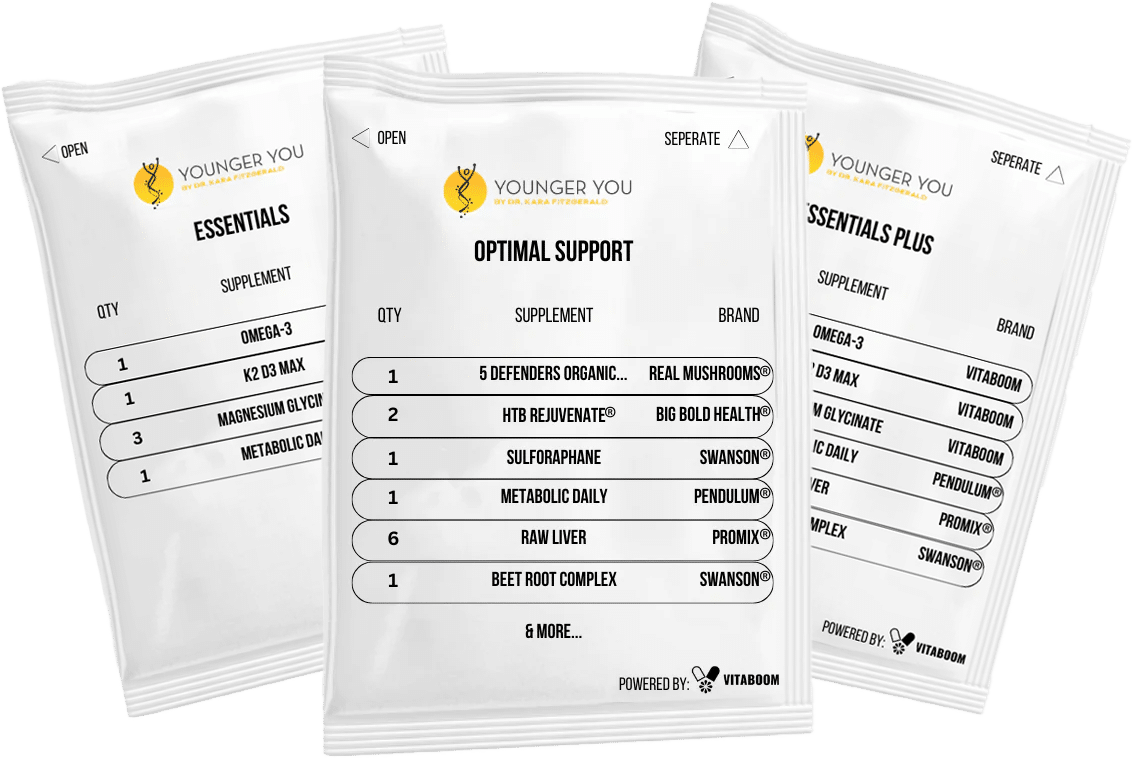
Younger You Daily Supplements are Now Here!
What could be more convenient than having your daily supplements all pre-portioned in one pouch? Choose your level to get the combination of supplements that’s right from you. Monthly subscription available.
(note you’ll be leaving www.drkarafitzgerald.com to go to www.vitaboom.com to complete your purchase)

Related posts