
Is Your Liposomal Supplement Really Liposomal?
Key Takeaways
- Longevity culture keeps adding new hacks, tools, and protocols, and implementing all of them is close to impossible alongside a full life
- Blue Zone centenarians didn’t need to think of these as separate longevity interventions: health-promoting exposures were built into their daily lives (the exposome)
- Their diets illustrate the point: polyphenol-rich and plant-forward, but also full of foods modern longevity culture frowns upon
- Blue Zones research has identified several exposures that form part of centenarians’ daily lives and likely contribute to their longevity
- These include physical activity, time in nature, tight social & family connections, a sense of purpose, religious practices, a relaxed pace of life, and traditional occupations such as farming, shepherding, and handcrafts
- While the West seems to be ever more focused on cutting-edge, individual (and often intense) practices and habit stacking, life in the Blue Zones seems to naturally integrate micro-practices that may cumulatively support healthy aging
As longevity keeps gaining more and more attention, the quest to find the exact “things” that will allow us to “hack” our biological age clock continues to intensify, whether that’s foods, lifestyle practices, supplements or other interventions.
And longevity science hasn’t been sitting around either. Researchers are currently evaluating a dizzying list of longevity tools: peptides, mitochondrial transplants, cellular reprogramming with Yamanaka factors, drugs like rapamycin, metformin, and GLP-1s, thermal shock protocols, and photobiomodulation.
If we were to try and follow all of the latest trends, we would have to wake up at the crack of dawn and get started with light exposure, grounding, meditation and breathwork, followed by physical activity, sauna and cold plunging, all while fitting in time-restricted eating, blue-light blocking, and dozens of supplements. Is it even possible to do all of this while keeping a full-time job and a meaningful social life without becoming exhausted or overwhelmed?
Perhaps the issue isn’t simply that we’re trying to do too much. The lived reality of modern, Western life differs from that of traditional populations that have historically experienced exceptional longevity, where many health-promoting behaviors were simply built into daily life.
Take, for example, the so-called Blue Zones: regions around the world identified as having unusually high numbers of people living to very old ages. These long-lived individuals likely weren’t thinking about exercise, stress management, social connection, or polyphenol intake as separate longevity interventions. Their environments and daily routines naturally provided many of these exposures, which together make up what researchers call the exposome. In our modern lives, we may need to be more deliberate about recreating some of these benefits, but that doesn’t have to mean adding another long list of practices.
So, what could we learn from them?
The Blue Zones Evolution
What exactly are Blue Zones and why might they offer useful insights into longevity? The concept of Blue Zones first appeared in the early 2000s when demographer Michel Poulain and medical statistician Giovanni Pes began identifying villages on the Italian island of Sardinia with an exceptionally high number of centenarians and marking them with blue circles. In their seminal 2004 paper, they defined blue zones as specific geographic areas where the population is characterized by exceptional longevity compared to the rest of the territory. The concept was further popularized by National Geographic journalist Dan Buettner, who teamed up with Poulain, Pes, and other researchers to identify and study other such areas around the world.
Despite recent criticisms (the “Newman controversy”) on demographic data validity, in 2025 Dr. Pes and colleagues responded to the critique and defended the data behind the four original Blue Zones (Sardinia, Ikaria, Okinawa, Nicoya). Dr. Pes also noted that zones are likely to change over time – some may disappear, and new ones may emerge – due to factors such as Westernization, migration, and urbanization. A case in point: mortality rates in Okinawa’s younger generations are similar to their national peers, and the Nicoya zone in Costa Rica is gradually shrinking, yet new Blue Zones may be emerging in different parts of Costa Rica, the Netherlands, and China. Therefore, we shouldn’t get hung up on the term “Blue Zones” but look at the evolving demographic data to identify current, long-lived populations to keep exploring what presently defines longevity, what helps maintain it, and what factors threaten it.
Is There Really a Longevity Diet?
What if healthy aging isn’t about one single intervention or the perfect diet?
When we look across dietary patterns associated with exceptional longevity, healthy aging, and biological age reversal, an interesting picture begins to emerge. The diets themselves may look quite different, but some common characteristics repeatedly show up: an abundance of whole, plant foods and polyphenol-rich foods, plenty of nutrient density, and relatively little exposure to highly processed foods.
In fact, one proposed contributor to exceptional longevity in the Blue Zones is the relatively high intake of polyphenol-rich foods. But none of this came from supplements or carefully tracked targets. It came from traditional, local foods eaten day after day. And what stands out is how different those foods are from one region to the next. There is no single superfood or compound tying them together.
The traditional Okinawan diet is rich in soy and complex carbohydrates, coming from root vegetables. It isn’t particularly protein-heavy, but it is packed with polyphenols from leafy greens, seaweed, turmeric, and herbal teas, as well as other whole foods. In particular, purple sweet potatoes, commonly consumed by Okinawa residents, contain very high levels of anthocyanins, which are associated with improved endothelial function and better lipid and glucose metabolism in humans. Older Okinawans also consume good amounts of soy, about 3oz daily in the form of tofu, miso, and natto, adding yet another family of polyphenols, isoflavones, to the mix.
Switching over to the Mediterranean side, high consumption of extra virgin olive oil (EVOO), wild greens, legumes, sour (fermented) dairy, and fresh fruit are prevalent in the Blue Zones of Ikaria (Greece) and Sardinia (Italy). Daily consumption of 1-2 tablespoons of olive oil has been associated with a lower risk of cardiovascular disease and stroke. The Sardinian and Ikarian diets also frequently include raw and cooked wild edible greens, such as chicory, dandelion, and purslane, which are another rich source of polyphenols. They are typically garnished with EVOO and a squeeze of lemon, further boosting the polyphenol content, and consumed with their nutrient-rich cooking juice (see our Greek Horta recipe here).
In Nicoya, beans, squash and corn (“the three sisters”) make up the core of the 6000-year-old Mesoamerican diet. Black beans in particular are a rich source of the same deep-purple polyphenols (anthocyanins) found in blueberries. The Nicoyan diet is also rich in fruits – often eaten 1-3 times per day – with mango and papaya being popular choices. Interestingly, the specific mango cultivars from Costa Rica have a higher polyphenol content, including xanthonoids such as mangiferin.
Purple sweet potatoes and seaweed, wild greens and olive oil, black beans and mango: different foods, different plant compounds, but the same underlying pattern of eating a wide variety of plants, every day, as part of ordinary meals.
We’ve seen similar connections in our own research. Our 2025 papers identified that the significant bio age reversal seen with the Younger You program was associated with the high polyphenol content of the study diet, with polyphenols appearing to be one of the biggest drivers of the effect. However, it’s important to emphasize that the research was looking at the whole Younger You intervention, and we are not concluding that polyphenols were the only consequential component. The dietary pattern, lifestyle practices and other elements of the intervention all matter. For a deeper look at the science, see our posts on polyphenols and biological age and on our 2026 EWAS analysis (summary here).
Why Blue Zone Diets Expand Our Idea of the “Perfect” Longevity Diet
It is interesting to note that in both Ikaria and Sardinia, gluten is actively present in the daily diet in the form of traditional breads, pasta, and sweets (albeit made using high-quality, local ingredients and traditional preparation methods). Similarly, various forms of dairy (mostly fermented) are consumed regularly in several Blue Zones. Other seemingly contradictory foods that are staples in the diets of long-lived individuals include soy, corn, and rice. And let’s not forget the weekly glass of polyphenol-rich Sardinian Cannonau red wine. This contrasts starkly with the high-protein, low-carb, gluten-free trends in the US and elsewhere.
Blue Zone dietary patterns are also rich in sweet fruits, starchy vegetables, legumes, and whole grains, and tend to lean more on plant foods and less on animal protein, as illustrated in the table below.
| Okinawa | Sardinia | Ikaria | Nicoya | |
|---|---|---|---|---|
| Daily energy intake per capita | <2000 kcal | 2600 kcal | <1500 kcal | 2392 kcal |
| Dietary pattern | Plant-based | Mediterranean diet | Mediterranean diet | Traditional Mesoamerican |
| Frequently consumed foods | Tofu, vegetables, purple potatoes | Pasta, sourdough bread, vegetables, beans and whole grains, red wine | Olive oil, legumes, vegetables, fruit, red wine, herbal tea, honey | Beans, squash, and corn; rosquillas; tortillas; fruits such as mango & papaya |
| Traditional meal examples | “Nbushi”: local vegetables such as daikon, Chinese okra, carrots, or squash, seasoned with miso and cooked in their own juices | Traditional “minestrone”: made with onions, fennel, carrots, legumes (beans, broad beans, peas), potatoes, and bacon | “Soufiko”: made with eggplant, yellow pepper, potatoes, green beans, tomatoes, onions, garlic, zucchini, chopped red pepper, extra virgin olive oil, red wine | “Gallo pinto”: a mixture of rice and black beans, often accompanied by corn tortillas |
Table adapted from: https://pmc.ncbi.nlm.nih.gov/articles/PMC10934765/
Full table: https://pmc.ncbi.nlm.nih.gov/articles/PMC10934765/table/nutrients-16-00729-t001/
Rather than asking how Blue Zone elders “get away with” bread, pasta, rice, corn and wine, it may be more useful to ask what our modern food rules are missing. These foods were eaten as part of traditional meals, made from local ingredients, often shared with family and neighbors, and eaten by people whose days were full of walking, working outdoors and resting. The food is hard to separate from the life around it.
Reflecting this, the authors of a recent study conclude: “Moreover, in the Blue Zones, longevity is most likely achieved through a combination of diet, lifestyle, and sociocultural factors, not by diet alone.” There must be something more to the story…
The Exposome: How Everyday Exposures Shape Longevity
Indeed, researchers suspect that cumulative environmental exposures, also called the exposome, play a significant role in influencing our aging trajectory. Diet is just one of many environmental factors that can shape our healthspan and longevity by modulating gene expression and disease susceptibility.
Some of these exposures, such as air pollution or chronic stress, can work against us, while others can be protective. And despite the heterogeneity between the Blue Zones, the scientists were able to find several common factors likely contributing to longevity in these regions, most of which are simply part of everyday life.
The Blue Zones themselves show what can happen when that everyday life changes. As diets and lifestyles have become more Westernized, mortality rates in Okinawa’s younger generations have become similar to those of their national peers, and the Nicoya zone in Costa Rica is gradually shrinking. The genes likely haven’t changed in a generation or two, but daily life certainly has. We’ll explore some of these everyday exposures below:
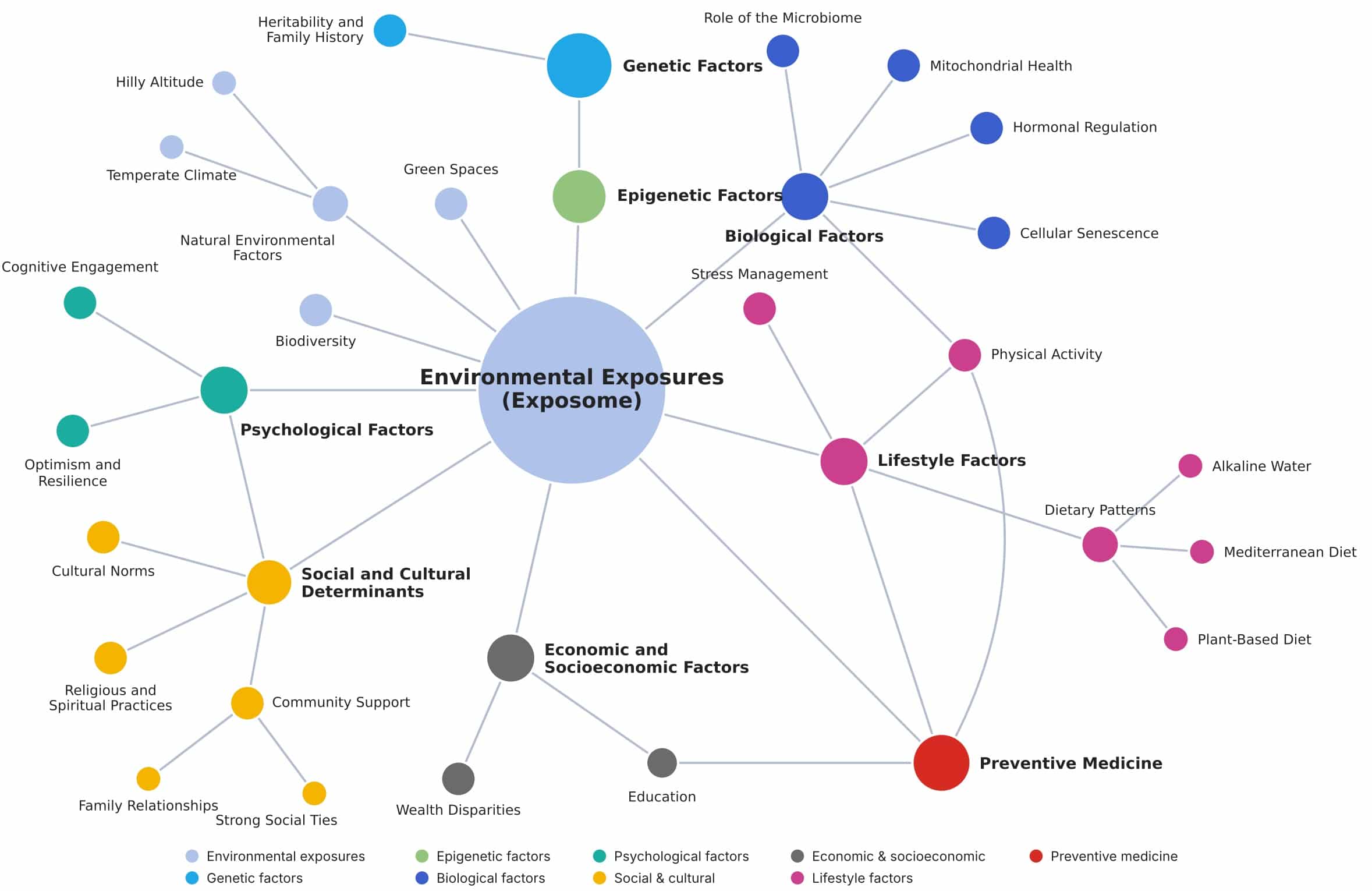
The interplay between environment, culture, and biology in shaping the aging process
Image adapted from: https://www.mdpi.com/2072-6643/17/4/722
5 Everyday Exposures That May Support Healthy Aging
Movement as Part of Daily Life
In the Blue Zones, movement is essentially incorporated into daily life. Almost everyone in Okinawa engages in some form of gardening, and the low-set furniture works the core and lower body every time they sit down and get back up. Many elderly Sardinians continue work in the agriculture and animal husbandry fields – a physically demanding profession. In fact, it is estimated that Sardinian shepherds typically walk 8-12 km [~5-7 miles] a day, simply as part of their “job”. And in Ikaria, the mountainous, hilly terrain can turn even a short walk into a mini workout. Just like in Sardinia, long-lived individuals in both Ikaria and Nicoya are involved in farming well into old age. Nicoyans also tend to “do everything by hand – there are no machines for housework or gardening.”
Strong Communities and Family Connections
Another daily “exposure” that is at the core of the Blue Zones lifestyle is the time spent nurturing close bonds with family members, friends and the wider community. In Sardinia, the elderly remain in their family homes, taken care of by younger generations – retirement and care homes are not even considered. Okinawans cherish their “moai” – groups of friends who get together often and help each other in times of need. In Nicoya, a strong sense of community is deeply woven into the social fabric, with religious and cultural traditions regularly bringing people together. And for Ikarians, contact with neighbors, family, and friends is simply the order of the day, despite their homes being isolated.
Meaning and Life Purpose
Having a sense of purpose and an optimistic outlook may add years to our life expectancy – as suggested by the OLSAR and MIDUS studies. In Okinawa, this is known as “ikigai” or reason for living, something that gets you up in the morning. Many retired Okinawans continue to keep their minds busy and bodies moving with odd jobs and volunteering. The Nicoyans’ “plan de vida” helps them overcome difficulties, have a sense of direction, and maintain a positive outlook. Optimism is also part of the Sardinian elderly’s approach to life, and they also report greater life satisfaction.
Regular Contact with Nature
Regular exposure to nature, such as spending time outdoors in parks and forests, living in coastal and mountain areas or simply viewing greenery, has been associated with lower cortisol levels, improved microbiome diversity, enhanced immunity, better mood, and enhanced cognitive function. Living in the Blue Zones, which tend to be mostly rural areas, means living immersed in nature. For example, most of the Greek island of Ikaria is part of a nature conservation network due to its biophysical diversity. Sardinians and Nicoyans naturally spend time in nature as part of their farming and pastoral activities. And for Okinawans, gardening is a hallmark of their lifestyle.
A Relaxed Pace of Life
It’s no surprise that getting adequate rest is essential to our health. Long before the concept of the power nap was born, inhabitants of the traditional Blue Zones like Ikaria and Nicoya took their afternoon rest seriously. And today they still do so. Ikarians truly enjoy a relaxed pace of life (napping included), and Nicoyans, active in the morning, take the time to rest in the afternoons – practices which associated with a reduced-stress environment and mental well-being.
The above are only some of the environmental factors making up the exposome that shapes biological aging and longevity. Others include climate and water quality, religious and spiritual practices, and microbiome diversity. What is emerging as a key takeaway, however, isn’t just the wide range of factors but how they fit naturally into daily lives, often without being thought of as health practices at all, shaped by long-standing traditions and cultural norms.
How to Apply Blue Zone Principles to Everyday Life
Whilst we may not be able to move to an island immersed in nature or swap our office jobs with farming, we can recreate the exposome factors in our daily lives on a smaller scale. Think daily micro-practices integrated into your usual routine, rather than new items on the to-do list. For example:
- Walk or cycle for short errands, take phone calls on foot, or choose the stairs
- Grow something, even if it’s a few herbs on a windowsill or balcony
- Set up a standing weekly meal or walk with friends, family or neighbors
- Eat lunch outside, or take a short break in a park or green space
- Allow yourself a short afternoon pause instead of pushing through the slump
- Cook simple, traditional meals at home, and share them when you can
For those who like a bit more structure, our Younger You program is built on the same idea. Backed by research, the program includes 30 minutes of some form of physical activity at least 5 days a week (hiking and gardening count as well), 20 minutes of relaxation technique daily, and making the time to connect with family, friends and the wider community.
| Younger You pillar | Exercise | Relaxation | Sleep | Connection |
|---|---|---|---|---|
| Examples and tips | Sports | Meditation | Dark, cool room | Share a meal |
| Dancing | Body relaxation | Reduce noise | Volunteer | |
| Walking, jogging and hiking | Breathing exercises | Relaxing pre-bedtime activities | Time with family and friends | |
| Gardening | Yoga & tai chi | Consistent bedtime routine | Cuddle with a pet |
Simple ways to incorporate Blue Zone-inspired longevity practices into everyday life.
And as for the food, we can easily add in more polyphenols (or epinutrients as we like to call them in Younger You) from vegetables, fruits, herbs, spices, nuts, and seeds. Younger You comes in two forms, and it helps to be clear about the difference.
The Younger You Intensive is the short, targeted protocol used in our research. It is not intended to perfectly replicate a traditional Blue Zone diet, or to be a lifelong way of eating. It is more structured, and it does include more animal foods than are typically found in some of these longevity-associated patterns. Its job is to deliver a concentrated intake of epinutrients over a limited period, providing approximately 2,908 mg of polyphenols per day, alongside a broader, nutrient-dense dietary pattern.
Younger You Everyday is the more relaxed, long-term approach. It keeps the emphasis on polyphenol-rich foods but makes room for healthy grains and legumes, and it incorporates many of the Blue Zone lifestyle pillars described above: daily movement, rest, relaxation and connection. In this way, it blends some of the wisdom we take from the Blue Zones, particularly their emphasis on polyphenol-rich foods, with what we know from modern nutrition research and the realities of modern life.
Want to recreate your own little taste of the Blue Zones? Check out our longevity-inspired recipes:
- Bitter Melon (Okinawa): https://www.drkarafitzgerald.com/recipe/bitter-melon-eggs-recipe/
- Wild Greens (Ikaria): https://www.drkarafitzgerald.com/recipe/greek-horta-recipe-greens-with-extra-virgin-olive-oil-and-lemon/
- Minestrone (Sardinia): https://www.drkarafitzgerald.com/recipe/epinutrient-minestrone/
- Mango Megaboost shot (Nicoya): https://www.drkarafitzgerald.com/recipe/vegan-megaboost-shot/
Final Thoughts
The Blue Zones are not giving us a completely new longevity playbook. Rather, they reinforce many of the principles we already see emerging from longevity research, functional medicine, and our own Younger You research. They also remind us that these principles exist within a much broader exposome, shaped not only by what we eat and how we exercise, but by our environment, relationships, culture, and daily lives.
The goal isn’t to perfectly replicate life in a Blue Zone or add another long list of longevity practices to our already busy lives. Instead, we can take the key learnings and adapt them to our own circumstances, creating daily routines and environments that make healthy choices feel more natural and sustainable.
Perhaps one of the most important lessons the Blue Zones can remind us of is this: longevity doesn’t have to be another thing we add to our to-do list. It can be built into the way we live.
Get the Younger You Program Overview by joining our newsletter:


Related posts