

The GLP-1 Problem No One Is Talking About: A New Metabolic Approach

Access the Mastering Functional Hormones Testing Course for free when you become a DUTCH Provider. Get expert clinical education, comprehensive patient reports, and validated and peer-reviewed research on the DUTCH Provider Portal.

Biotics Research Corporation utilizes “The Best of Science and Nature” to create superior nutritional supplements, available exclusively to healthcare professionals.
It was a pleasure to sit down with Dr. Nir Barzilai for a conversation that turned out to be both lively and thought-provoking. His decades of research on centenarians, biological age, and the hallmarks of aging have shaped how we think about longevity and what’s possible when we start targeting aging itself, not just individual diseases.
We get into the science behind why some people live 20–30 years longer and healthier, and what it means to measure the biological age of individual organs. But we also hit a few sparks, especially when it comes to nutraceuticals and the role of metformin in prevention. I don’t agree with everything you’ll hear, and I followed up with Dr. Barzilai afterward to unpack some of the more provocative claims. We may just need a second round for this one… stay tuned. ~ DrKF
PS. Join me and an all-star lineup of experts in our upcoming Functional Medicine IS Longevity Medicine Masterclass™, a free online event that acknowledges, unites, and elevates the role of functional medicine in longevity medicine. Don’t miss what will be an inspiring, high-energy event – book your spot here.
Why Centenarians Are Defying Science: Secrets to Living 100+
What if we could not only slow aging but measure where it starts in the body, target it directly, and dramatically extend healthspan? In this compelling episode of New Frontiers, Dr. Kara Fitzgerald sits down with renowned aging researcher Dr. Nir Barzilai to explore how centenarians are reshaping our understanding of longevity.
Dr. Barzilai shares key insights from his groundbreaking studies on biological age, organ-specific aging, and why many long-lived individuals defy conventional risk profiles. He names four FDA-approved drugs that target all the hallmarks of aging, and explains why metformin remains a powerful, if sometimes controversial, tool in longevity science. They also dive into the debate around nutraceuticals and the exciting future of biomarkers that may pinpoint which organ is aging fastest.
From prevention to precision, this episode offers clinicians cutting-edge insights that could transform how we understand – and intervene in – the aging process.
In this episode of New Frontiers, learn about:
- The Biology of Aging vs. Chronological Time: Why biological age offers a more accurate picture of health and how it opens new doors for targeted prevention and intervention.
- What Centenarians Teach Us About Healthspan: Discover why Barzilai’s research found centenarians don’t just live longer, they live decades healthier, with a dramatic compression of morbidity.
- The IGF-1 Paradox After Age 50: Explore why low Insulin-like growth factor 1 (IGF-1) may be protective in older adults, and how this flips the script on popular growth-promoting therapies.
- Organ-Specific Aging as The Next Frontier: Learn how researchers are now measuring the biological age of individual organs and why this may soon guide more personalized, preventive care.
- The Case Against Chronic Growth Hormone Use: Hear Barzilai’s evidence-based warning against growth hormone therapy for longevity, plus what we should be doing instead.
- Rethinking Metformin: Understand the real story of metformin, including why it was originally used for aging and infections, and what it can teach us about multi-target therapeutics.
- The FAST Trial and the Future of Aging Biomarkers: How Barzilai’s team is building the tools to detect whether aging interventions are working long before chronic disease sets in.
Follow-Up: Who Might Consider Metformin for Longevity?
After the interview, Dr. Fitzgerald followed up with Dr. Barzilai to clarify one of his more provocative points: that individuals begin taking metformin around age 50–60, even without diabetes.
Here’s what he shared:
DrKF asked: Since not every 50- or 60-year-old’s health status is the same, how do we stratify who is a good candidate for metformin?
Dr. Barzilai replied: You are right! I am not sure we can give an answer before more studies for aging (and not diabetes). To be prudent, you may consider something for over the age of 50 to suggest benefits: overweight, HbA1c near 5.7, sensitivity to flus, bad COVID in the past, decrease in renal function, had MI in the past, past cancer(?) etc…
So basically, until we have more research on metformin as an intervention for aging more broadly, Dr. Barzilai recommends using it in individuals who are moving along the diabetic continuum or who have another reason for strict management of blood sugar.
We may revisit this topic in a follow-up conversation or mini-blog to dive deeper into these nuances. Stay tuned!
Dr. Kara Fitzgerald: Welcome to New Frontiers in Functional Medicine, where we are interviewing the best minds in functional medicine. And of course, today is no exception. I am here with Dr. Nir Barzilai. He is a true pioneer in the field of aging research. He’s published over 330 peer-reviewed papers and is known for his groundbreaking work in extending healthspan and lifespan, both in humans and animals. He’s leading the TAME study, that’s Targeting aging with Metormin, which aims to prove that a single drug can fight multiple age-related diseases.
Dr. Kara Fitzgerald: Dr. Barzilai, it is such an honor to have you today on New Frontiers in Functional Medicine. I’ve been paying attention to your work for so many years and gosh, I’m just really excited to dive in and kind of pick your brain in all of the areas— Well, as many of the areas as we can get to that you’ve been investigating. So welcome.
Dr. Nir Barzilai: Terrific, nice being with you, looking forward to going to all the areas you want.
Dr. Kara Fitzgerald: Yes, I mean you got famous with studying the supercentenarians and I want to talk about that but I know you’ve done a deep drill down into biomarkers and then we’re going to translate and think a little bit about how clinicians can interpret and use your science today. And of course we’ll talk about the TAME trial and so on and so forth. So much, much, to talk about. But first, I want to ask you about your journey into this field. I mean, you’re really kind of one of the first biogerontologists. You really played a pivotal role in creating what is now extremely popular and getting a lot of attention: investigating aging.
Dr. Nir Barzilai: Look, the journey really started much before that because when I was thirteen, my friends were looking at their grandparents and saying, what happened to them? Where are they coming from? And for me, it was clear, not where they’re coming from, but where I am going to. And I think that was different. So it was always for me, the biggest question in biology. When I went to medical school and I learned that you can measure glucose or cholesterol or blood pressure, you could put 100 people in front of me and I would know who has cholesterol or glucose, but I would know who’s young and who’s old, right?
Dr. Nir Barzilai: When I went to my residency I had an attending [physician] who, whenever I presented a patient— And by the way, I’m doing this in clinic too— This is a 76 year old woman. He would stop me and say, “Does she look younger or older than her age?” And I thought, why does it make a difference? But it does because you can be 74 and all your systems are completely fucked up and there’s nothing that you want to do. And you can be 95 years old and a little bit of antibiotics will get you out of the hospital without hospitalization, right? The biological age and the chronological age are not the same and understanding that gave me this view that if that’s so, there is something that we can do about it. If we can harness, if we can understand this biology, that means this biology can be targeted. And fast forward, yes, that’s what we can do now.
Dr. Kara Fitzgerald: That’s amazing. So you had that original insight that your destiny was to be like your granddad. And I’ve listened to other interviews with you where I think he was obese, and if I’m not mistaken, maybe he was a diabetic. So you, at 13, had that insight. And then in residency, you had this extraordinary attending physician who asked you that question, do they look old or not? And that was the epiphany that— I mean these things shaped where you are. Okay, so keep going keep going with, so what next. Then what did you do
Dr. Nir Barzilai: I wanted to study aging and then, okay, how do I get there? Well, first of all, internal medicine, of course, and then which subspecialty? Because I wanted to go into science. And I decided on endocrinology because I thought that I know a lot about those hormones that are declining with age and maybe it’s going to be just so simple as giving back those hormones and we’ll solve aging. Which happened to be much more complex and generally not true. But then, I went not only to endocrinology, I really went to metabolism and I think that gave me the knowledge and the tools to start both science in animal models, in cells, and to think of how can we go from cells to cities, right, and to the world.
Dr. Kara Fitzgerald: Yeah. When did your investigation into supercentenarians and centenarians come into play?
Dr. Nir Barzilai: Right around the time that I started with animals, actually. There is a famous experiment by Cynthia Kenyon, who was looking at nematodes, and she changed one gene in this nematode that caused them to live up to five times longer. One gene and longevity. And that was just so exciting, the idea that there’s a genetic way and it might not be that complicated to live much longer. And while a lot of my colleagues, when it came to humans, were looking at diseases like progeria, an early aging, and understanding them, I thought that’s not enough. I knew that you can do something really dramatic in animals and screw them up so much that you’ll get a phenotype. But for me it was, okay, I want to look at the other side. What causes longevity? And I thought maybe if I look at a 100-year-old, they could give me a hint if indeed they live healthy, not only longer.
Dr. Kara Fitzgerald: Yeah, what was the gene she was looking at? What did she identify that allowed nematodes to live so much longer?
Dr. Nir Barzilai: It’s called daf-2 and it’s something that is not a complete knockout, but it decreases the insulin IGF-1 signaling pathway, the insulin and growth hormone signaling pathway, which is just one in nematodes. So it gets more complicated, but that’s the pathway that it targeted. So the paradox for me, coming from metabolism, was that this nematode was actually insulin resistant, right? And we’re all talking about insulin resistance and how it’s a marker and maybe a cause for lots of the aging… Which it’s not by the way, but anyhow. And not only that, the nematodes accumulated visceral fat. They had fat around their intestine and they became obese. And this paradox was even more surprising in the sense that it’s against everything we knew. We knew that longevity is associated with thinness, with insulin sensitivity, and those were the opposite, but still they lived five times longer.
Dr. Kara Fitzgerald: That’s amazing. Because they had this gene basically inhibited?
Dr. Nir Barzilai: Right.
Dr. Kara Fitzgerald: And then from that, and I’m sure it was a while and many steps and many things happened, but you began to look and you wanted to investigate the genetics of humans.
Dr. Nir Barzilai: Well, what really happened in my mind intellectually is to say, okay, there’s the insulin signaling pathway and the growth, the IGF-1 pathway, and maybe we have to look at it differently. And what helped me think about it is the fact that in nature, the small, you know, the dwarf, live longer. The little dogs live longer and the the ponies live longer and so on, even in the lab, when you knock out growth hormone, or IGF. When you don’t have enough growth hormone action, they live longer and when you have more they live shorter. And so it was easier now to focus on the growth hormone IGF pathway rather than the insulin signaling pathway.
Dr. Kara Fitzgerald: Talk to me about the supercentenarian work then and connect the dots with this original epiphany.
Dr. Nir Barzilai: So look, really the most important thing is, as I noted before and which we couldn’t know in the beginning is, do they live longer or do they live longer and healthier? And the answer is— and we did several studies, and harmonized several studies, and we published that— that centenarians don’t only live longer, they live 20-30 years healthier.
Dr. Kara Fitzgerald: Yes.
Dr. Nir Barzilai: By the way, when my centenarians were born, life expectancy was 50 years old, so they anyhow, doubled their lifespan. But if you compare it to the people who were living right there at that time they lived healthier. And ours and the NHANES 1 study were done at the same time. In fact, after the age of 100, 30% of our centenarians don’t have any disease. And by the way, I’m not saying that’s true for every centenarian around the world, but that’s my group. In other words, there is a group that can live healthier and can live longer. But that wasn’t really the interesting thing. The interesting thing is that they had what we call a compression of morbidity. They were sick very little at the end of their lives, right? Those 30% that didn’t have any disease would not wake up one morning. And this became the vision that we can live healthier, longer, and actually decrease our morbidity. The CDC, may it rest in peace or may it resurrect, I guess, the CDC followed the medical costs in the last two years of life of somebody who dies at age 100 and it was one third the cost of those who die when they were 70 years old. So it’s not only my study, it’s a national study.
Dr. Nir Barzilai: And we could start calculating what we call longevity dividend. And there is this guy, Jay Olshansky and he said, guys, you don’t understand what you’re saying. You’re saying, okay, those people are not in the hospital, but where are they? Because there is an economical value to the fact that they are traveling, they are shopping, they are building houses for their kids. So when you calculate that, the benefits for the economy are such that they are the solution. What you’re seeing is the solution to our economy, not the burden to our economy, which many people think.
Dr. Kara Fitzgerald: Wow, that’s pretty extraordinary. And when you investigated them, when you looked into their genetics, what are the key players that jumped out?
Dr. Nir Barzilai: So I’m not going to let you off that quickly. I’ll tell you two other things before I answer that. Because I have to convince you, okay? We have three hypotheses. One is that they just did then what we know is right to do now. They ate the right thing, they exercised, you know, all the things we have to know. And I’ll tell you immediately, the answer was no. 60% of the male centenarians and 30% of the women centenarians were smoking, almost half of them were and are overweight or obese, exercising, even moderately, less than 50%, vegetarian, like 2%. So the answer is not that individuals couldn’t have done it, but that wasn’t the group. And again, it was like the NHANES 1 data, pretty much. They were a little bit worse, maybe, than NHANES 1. So it wasn’t that.
Dr. Kara Fitzgerald: That’s fascinating. And I’ve heard you talking about meeting one of your first centenarians and I think she was smoking or something and she said—
Dr. Nir Barzilai: Yeah, yeah. And she was smoking for 95 years!
Dr. Kara Fitzgerald: That’s amazing.
Dr. Nir Barzilai: In fact, I met her when she was 100 years old and in her apartment and she was smoking. I said, nobody told you to stop smoking? She said all four doctors that told me to stop smoking, they died, right? But then I started sending her reporters. When they interviewed me on my studies, I said, just go and talk with people and you’ll see what I mean. And she discovered that… So by the way, after I visited, she said, okay, I’ll stop smoking. But then when reporters came, she understood that she’s a celebrity for being a hundred year old and smoking. And by the way, she lived to be 110 and she resumed smoking. So I always said, I don’t know when you’ll die, but without the cigarettes, I bet it would have been much longer. I’m not sure.
Dr. Nir Barzilai: I think the point of this is, in fact, that for those people it didn’t matter. And you could see from time to time in the papers about centenarians and what they think is the secret for longevity and it makes no sense. I never moved, I just stayed like that, or I ate cakes all my life, or I’m drunk… For them, it didn’t matter, which is not the same as for us. It matters.
Dr. Kara Fitzgerald: Yes.
Dr. Nir Barzilai: So the second thing that we looked at is maybe— We use genetics in clinics now and we know that there are lots of SNPs that are risk for diseases, for cardiovascular disease and for cancers and for everything. And I’ll give you just an example that happened after the first 44 centenarians that we had. And it took us great effort and it cost a fortune to do a whole genome sequencing for those 44 centenarians. And this was without a control, only the centenarians. And the only thing we could ask is do they have any of those SNPs? Maybe they have the perfect genome. Maybe they’re just one of 10,000 that just don’t have any of this stuff and that’s why they’re healthy. We didn’t expect that 44 centenarians will have over 260 SNPs and that each one of them was supposed to make them sick and they’re 100 years old and they’re not sick. And that includes ApoE4 for example. With ApoE4 you’re supposed to be demented at 60 or 70, and be dead at 80. So they’re 100 years old and not demented.
Dr. Kara Fitzgerald: Yeah. Fascinating. They’re smoking, they’re clear as a bell, and they’re APoe4 positive.
Dr. Nir Barzilai: Right. So those two things just to show you that they must have something that slows their aging. And the first thing that we picked… So okay, so here is another challenge. If you take a blood sample from centenarians and something is high, what does it mean? On one hand this centenarian statistically had a 30% chance of dying the next year, so maybe it predicts its mortality. Or maybe it’s what got them there. How would you know? And the answer is, when I initiated the study, I wanted their offspring that inherited, let’s say, half of their longevity. And those who are married to their offspring who share the environment in case they don’t have longevity themselves. We would study them, but not in the same group. And one of the things was that for the phenotype, if the offspring that are 20, 30 years younger have this phenotype, it suggests that it’s important, okay?
Dr. Nir Barzilai: If they don’t, then I don’t know what it means to be a centenarian and have something basically at the end of your life. And the one thing that came up almost immediately, you know, we had 150 people in our studies, approximately. The HDL cholesterol of a centenarian was average, you know, between 45 and 55 if you’re male or female but their offspring had twice the HDL. I mean, we had offspring with 140 HDL. Now HDL goes down with age by five points every eight years but cross-sectionally, it’s the same. How can something cross-sectional be the same, but change with age? Maybe because if HDL goes down, you die, and the average who are alive are keeping the HDL normal, right? That there’s a longevity effect of HDL. And that supported that because the centenarians now had normal HDL, but their children had high HDL levels. And that led us to the first two functional genotypes that we discovered that are also now being made into drugs, not for longevity, but might be for longevity.
Dr. Kara Fitzgerald: Interesting. And also HDL particle size, correct?
Dr. Nir Barzilai: Correct.
Dr. Kara Fitzgerald: So quantity and the type of HDL. They just have a ton of it.
Dr. Nir Barzilai: Right. And they had big particles.
Dr. Kara Fitzgerald: Wow. And that continues to bear out? That original hypothesis that… When did you document that? When did you publish on that particular gene?
Dr. Nir Barzilai: I think in the early 2000s.
Dr. Kara Fitzgerald: Wow. And you would still stand by that data as a key player.
Dr. Nir Barzilai: Yeah, it was validated. Not only that, the genotype that we discovered was validated by some, but not all, but was validated genetically. And as I said, two drug companies looked at my data and decided to do something about it. One is a CETP inhibitor by Merck and one is a ApoC3 inhibitor by Ionis. They were Isis then but now they’re Ionis.
Dr. Kara Fitzgerald: Fascinating. Okay, and the CETP allows for the higher quantity and larger particle size of HDL. And the ApoC3 keeps triglycerides low? What’s the mechanism of that?
Dr. Nir Barzilai: HDL and triglycerides. Both of them have phenotype of HDL and triglycerides.
Dr. Kara Fitzgerald: Interesting, that’s fascinating. So can we translate that immediately into action for the mere mortals? I mean, how would you translate that?
Dr. Nir Barzilai: So the drugs that were developed were developed for cardiovascular protection. One of the things that we noticed, the people that had this genotype for CETP had much better cognitive function. And we told Merck, as they discovered that, we said, why don’t you try to design a study and look at cognition? And they looked at cognition, but the study was for people who were 50 years old and so they don’t do much with cognition in a year study or so. So, so they missed it. But now there’s actually articles suggesting that taking the drug is protective from cognitive function. We have to see how it rolls, but for us, it was really an aging drug. Those with the genotype also had less cancers than others. So at least in our hand, it looked like it protects from age related diseases rather than from just one important disease.
Dr. Kara Fitzgerald: Interesting. Just keeping your HDL quantity up has a broad spectrum effect.
Dr. Nir Barzilai: Right. And by the way, as you noted, I want to double down on that. The HDL was a phenotype, whether this is the important thing, or whether it’s the large HDL particle, or maybe it’s the large LDL particle. I mean, there are so many things associated that you couldn’t say what’s most important. And also we know that this is an inhibitor, but if you inhibit this pathway, this pathway is a way to get rid of lipids. So it has to be some modulation and not a total thing. But you ask practically, those drugs are going to be marketed soon. Phase three was years ago, but they had to find the right combination and the right time to bring… The pharmaceuticals are doing that. But it looks like it’s coming around and it will gain more indication and keep an eye on it.
Dr. Kara Fitzgerald: Yeah, absolutely. Very interesting. How are the second generation of your original centenarian cohort? How are these folks?
Dr. Nir Barzilai: So they have half the cardiovascular diseases, they have roughly half the cognitive decline, half the mortality. I was just in a meeting where they presented data from Europe on centenarians. It was a centenarian meeting. And they basically showed that if you have two parents who are over 100 years old, it will contribute 24% to your longevity. So compared to the two others, let’s say if in your environment people live to be 80, then you’re likely to be, you know, 80, so it’s 16 and 24%. So it’s about 100, you’re going to be about 100 years old. With only one of your parents, it’s 13%, okay? So it’s still into the 90s. But interesting, even the third generation has effect of longevity of like 8%. So the inheritance of long life is really very impressive, no matter when the other parent died.
Dr. Kara Fitzgerald: That’s pretty interesting. That’s interesting. There’s a lot of effort, of course, because many of us don’t have supercentenarians or centenarians in our family. So there’s a lot of energy around your genes not being your destiny. And, you know, there’s much intervention that we can do, which, of course, is true. But it is interesting to see. But the caveat is that these are healthy centenarians, correct? I mean, I have friends who’ve got long-lived parents, but one in particular, a good friend of mine, his mom spent the last three years in bed, and I think she passed at 103.
Dr. Nir Barzilai: Right, so she wouldn’t be in my study. Right. And yeah, let’s make it clear, I didn’t present all the centenarians in the world, right? I presented a selected people who actually had to consider themselves healthy and independent living at age 95. After that, it didn’t matter, okay? But that they had clearly long health span. So I’m not saying all the centenarians are like that, but we were going to pick the best of the best in order to also find the best finding. So people are saying, I know other centenarians, and I totally agree. I would just argue one thing: Even if this 103-year-old has spent the last three years of her life in bed or with lots of needs, still, the percent of healthspan versus lifespan is quite incredible, right? And it worries me, I think we don’t have a good exit strategy. And I think that’s a problem and I think we have to fix it.
Dr. Nir Barzilai: I think of Daniel Kahneman. I don’t know if you know this Nobel laureate for economy, who at the age of 90 basically went to Switzerland to have an assisted suicide and he wasn’t like that. He wasn’t demented. But he said, look, I’m 90 years old and I have renal failure, so in the next year I’m going to need dialysis and I know what it means and I know there is sepsis and stuff. So I see the future, I’m very content with my life, I’m going to separate with everyone, and I’m out of here. And I really want to work on extending health span and with the knowledge that the morbidity will decrease, but not always. And so we need to think of an exit strategy.
Dr. Kara Fitzgerald: That’s very interesting. That’s very, very compelling. Yes, I think it’s extraordinary that you’re bringing that conversation front and center because a lot of us, I think, just secretly hope for a compression of morbidity. You hope for it. But to your point, I mean, how do you control for that? We just don’t know. And yeah, really fascinating and I think that’s fair to consider. So other genes, you looked at IGF-1 receptor in this population as well.
Dr. Nir Barzilai: So, I’ll make it even more dramatic. 60% of centenarians have something genomic that inhibits the growth hormone IGF signaling pathway. It’s the most common abnormality in our centenarians. And even women with the lower half IGF-1 level, so they’re already 100 years old, they live twice as long as those with the upper IGF-1 level. And those women have better cognitive function and they don’t pay on muscle, they have the same physical activity, so it’s not that there is any exchange. And in order to understand what happens really, we actually went to the UK Biobank. The UK Biobank have, I don’t know how many, but I know millions of people with basically their electronic medical records, with a lot of things that they’re doing extra. And like 250,000 of them have IGF-1 level, which is a good indicator of the growth hormone status.
Dr. Nir Barzilai: And we basically showed that when you are young, high IGF-1 level is protective for everything and for mortality. By the way, not for cancer, but all the other diseases. You have high IGF-1 level, you’re doing better and you die less. And somewhere at the age of 50, it flips. So the same IGF-1 level when you’re over 50 is associated with all diseases and mortality, except cancer, because high IGF-1 is bad when you’re young and when you’re old. But this was kind of the striking finding. And it kind of intuitively explains that when we go through this threshold somewhere between 50 to 60, it’s individual, and we start to break down, then it really makes no sense to invest in growth. We need the energy to be invested in stopping the breakdown. And maybe this energetic shift really explains why it’s so important to have lower growth hormone access when you’re older.
Dr. Kara Fitzgerald: Explain that. I mean, how do we think about that in terms of… I mean, I know that you know Valter Longo who’s been on my podcast a couple times. He, of course, talks about lower growth hormone being protective in his focus is in cancer. There’s a lot of energy towards maintaining growth hormone levels as an anti-aging strategy clinically, using growth hormone therapeutically, using peptides that will increase growth hormone, really consuming high quantities of protein to maintain muscle mass, which will indirectly, likely influence growth hormone if you’re laying down muscle. So there’s that. And then also, I mean, of course you’re familiar with Greg Fahy’s study and Steve Horvath and using growth hormone injections in an older population and regenerating the thymus gland to a certain extent and reversing the epigenetic clocks that they measured. So how do you reconcile what appears at a glance to be kind of conflicting?
Dr. Nir Barzilai: So yeah, and it worries me. So let me explain a few things. First of all, I have to say that the effects that we were showing were larger in females than males, in part because for every hundred centenarians, there’s 80 women and 20 men. So we don’t have enough power, but it looks like it’s more female specific. In fact, we took it to the lab and did a reverse translation. We found these findings in centenarians, we noticed that there was a development of IGF receptor inhibition inhibitors by, we went to Amgen, but other companies that were trying to use it for cancer, because cancer expresses IGF receptors, so they tried to look at it. And by the way, it didn’t work.
Dr. Nir Barzilai: But we had this IGF receptor antibody, we murinized them and we injected it into old animals. And the female animals lived 10% longer, but much more impressive was their health span. They were running better and cognitively better and everything was better there. It didn’t work like that in males. So I’m saying there could be a sex specific effect, but that’s not to say that more growth hormone is necessarily better. The experiment with the thymus was interesting. I could simply say metformin took away the actions. Metformin was the needed one. But, there are a few issues. Let me just say the first one. We know that the epigenetic wasn’t the right thing to do because the epigenetic test was done on white blood cells and there was a very different change in the composition of new cells that were created. So this clock didn’t really reflect true aging. It reflect the biology of new cells because of the thymus.
Dr. Kara Fitzgerald: Oh, that’s interesting.
Dr. Nir Barzilai: And by the way, I think it’s a great target to do thymus and to see what happens. The second thing is that the fact that usually it’s good to have a low IGF-1 doesn’t mean that there’s no indication, from time to time, to use growth hormone. You know, growth hormone was used after stroke with some success for a short period of time. So I think there’s a chronic basis of what you want your IGF-1 level to do and there are cases where you can try a growth hormone and there’s also the sex differences that I’m not sure– By the way, there are conflicting results on that. I mean, I had a really cool study on males, only males. We noticed that 12% of our centenarians have a deletion of exon 3 of the growth hormone receptor. And by the way, we replicated it in several studies, several other populations, all the same results. This is not a very rare deletion, but it’s like in 3% of the population so it was highly relevant in our centenarians. All the longest living in four studies had much more of that, so it looked like it’s important.
Dr. Nir Barzilai: And when we measured the IGF-1 level in those people it was really low, significantly lower. So it made sense. It took us 10 years to publish this paper because our centenarians, though they had lower IGF-1 level, they were two inches or more taller than anyone else and it made no sense to us. Like, what am I going to say? You know, what blah blah can I say? Until we actually took the cells to the lab and we showed that the cells from the centenarians, we have immortalized lymphoblasts. The cells, when you incubate them, their activation of the growth hormone receptor is decreased. Okay, so it’s a problem. But when you incubate it with growth hormone, it was amazing, it was flipped. In other words, the activation was doubled. And so was the proliferation.
Dr. Kara Fitzgerald: Interesting. That’s fascinating.
Dr. Nir Barzilai: So I don’t want to confuse you so much, but this is what happened. When they went through puberty and growth hormone was high, the receptor was hyperactivated. And when growth hormone was low, the receptor was hypoactivated. So they grow taller but then throughout their life, they had lower IGF-1. Again, it’s men. In this example, it’s men. So I’m really not comfortable to really talk about the sex difference totally. It might be more confusing or needs more study. Hey, that’s why we call it research. If we found it the first time, it will be only search, right? So I’m not sure about it, but I would just state that basically chronic growth hormone therapy is probably dangerous for everyone.
Dr. Nir Barzilai: So I have to tell you this anecdote. It happened not long ago. I was talking to laypeople in Florida and I was talking about this example and there were questions. There’s this guy, old guy, and he gets up and he says, well, I’m 95 years old and for the last 15 years I’m injecting growth hormone. The last question you want to deal with. Of course to him I said, but I already told you that for centenarians it doesn’t matter what they’re doing. Okay, if they have genes to be centenarian, they’ll get there. That was how I came out of it. So after that, he comes to me and behind him there is another old man. And he said, this guy is my doctor. He’s one who’s recommending growth hormone. I said, how old are you? He said 88. Are you taking growth hormone? Yes. Your patients are all getting growth hormone. Yeah, I’m giving all my patients growth hormone. How many of them died? Nobody died, he said. So, people have their own experience and I’ve no doubt that there’s some–
Dr. Nir Barzilai: Look, the nice thing with growth hormone, the reason that people believe in it, is because they’re losing subcutaneous fat around their muscles. So they actually look better, okay, because it’s like politics, okay? But I think for many other purposes, it’s not really safe to give growth hormone. And there are many studies like that, and unless there’s another study that shows that there’s some population, or some conditions, I think this is a very fundamental problem in aging. And I think that low growth hormone is really very important for my centenarians to get there.
Dr. Kara Fitzgerald: Yeah, okay. All right, point taken. So there’s a time when we want it, we want robust amounts and our body responds and it’s ready. And there’s a time when we want to put our energy towards preservation and not, you know, not growing. Got it.
Dr. Nir Barzilai: By the way, you see, you got me to be a scientist now and I’m kind of regretting making it too complicated. You’ll decide.
Dr. Kara Fitzgerald: No, no, no, I think it’s really interesting. I mean, what you’re saying is, well as my mentor always said, embrace the uncertainty. It’s not a straight line, and it’s not a straight line answer. But I think there is a fundamental take home around there being a time and a place for growth hormone. I do though, epigenetic clacks notwithstanding, I do think it’s interesting that Fahy and his team have regenerated thymus function and it’ll be interesting to watch that.
Dr. Nir Barzilai: Yeah, I think that’s a cool idea and it was worth studying.
Dr. Kara Fitzgerald: Yeah, yeah, that’s right. And it’s short term too. It’s not a chronic use of growth hormone. All right, so let’s go to… Well actually, I want to just button up a little bit on the CETP gene, this healthy cholesterol pattern. How would you translate? What would be your action for your regular patients? How do we advise people. I mean the usual things of exercise and healthy dietary pattern and using medication if indicated to maintain healthy cholesterol levels, etc. These people with fabulous HDL and fabulous LDL, would you use the tools that we’re using, lifestyle and sometimes medication?
Dr. Nir Barzilai: Look, I think what’s common to all of us, the longevity doctors and the functional doctors, is that we believe that exercise, diet, sleep, and social connectivity are important for health. And not only that, but you can optimize that. By the way, I used to say maximize it, like do more, but it’s really not true. It’s optimized. You don’t want a 90 year old man to run the marathon eventually, right? That’s not a good optimization of his health. And this thing you optimize at any age, right? Now you cross the age of 60 and you feel something. I’ve been there. You cross the 50s, you start seeing what you’re starting to lose. You’re trying to maximize everything and in my mind, that’s the point where we’ll start to do prevention. And by prevention, I mean with medicine, and I mean before you get disease.
Dr. Nir Barzilai: If our whole hypothesis is that aging drives diseases, then you need to interfere before diseases, just like you do with cholesterol, okay? Before you get the heart attack and not after. And we’re trying to figure out who, when, and which drugs. But there are four drugs now that for us have passed the test of gerotherapeutic, you know, that they’re actually targeting all the hallmarks of aging. When you give it to animals, the animals live longer and better. And when you look at human studies, at clinical studies, you give this drug for one indication and hey, in clinical studies, it prevents variety of other diseases.
Dr. Nir Barzilai: You give it for one indication and hey, in clinical studies, it decreased not disease-specific mortality, but overall mortality. So there are four drugs that on a scale of 12 are 11 and 12. And I think the challenge is if you need this treatment, which drug should you get? And of course we even don’t know about combination and we don’t know about a huge amount of drugs that are now in biotechs and are going to be really, more dramatically changing our health span.
Dr. Kara Fitzgerald: Well, talk about these four.
Dr. Nir Barzilai: So it’s metformin, SGLT2 inhibitors, GLP1 agonist, and bisphosphonates.
Dr. Kara Fitzgerald: Oh, interesting. Okay.
Dr. Nir Barzilai: Rapamycin is not getting in there because there’s no clinical studies on that. But I want to say even before that, neutraceuticals are a real problem for me. And I think we should use drugs much before nutraceutical. And there are many things with nutraceutical. I mean, we don’t know what’s in the bottles even, and there’s no clinical studies, and then there are combinations. And we don’t know anything about the combinations, except that we know— There’s a JAMA study about a year ago where they showed that they followed seven million people over 12 years, and they showed that those that had multi-supplement had increased, 4% increase in mortality. This is so surprising because those people usually also exercise and diet, and still you had the signal.
Dr. Nir Barzilai: So I would say, nutraceuticals need to go through clinical studies, and we’re trying to convince the FDA to have a supplement that we’ve studied because that will be important to give to our patients. But even before you’re considering a supplement, you should consider FDA approved drugs because you know they’re safe. There’s a lot of data about them and combinations and their side effects. And also you want doctors to lead this longevity matter. You don’t want to kill many people on the way to success so I think it makes much more sense for me to consider FDA approved drugs than a combination of supplements that you don’t know what they’re doing.
Dr. Kara Fitzgerald: I will push back a little bit on that. I hear you. By the way everybody, I will corral together all of these papers that we’re chatting about and make them available to you on the show notes. I think that JAMA multivitamin study, wasn’t it used? I think it might have been using UK Biobank data as well if I’m not mistaken. Do you happen to know that? But I’ll find it.
Dr. Nir Barzilai: I didn’t think so, but I’m not sure.
Dr. Kara Fitzgerald: Okay, that’s fine. Yeah, okay. Well, we’ll find it. I remember when it came out and having some questions around how much I…
Dr. Nir Barzilai: By the way, obviously those studies are complicated, right? It’s not a clinical study. So always, you can find something, but it was, it was worrisome.
Dr. Kara Fitzgerald: I respect your response to that, but you can’t be throwing, say, vitamin D and omega-3 fatty acids in that camp, are you? Do they fall in your nutraceutical bucket?
Dr. Nir Barzilai: Look, vitamin D helps only people with osteoporosis. I don’t think there’s any study that shows, not on the biology of aging and not on clinical, that vitamin D is needed. Believe me, I have the lowest vitamin D in the world and I’m not taking it.
Dr. Kara Fitzgerald: Do you? Interesting.
Dr. Nir Barzilai: I actually think that we don’t understand enough about vitamin D. As an endocrinologist, I think there is a feedback mechanism that they are missing. I mean, why would my vitamin D be low if I’m sun tanned? I don’t know if you noticed, I’m sun tanned. My PTH is good, my calcium is good, and my vitamin… I think it’s because I don’t need vitamin D. I understand the association between vitamin D and diseases, but that doesn’t mean that vitamin D is solving the problem. I think we’re missing maybe physiology, maybe other things. So, I’ll tell you that the other reason is that I have coronary calcification and I’m thinking, you know, maybe if my vitamin D is there on purpose, why am I going to increase calcification? I mean, it’s a little bit personalized medicine for me. And my doctor wanted to give me vitamin D and I said, show me. And he said, well, osteoporosis. So I did a bone scan and that’s another thing. My bones are two standard of deviations thicker. Okay. So I have some calcium problem. I don’t know that I need vitamin D.
Dr. Kara Fitzgerald: Well, maybe vitamin K. If you came to my practice, I would probably want to give you both. You know, K2. But can have that conversation later. Fascinating. Well, geez. I don’t know. Maybe we’ll have to have… Sometimes we do podcasts after the podcast. I’ll pull together my vitamin D research and talk to you. It’ll be interesting to hear how people respond to that. It’s such a… That’s very interesting coming into the belly of the beast.
Dr. Nir Barzilai: I know. I’m in the lion’s den. I know that. But I really wanted to say, even if you have indication and even if you have there, why don’t you consider FDA approved drugs?
Dr. Kara Fitzgerald: Fair, that’s fair. No, I don’t think anybody in functional medicine is going to kick a well-prescribed drug out of a program. No, I agree with you. Although, let’s talk about metformin because you have been working on the TAME trial, you’ve been looking at metformin for many, many, many years and I would love to understand that. How did metformin get into your world? Were you influenced by the centenarian data? I mean, going back to the worms who were like insulin-resistant— which sounds so funny to me— and had visceral adiposity, truncal adiposity, and yet they were living for a really long time.
Dr. Kara Fitzgerald: How did you end up getting into really aggressive glucose control? And your list of top drugs are all about really aggressive glucose control. And of course, keeping your IGF under control is going to play a huge role. Keeping your growth hormone low is going to play a huge role. So you got into this whole metformin direction, and I do want to hear about it. And I also want to throw out, as you’re talking about it, at some point, I want to talk about using it in healthy individuals and the issues with mitochondrial damage. So, boom. Go to it.
Dr. Nir Barzilai: Okay, so the serendipity story is that I was trained in Israel and that was in the mid 1980s, and metformin, like everywhere in Europe, was available for diabetes and was clearly an effective first-drug choice for metformin. It has been for so many years.
Dr. Kara Fitzgerald: Yes.
Dr. Nir Barzilai: I came for a fellowship at Yale in 1987 because I was interested in aging and I wanted to look at insulin resistance and aging. And the project that was available— By the way, I was with a very famous guy, Ralph DeFronzo, he’s still very active. And he said, the project for you is to find the mechanism of action of metformin in type 2 diabetes. And I’m saying it’s funny because some people say, you’re wrong. The mechanism of action of metformin is this. And I said, yeah, who’s the author of the study? And then they discovered it’s me, right? So I can increase my knowledge and I’m not taking back anything I wrote. Metformin became available in the United States only in 1992 or 1993, okay? Like years later.
Dr. Nir Barzilai: But the story of metformin is that it’s an extract of the French lilac but it’s not nutraceutical, okay? It was modified. There are actually several cousins that had several other side effects until you get to metformin. But what was it used for? It was used for osteoporosis, osteoarthritis, to prevent flu, they tried it for malaria.
Dr. Kara Fitzgerald: Wow.
Dr. Nir Barzilai: It was an anti-aging drug. And then somebody noticed that people with type 2 diabetes, it lowers their glucose. So it was hijacked for glucose and the diabetologists are pretending that it came from diabetes, but no, it didn’t come from diabetes. But when it came to diabetes, people noticed that people on metformin are doing better. In clinical studies, cardiovascular disease, cognitive decline, and more data has accumulated to the effect that metformin now is the first drug— So first of all, it was repurposed, right? It’s for diabetes. FDA indication is only diabetes, but it’s repurposed. So polycystic ovary syndrome is the first drug of choice. It was used for obesity, of course, not anymore, but it was for obesity.
Dr. Nir Barzilai: The clinical trial, the DPP, it was prevention of diabetes, so it’s for pre-diabetic. Now, in New York, two summers ago, it was prescribed for COVID patients because there was the clinical studies that showed that metformin prevented hospitalization, death, and long COVID if it’s given in the first few days. Also showing you, metformin is not only metabolic, it’s also infection. It’s also for inflammation. It’s also other hallmarks of aging.
Dr. Kara Fitzgerald: It’s kind of fascinating. Its original indication was osteoporosis?
Dr. Nir Barzilai: Well, I didn’t say indication it was used that way, right? It was in Europe so there’s no FDA, there’s no indication, but that’s how it was used. You’ll see lots of studies on that. And then the studies were on diabetics. And by the way, now macular degeneration, a lot of patients with macular degeneration get that. So it’s legal to repurpose an FDA-approved drug. It’s legal and it’s being used. There are more people without diabetes using metformin than with.
Dr. Kara Fitzgerald: So you can dance through the hallmarks and basically point to metformin, you would say.
Dr. Nir Barzilai: All of them. Metformin is maybe the only drug that we know hits all the hallmarks. Rapamycin misses one. When I say miss, maybe it hasn’t been studied yet. Realize that metformin is a 100-year-old drug, right? So there’s a lot of studies, lots of people have looked at that. And you can look, every month there’s a new study on metformin and it’s important. So that’s kind of the story to metformin. I just want to say the TAME study is not about showing what metformin is doing because it has been done. The TAME study is about showing the FDA that we can target aging and prevent not one but several age-related disease and mortality. That was the only point and also for other pharmaceuticals, like Eli Lilly is considering to do a TAME study on GLP-1, to just show the way of how do we test a drug that targets aging.
Dr. Nir Barzilai: By the way, it’s third of the price, or quarter of the price, of developing a drug for a single disease. Because if you take a population of 65-year-olds and you’re agnostic to the disease, you’re saying I’m giving you metformin and I don’t know which disease you’re going to get first. If your mother is diabetic and you’re obese, you’re going to get diabetes, but whatever it is that you’re going to get first, we’re going to prevent it or delay it, right? So that’s the idea. It’s not a very expensive study except when you have to raise the money yourself. And it’s a template for the industry and it’s a template that will be used wildly, I presume, because the FDA has said, okay, bring it on.
Dr. Kara Fitzgerald: So have you started it? Are you recruiting?
Dr. Nir Barzilai: No, And we’re waiting. So many things happened. We had a billionaire that was going to fund this study and he lost his billion. Then COVID happened, then we had another big foundation that was going to fund it and then they pulled back. And now we have several other options and I’m not going to tell you what they are because I don’t want to be again quoted as next year.
Dr. Kara Fitzgerald: Yeah. Yeah, but ultimately you’re going to be looking at a multi-clinical trial. These are going to be healthy middle-aged people, I believe, right? And they’re going to receive metformin.
Dr. Nir Barzilai: Right. We don’t want to recruit the people who are going to be centenarians, right? In fact, it’s more of a secondary prevention in the sense that they could have had a heart attack already, or they could walk slowly or something like that. It’s not that there’s no sign of aging. In fact, if you’re just a 40-year-old, biologically, you’re not going to get into this study. You have to show something. But basically, it’s a secondary prevention of aging. I mean, it’s aging when the secondary prevention is age-related diseases.
Dr. Kara Fitzgerald: Okay, okay, so they have to have something, but you don’t really care what. But they’re not coming in with two parents who are 120.
Dr. Nir Barzilai: Right, right. I’m saying I don’t care. It’s more that I’m agnostic, right? It doesn’t matter. This disease is going to come because you have aging going on there. That’s the risk factor.
Dr. Kara Fitzgerald: Right, right, okay. You know, it’s funny, I was thinking about berberine, because berberine recently made JAMA. There was a review on it, which is extraordinary because of course we use a lot of berberine in our world. It has an influence on blood sugar but I would imagine that you’re not the biggest fan of berberine, given your nutraceutical comments earlier.
Dr. Nir Barzilai: No, no, look, I don’t know what Beberine is doing, but I don’t think that it’s metform.
Dr. Kara Fitzgerald: Yeah.
Dr. Nir Barzilai: I don’t think it’s metformin. Even metformin is funny because although it’s one drug, it hits the hallmarks in two different pathways. Metformin can work even in cells that don’t have mitochondria. I don’t know if mitochondria is always necessary. Metformin can work also if you knock out AMP kinase, which is a major mechanism. So when people came to me and said, we’re going to imitate metformin, we’re going to target the mitochondria, I’m not sure that’s going to be metformin, necessarily. Okay?
Dr. Kara Fitzgerald: Okay. Can you just like give me a rough of the metformin mechanisms since you’re the one who identified them?
Dr. Nir Barzilai: I’d love to give you this slide that it’ll take me 10 minutes to show how it goes, but the important part for metformin, there is an important transporter that gets it into the cell. It’s called OCT1. I think it’s important to note also because between 3% and 6% of patients with metformin have diarrhea that lasts over a week. And the reason is that they either have some genetic mutation in OCT1, and also, sometimes there’s no expression of OCT1 for whatever reason. And if you have mutation or no expression your metformin is not going to be transferred from the intestine and that’s why you get diarrhea. So it’s not going to help you anyhow. You don’t have to say, oh, I’ll have diarrhea but I want metformin. It’s not going to go in. Okay?
Dr. Kara Fitzgerald: Okay.
Dr. Nir Barzilai: Okay. So then it enters the cells and goes to the mitochondria. So let me tell you something really dramatic. Metformin is a weak cyanide. And when I say it’s a weak cyanide, think of those eight centenarians who might have a mutation that mimics metformin. What if I give them metformin? Wouldn’t I make it a big cyanide? Wouldn’t I kill them? I think if people don’t feel good with this drug, they shouldn’t take it or take low [dose]. It goes to the mitochondria but that’s very important because in the mitochondria, two things happen: There’s an energetic shift that increases AMP kinase and does all this pathway that is involved in improving insulin action, you know, the anti-diabetic effect, but also inhibition of mTOR and does what rapamycin is doing and by that targeting half of the hallmarks of aging.
Dr. Nir Barzilai: On the other side, because it kind of stunts the mitochondria, there’s also less oxidative stress and less inflammation and less of other things that are related. It’s not senolytic, but it’s senomorphic, it decreases secretion of SASPs [Senescence-Associated Secretory Phenotype factors/molecules]. So it has basically a lot of effects, probably through those major pathways, and maybe not all of them. People are saying, you’re arguing about what the mechanism of action of metformin is, but we’re not arguing that they target all the hallmarks of aging, okay? And really this is what’s important. I think some of what we’re seeing is just secondary. We don’t know how it starts, but that’s how it ends. And that’s kind of metformin.
Dr. Nir Barzilai: But saying that, an important study came from Charlotte Peterson, where she had a grant to show that she can exercise 75-year-old people, half of whom are on metformin, and her hypothesis is metformin will have better results on everything because it’ll be synergistic to exercise. Exercise and metformin will be great. What she published is a paper that showed that the people on metformin, their muscle grew less. Okay, their muscle grew less. So for that, you have to go and read the paper and get to supplement four. And supplement four, it’s interesting because she measured the strength of the muscle several ways and there was no difference between the groups. So in my mind, if you have less muscle and the same force than every gram of muscle is better. So I said, give me the muscle. And this paper that I’ve done with those samples is less known, was not covered as much, but we found that on one hand, it decreased mTOR genes that are important for the muscle to hypertroph. But on the other hand, it changes genes for autophagy, for inflammation, for many other things. In fact, the quality of the muscle— So there was a trade off. The muscle was maybe not as big, but it was better. Okay?
Dr. Kara Fitzgerald: Interesting.
Dr. Nir Barzilai: But please understand… You know about the XPrize.
Dr. Kara Fitzgerald: Yes.
Dr. Nir Barzilai: Okay, so the XPrize is, we give you a year to decrease your biological age by 20 years, okay? Good luck, but there will be results. The XPrize wants to consider three things: immunity, cognition, and muscle. Please understand that they can be contradictory. If muscle is about making the muscle bigger, then it’s not going to happen whenever you use metformin or rapamycin, but it’s going to be more effective if you’re going to look at immunity and on cognition, okay? And I think that the lesson from it is that for longevity, we really have to do several things. In other words, if you’re on metformin or rapamycin, you better exercise your muscle. Maybe there’s a better time and stuff, you have to figure it out. And that combination of drugs might help to make you stronger on one that is deficient.
Dr. Nir Barzilai: I’m on the scientific advisory board of XPrize and I was going from company to company to ask them, what’s your weakness? Because you’re going to be graded on all of them and if you have a weakness, why don’t you team with another team that has another weakness that you don’t and maybe this combination is going to really take you somewhere. Another thing that I’ve done in my studies is we took— And we did several studies with several gerotherapeutics, but I’ll describe the metformin one. We took, I think, 15 people to a double-blind, crossover study, where for six weeks they got metformin or placebo, two weeks, you know, crossover, nothing.
Dr. Kara Fitzgerald: Washout?
Dr. Nir Barzilai: Washout. Then those with placebo got metformin and those with metformin got placebo. And at the end of each study, we took a biopsy from their adipose tissue and muscle and we were really interested if the biology of aging has changed. If our transcript has changed. And the interesting thing is that the transcript has changed, of course, in the metabolic genes, but also in other genes. BRCA1 expression has changed. Lots of things that are not just the metabolic have changed. Again, making the argument that this is much wider effect than just metabolism.
Dr. Kara Fitzgerald: So, even as it’s been kind of vilified as being a mitochondrial toxicant, an electron transport chain toxicant, your argument is just strongly against that and you’re…
Dr. Nir Barzilai: Well, yeah, there’s two things that are actually very important to say. First of all, if you do VO2 max and you’re on metformin, you’re not going to get to the VO2 max, right? Now we don’t need VO2 max. Okay, VO2 max is a great provocative tool, but we don’t need VO2 max to function. What happens below the VO2 max has a lot to do with aging, okay? And maybe protects you from harm of exercise. And the second thing that’s really related, metformin is for old people. It’s not for young people. Metformin lowers IGF-1, so we don’t want it because it’s always better when you’re young to have IGF-1. If you’re exercising and you want to build muscle, don’t take metformin, okay?
Dr. Nir Barzilai: I think that’s very important. You know, Peter Attia took metformin when he was young and really bad mouthed and it’s like, how silly can you be? Of course it’s not good for you, okay? There’s antagonistic pleiotropy hypothesis of aging, right? Things that are good for you when you’re young are against you when you’re old. And metformin is good for you when you’re old. Look, if you’re diabetic, if you have PCOS, yeah, there is indication. But otherwise it’s a potent drug and you have to use it right.
Dr. Kara Fitzgerald: Yeah. Awesome, that’s great. Okay, so I guess we’re just pretty much in wrap up here. I could continue to pick your brain on it, but I want to maybe just ask you a couple questions about the Biomarkers of Aging Consortium and just any highlights to share from your work there. I know you, I guess really before (Michael) Snyder, where you were identifying those sort of aging spurts looking at very omics data, I think. And I know you’re working with Dan Belsky, who was just on the podcast not too long ago in the Biomarkers of Aging Consortium. Tell me a little bit about your work there and what you’re thinking and if there’s any highlights on measuring biological age.
Dr. Nir Barzilai: Okay. So two things. We’ve measured 5,000 proteins in thousands of people in our studies. And basically we published a lot about the proteomics that are increased between age 65 and 95. But the most exciting paper is a paper with Tony Wyss-Coray, it was in Nature last year. Because when I looked at the data first, what was striking, when we put them in pathways, there was breakdown. There was a breakdown of collagen, and of platelets, and of lots of stuff. And then because of the breakdown, we said, maybe what we have in our proteome in the blood is proteins that are coming from organs that are breaking down.
Dr. Nir Barzilai: So what are proteins that can only come from those organs? And we looked at 22 organs and then we actually calculated not only the biological age of the whole body, which we could do with those proteins, but actually the biological age of the organ. Now, if you’re aging slowly, basically all your organs will age slow and if you’re aging fast, all of them will age fast. But the correlation is 0.8. So I’m working now on a group of people who are slow agers, but their brain is fast ager, okay? Or liver agers. So why is your liver aging more rapidly? Are you a drinker? Do you have cancer, you know? But I think the prospect of having not only your biological age, but also what organ might lead your aging and can we focus on that is going to be just terrific.
Dr. Nir Barzilai: I would tell you that Dan Belsky and I are invited to give a full report to ARPA-H for our projects where in 18 months we are going to find all the biomarkers of aging— now listen— that are changing with therapy. So we’re going to get blood samples from DPP, from GLP-1, from SGLT-2, from metformin, from all those drugs and lifestyle interventions and we’re going to see, not only what is your biological age, but which have changed. Look, the epigenetic biomarkers are changing little or slow, okay? Probably proteomic and metabolomic will be much more important. Now every one of those therapies will do its own thing, but all of them together will have the biology of aging inside, and those will be turned in the major markers.
Dr. Nir Barzilai: So watch it for the next 18 months or two years. We’ll have a major, major advance of how to measure aging that is clinically relevant, right? The whole idea is somebody is coming to you, you want in three months to show that they’re going in the right direction. When we’re doing a phase two trial, we want to see that the biomarkers are going to the right direction before we waste money on phase three.
Dr. Kara Fitzgerald: And this is the FAST trial.
Dr. Nir Barzilai: This is the FAST trial. Right.
Dr. Kara Fitzgerald: Awesome, awesome. Well, you must be a fan of the Pace of Aging, his clock, the Dunedin Pace of Aging.
Dr. Nir Barzilai: Absolutely. I think Dan Belsky is really the man to take us forward on this road. He’s smart, he’s a leader and I’m glad that you had him on this program. I’m a fan.
Dr. Kara Fitzgerald: Yeah, well, Dr. Barzilai, thank you a million times for joining me and going over and just covering all of this information in such a careful, careful way. I certainly appreciate it. I just very much appreciate this careful exploration and really kind of blowing up some of the misinformation that’s being reported out there.
Dr. Nir Barzilai: Good questions, I enjoyed it too, and best wishes. I hope it’s helpful.
Dr. Kara Fitzgerald:Thank you.

Dr. Nir Barzilai is a leading voice in geroscience and the biology of aging. He serves as Director of the Institute for Aging Research at Albert Einstein College of Medicine and has authored over 330 scientific papers. Dr. Barzilai’s groundbreaking work on centenarians, healthspan, and the Targeting Aging with Metformin (TAME) trial is helping to redefine aging as a modifiable risk factor. He is also co-founder and President of the Academy for Health and Lifespan Research and author of Age Later: Health Span, Life Span, and the New Science of Longevity.
https://einsteinmed.edu/faculty/484/nir-barzilai
Public Contact: X@NirBarzilaiMD
LinkedIn: https://www.linkedin.com/in/nir-barzilai-7a86a7212
Join Dr. Kara Fitzgerald and leading experts LIVE on Sept 17–19, 2025 for a free virtual Masterclass on redefining healthcare & longevity through the lens of science-backed, systems-based approach. Register now: www.functionalmedicineislongevitymedicine.com
Exclusive Offers for New Frontiers Listeners
Get 15% off OneSkin with the code DRKARA at oneskin.co/DRKARA
Find out why MitoQ’s mitochondria-targeting is a critical step for your healthspan and longevity strategy.
Nir Barziliai, MD, on what we can learn about longevity from SuperAgers and Centenarians
CETP inhibitor by Merck and ApoC3 inhibitor by Ionis
DrKF Video Blog: Does Multivitamin Use Increase Mortality Risk?
Biomarkers of Aging Consortium
Research from Dr. Barzilai
The TAME Trial – Targeting the Biology of Aging. Ushering a New Era of Interventions
FAST Initiative – Finding Aging biomarkers by Searching existing Trials
A genotype of exceptional longevity is associated with preservation of cognitive function
Unique lipoprotein phenotype and genotype associated with exceptional longevity
Functionally-significant insulin-like growth factor-I receptor mutations in centenarians
Undulating changes in human plasma proteome profiles across the lifespan
Visceral Adipose Tissue Modulates Mammalian Longevity
Low insulin-like growth factor-1 level predicts survival in humans with exceptional longevity
Central and Opposing Effects of IGF-I and IGF-Binding Protein-3 on Systemic Insulin Action
Late-life targeting of the IGF-1 receptor improves healthspan and lifespan in female mice
Metformin as a Tool to Target Aging
Benefits of Metformin in Attenuating the Hallmarks of Aging
Complete List of References from Dr. Barzilai
Additional Research Mentioned in the Podcast
Reversal of epigenetic aging and immunosenescent trends in humans
National Health and Nutrition Examination Survey (NHANES I)
Articulating the Case for the Longevity Dividend
Multivitamin Use and Mortality Risk in 3 Prospective US Cohorts
Diabetes Prevention Program (DPP)
DrKF Video Blog: Does Multivitamin Use Increase Mortality Risk?
Podcast: You Are Only As Young As Your Immune System with Dr. Greg Fahy
Podcast: Why You’re Aging Faster Than You Think & How to Slow It
DrKF Clinic: Patient consults with DrKF physicians including Younger You Concierge


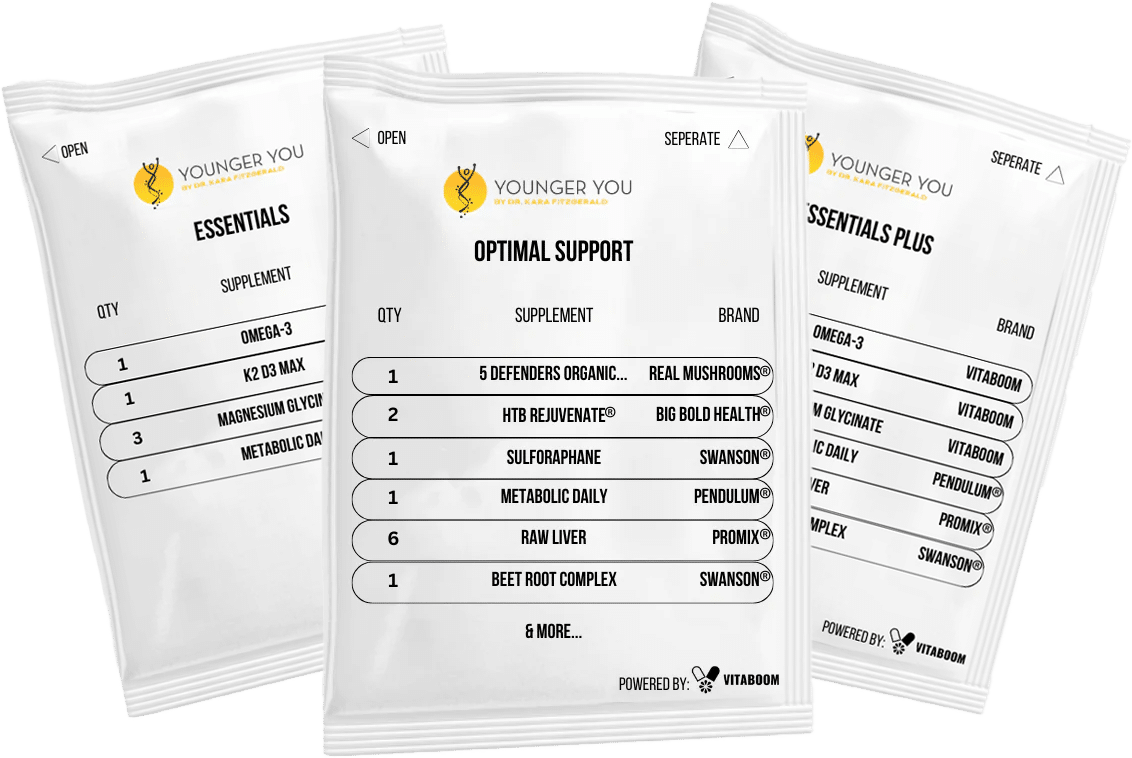
Younger You Daily Supplements are Now Here!
What could be more convenient than having your daily supplements all pre-portioned in one pouch? Choose your level to get the combination of supplements that’s right from you. Monthly subscription available.
(note you’ll be leaving www.drkarafitzgerald.com to go to www.vitaboom.com to complete your purchase)