

What New Science Says About Building Muscle | Brad Currier

Don’t forget to Become a DUTCH Provider today to gain access to free educational resources about the DUTCH Test, expert clinical support, comprehensive patient reports, and peer-reviewed and validated research! Learn more at dutchtest.com/for-providers.

For 50 years, Biotics Research Corporation has utilized “The Best of Science and Nature” to create superior nutritional supplements, available exclusively to healthcare professionals.

Timeline is a Swiss-born longevity brand founded by scientists, doctors and innovators on a mission to extend healthspan through clinically proven science. At the core is Mitopure®, a pure and patented form of Urolithin A, shown to improve mitochondrial function — a key hallmark of aging.

A modern patient lab testing experience, powered by provider expertise.
I was genuinely excited to sit down with Dr. Kelly Casperson for this conversation. Many of us know Kelly as a trusted voice in hormone and sexual medicine, but what continues to impress me is her role in changing the conversation around women’s health at a much broader level. From helping lead the effort to remove the FDA’s boxed warning on vaginal estrogen to advocating for better access to hormone therapies, she’s not just talking about change—she’s helping create it.
What I love about this discussion is that it goes beyond the usual menopause conversation. Kelly challenges us to rethink how we define menopause, how we evaluate hormone therapy, and how we support women through one of the most significant transitions of their lives. We dive into estrogen, testosterone, evidence-based medicine, patient autonomy, and the future of hormone care, but we also explore the bigger questions: What does good medicine look like? How do we balance evidence with individual needs? And how can we do better for women?
Kelly brings both scientific rigor and refreshing clarity to these topics. I think you’ll walk away with new clinical insights, a few paradigm shifts, and plenty to think about. ~DrKF
How Medicine Got Menopause Wrong | Dr. Kelly Casperson
In this episode of New Frontiers in Functional Medicine, Dr. Kara Fitzgerald sits down with urologist and women’s health advocate Dr. Kelly Casperson to discuss one of the biggest paradigm shifts occurring in medicine today: redefining menopause as physiologic hypogonadism. Together, they unpack the historical consequences of the Women’s Health Initiative, the removal of the FDA’s boxed warning on vaginal estrogen, the growing evidence supporting individualized hormone therapy, and why testosterone should no longer be viewed as a hormone reserved for men. This wide-ranging conversation explores evidence-based medicine, patient autonomy, healthspan, and the future of hormone care through the lens of functional medicine.
In this episode of New Frontiers, learn about:
- Menopause as hypogonadism: Why redefining menopause as ovarian hormone deficiency fundamentally changes clinical decision-making.
- The legacy of the Women’s Health Initiative: How decades of misinformation reshaped hormone prescribing and influenced generations of women’s healthcare.
- The removal of the boxed warning: Why eliminating the FDA warning on vaginal estrogen represents a landmark shift in evidence-based women’s health.
- Evidence-based medicine beyond randomized trials: How clinician experience, patient values, and available evidence should all inform hormone therapy decisions.
- The timing hypothesis: Why earlier initiation of hormone therapy may offer greater protection for brain, bone, and cardiovascular health.
- Starting hormone therapy later in life: What current evidence suggests about individualized risk-benefit assessment beyond the traditional 10-year window.
- The expanding role of testosterone: Why testosterone supports far more than libido, including cognition, mood, energy, and mitochondrial function.
- Interpreting hormone laboratory testing: Why symptoms often provide more clinically meaningful information than population-based reference ranges alone.
- Progesterone formulations: The differences between oral micronized progesterone and topical preparations, including considerations for endometrial protection.
- Exercise, alcohol, and lifestyle interventions: Why hormones work best alongside resistance training, sleep optimization, reduced alcohol intake, and other foundational lifestyle strategies.
- Regulatory changes on the horizon: The evolving landscape of testosterone access, FDA policy, and what clinicians should anticipate over the coming years.
- Healthspan versus disease management: Why menopause represents an opportunity to proactively preserve cognitive, musculoskeletal, metabolic, and genitourinary health rather than simply treating symptoms after they appear.
Dr. Kara Fitzgerald: Hi, everybody. Welcome to New Frontiers in Functional Medicine, where we are interviewing the best minds in functional medicine. And of course, today is no exception. I am joined by Dr. Kelly Casperson. She’s a urological surgeon, hormone and sexual medicine expert, educator, and host of the podcast You Are Not Broken.
Dr. Kara Fitzgerald: She’s a leading voice in reshaping how we think about menopause, sexual health, and the long-overlooked needs of women in midlife. You’re going to walk away with a lot of cool information from this. And perhaps most inspirational to me is where she’s headed with her work. So yeah, getting that black box pulled was just a first. And she’s got a strong vision and many people working together and a governmental body, a regulatory body that’s actually listening. The FDA’s listening, changes are being made and she’s right in the mix and shares some of that with us.
Dr. Kara Fitzgerald: Kelly, it is just an absolute honor to have you with us today. Your work is so interesting and exciting, and just the fact that you’ve been called to kind of represent and change the conversation for women is just impressive. I know a lot of us hold you in high regard for the work that you’ve been doing.
Dr. Kara Fitzgerald: So our audience here is primarily functional medicine clinicians. That’s who you’ll be talking to. And I just have a ton of questions for you, but I feel like maybe what might be a fun place to start is getting a little bit of the backstory around you taking on getting the black box warning pulled, and what that journey looked like, and how you got involved, and any kind of tidbits you haven’t shared yet. It was such a monumental undertaking and occurrence for all of us.
Kelly Casperson, MD: Thank you. Yeah, it’s a lot of work getting to the point where you get to be on stage, right? So thanks for acknowledging it. And a lot of the work was done a decade before, you know, the first time people wrote to the FDA and had meetings with the FDA to get the boxed warning off was decades before. And it’s so interesting to see the comments, like, “You just decided on a Tuesday.” It’s like, no, the Women’s Health Initiative never even used vaginal estrogen.
Kelly Casperson, MD: And then a year after the media took that study and made hormones our body naturally makes be the enemy, the FDA, without great evidence, a year later put a boxed warning on all estrogen products, including natural estradiol products that were never in the study in the first place. Right? So really understanding the why, because people who know, knew that this should come off. And people who kind of naysayed it, bless them, they just didn’t understand. Or people thought, “Oh, that means you’re saying there are no risks.” And I was like, there’s still a laundry sheet of risks for every medication. That doesn’t mean it should be a boxed warning. A boxed warning means significant threat to life or limb, basically.
Dr. Kara Fitzgerald: Yeah.
Kelly Casperson, MD: So the meaning of why that came off, and the advocacy that certainly came before me, and really me being able to pick up the torch. One of my talents is as a communicator, right? And to rally people behind what this actually took to get it done, to be like, this is incredibly important. I have a friend who published a paper, which I talked about on stage, showing that 30% of women, if they’re lucky enough to get a vaginal estrogen prescription—30%—will not use it because they read the warning label after they’ve left the doctor’s office. And so that’s vaginal estrogen data.
Kelly Casperson, MD: And so, my ability as a communicator, I think, is why I got that spot on that stage. This is profoundly important. But I carried the torch, and I stood on the shoulders of those who came before me to build the case up to the point where we took it over the finish line.
Dr. Kara Fitzgerald: Awesome. And do you think it was just ignorance? I mean, was it nefarious? Like, how the heck did the black box get on— Because it was just a serious misinterpretation of the literature? Is it that innocent?
Kelly Casperson, MD: Yeah, basically the fear. So back in 2002, journal articles came in your mail. There was no social media, there were no podcasts, there was no Instagram, there was nothing to counter what the news said. Right? And we still see this. We see scary headlines all the time and then we’re back on social media being like, “Uh, actually, no.” So there was no means to correct misinformation. And if you didn’t get that journal article in your mailbox and read it and be like, “Oh, these women actually did pretty well on oral Prempro. This was not estradiol,” there was no way to counter it.
Kelly Casperson, MD: So it was just snowballing for a very long time. And I think that, combined with the dismissal of women, the dismissal of hormones, the dismissal of old women… Right? Like recurrent urinary tract infections. There’s nothing better than vaginal estrogen at preventing recurrent urinary tract infections. Nothing. And so I just think it’s all the little paper cuts that lead to a big problem until it becomes so big you’re like, we can’t keep ignoring this. It’s so egregiously wrong that vaginal estrogen causes blood clots, stroke, and breast cancer. It’s so egregiously wrong that the house had to fall.
Dr. Kara Fitzgerald: And it’s generations. It’s not just one generation. I look at the fallout, my mom’s experience, but also my sister. I mean, how many decades of women has this impacted?
Kelly Casperson, MD: Certainly the Boomers. So the Boomers were average age 50, 51 in 2002. I call them the pissed Boomers because once they get educated… Like, if you don’t know, you don’t know. But once you get educated about what happened and them having to go through menopause unsupported and dismissed, frankly, because the other options that we have aren’t as great as hormones. Because let’s be honest, menopause is a hormone issue, not a no-periods issue.
Kelly Casperson, MD: So the pissed Boomers, Gen X really, is who’s kind of taking this on and is righting the wrongs. And then the Millennials are super interesting because they’re coming up behind. They’re in perimenopause, and because they’re paying attention, they’re like, “We’ve got this grand idea. How about we don’t suffer in the first place?” And that is a complete culture change from having to earn the solution because you’re suffering enough, which is what the Boomers have had to do and what Gen X has had to do.
Kelly Casperson, MD: Are you suffering enough? And does the doctor then believe you’re suffering enough to offer you the treatment? Versus, how about we just start on some estrogen patches and some vaginal estrogen so that we don’t have bone loss and recurrent UTIs and sexual dysfunction?
Dr. Kara Fitzgerald: Yeah, exactly. All right, so then what do you think has shaken out? What is a logical approach to… Well, why don’t we first define menopause, actually? Because you’ve got a nice systems thinking around it.
Kelly Casperson, MD: Well, the word menopause is really stupid. That’s the very short version. We have to start there. And you’re right, if we don’t know what we’re talking about, we’re all just making assumptions and judgments based upon our preconceived definition, right? So menopause is a term coined in the 1800s when we didn’t have lab values. We didn’t really know what ovaries did, we didn’t know what hormones were. So this word came about from the observations of humans. All we could really observe is if you lived long enough, you didn’t have periods and you couldn’t get pregnant. Right? So the definition of menopause is the day after a year of no natural periods.
Kelly Casperson, MD: Well, that’s a shitty term for a couple of reasons. Number one, a third of modern women don’t have periods that end. Hysterectomies, ablations, IUDs, a baby when you’re older, and then your periods just never came back. So it’s a crappy definition because so much relies on it, people think, and a third of women don’t even really have a marker to be like, “I don’t really know when my period stopped.” So number one, a third of women don’t experience that.
Kelly Casperson, MD: Number two, it’s a symptom of the actual problem. Everybody talks about it like, menopause, perimenopause, postmenopause, blah, blah, blah, blah, blah. And you’re like, the word is a symptom. So not having periods and not being pregnant is a symptom of low hormones. So the actual thing that we’re talking about is outliving ovarian function. That’s what’s so goofy about it. Everybody’s like, “Well, you can kind of dismiss a symptom. What’s so bad about not having periods? Yay, no more periods. Yay, no fear of pregnancy.” And we’re like, actually, it’s profound hypogonadism. That’s what’s going on.
Kelly Casperson, MD: So that’s why the word menopause is problematic, because a lot of people don’t even know that. I mean, if we could see ovaries, it’d be a heck of a lot easier. We’d be like, “Yes, those seem to have gotten smaller over the past couple of years.” But so many older women are like, “I got a pelvic ultrasound and they couldn’t find my ovaries.” They’re shocked and freaked out. And it’s like, yeah, yeah, yeah. Atrophic ovaries. Testicles get smaller when they stop making testosterone. Ovaries get smaller. People are like, “Where are they?” And you’re like, that’s what they do, we just don’t usually look at them.
Dr. Kara Fitzgerald: So it’s hypogonadism, like physiologic hypogonadism. I mean, it’s part of the transition. I don’t know if physiologic is correct. And it’s not acquired exactly. I mean, it’s just the life journey. We move into this hypogonadal state and the fallout of that is system-wide. I don’t think there’s…
Kelly Casperson, MD: Yeah. It’s everything. Can you live without ovarian function? Yes, yes you can. Because I think so many people argue that. Can you live? Yeah, well, you can live with a bone fracture, but we tend to do surgery to optimize it so that you don’t suffer as much. So it’s really kind of this profound discussion of, are doctors here to only treat disease, or are we here to help people be the healthiest they can be?
Kelly Casperson, MD: Because when we have these big conversations of should we, shouldn’t we, blah, blah, blah, it always comes down to these actually big fundamental questions of what are we here for? What is our role? In 2026, knowing what we know, that can be very different than 1947 medicine. And so these are big, big questions that I think menopause, because it affects 100% of people, meaning everybody knows somebody who is going to go through this. It’s so common and it brings up these very, very big philosophical questions.
Dr. Kara Fitzgerald: Important.
Kelly Casperson, MD: Important, yes. Which is why I love the topic. It’s so juicy.
Dr. Kara Fitzgerald: Yes. Well, as soon as you reframe it as hypogonadism, any clinician is immediately thinking about the intervention. You immediately consider, how do we address this?
Kelly Casperson, MD: Yeah. When you get the word right.
Dr. Kara Fitzgerald: Yeah, When you get the word right. I think that’s important. I think redefining it, just calling it what it is. First of all, the fact that this is just an archaic term created by some guy way back in the 1800s.
Kelly Casperson, MD: I mean, it’s crazy, right? Because when you have a heart attack, we don’t say, “She’s having chest pain.” Chest pain is a symptom of an anoxic injury to the heart. And you can have chest pain for lots of other reasons, just like you can not have a period for lots of other reasons. But as physicians, what’s the underlying mechanism? What’s the underlying reason? And we’re like, Oh, it’s hypogonadism, not no periods.
Dr. Kara Fitzgerald: Right.
Kelly Casperson, MD: But we call your heart attack chest pain and we kind of dismiss it. We kind of dismiss it like that.
Dr. Kara Fitzgerald: It’s really compelling to simply reframe it. So with this reframing, how do we think about the intervention? How do you think about the intervention now? Or interventions?
Kelly Casperson, MD: Yeah. Well, it’s a wonderful opportunity to say education goes a long way, especially if we have short doctor visits. Books that are out, podcasts that are out, people… Ultimately we’re fascinated by our bodies, and ultimately our health literacy is really crappy. So people come into the clinic with all of these preconceived beliefs. Like, “Oh, it’s natural.” Yes, so is puberty and we try to relieve suffering during puberty if there’s suffering. So is pregnancy, but we try to relieve suffering and make it easy. The whole myth of natural as a reason not to intervene… Like, children get stuck in birth canals naturally. Right? That doesn’t mean we don’t intervene.
Kelly Casperson, MD: So it’s really a fun opportunity, especially if you have the time in a clinic, to be like, “What does natural mean to you?” What are you wearing on your feet? Socks and shoes? Not natural. Okay, let’s redefine again. We’ve got air conditioning today because we’re in Texas and it’s August. Let’s redefine what we’re willing to accept that’s natural and not natural. It’s called the naturalistic fallacy, that because something’s from nature, it’s therefore superior. And you’re like, well, arsenic’s natural, blah, blah, blah. So it’s fun to kind of dismantle that, especially when you have time in a clinic. But a lot of people don’t have time.
Kelly Casperson, MD: So a lot of that is then, what does the patient want, combined with what your knowledge is, combined with available evidence. And the fun thing is, when you actually look at what evidence-based medicine is, it’s three circles of a Venn diagram. In the middle is evidence-based medicine. It’s available data, available studies, mixed with patient desires, mixed with clinician experience. That was always the definition of evidence-based medicine.
Kelly Casperson, MD: And what we’ve done now, especially on the internet, is we’ve said it’s only randomized placebo-controlled trials. That’s not the definition of evidence-based medicine. So really coming back to that, to be clinician experience, combined with patient desires and wants, combined with available evidence. And that just opens it up.
Kelly Casperson, MD: Because are we going to get a 20-year randomized placebo-controlled trial looking at the prevention of dementia with hormones? Probably not. I’m a urologist and we do not have a 20-year randomized placebo-controlled trial looking at surgery versus radiation for prostate cancer. We don’t have it, we’ll never have it, and we can deal. Right? We can say risks, benefits, options, treatments, blah, blah, blah.
Kelly Casperson, MD: But when dementia is the number one killer of women in Australia right now, and it’s about to be the number one killer of women in the UK, and you know where America’s headed on that, are you going to wait for a 20-year randomized placebo-controlled trial, or are you going to make the best decision you have with the best evidence that we have, based upon a patient’s desires?
Dr. Kara Fitzgerald: That’s right. Yeah, it’s very… we’re sitting right at the beginning of some pretty significant empowerment by being able to have these conversations. And in functional medicine, generally speaking, we do try to have the time to be able to have the conversation. And our patient population tends to come to us certainly better informed or open to a different direction.
Kelly Casperson, MD: It’s wonderfully fun.
Dr. Kara Fitzgerald: Yeah, yeah. So there’s this massive possibility that sits in front of us. Menopause is, I think, the biggest pro-aging event in a woman’s life. And we have the opportunity to directly impact what that experience is like, directly impact health span.
Kelly Casperson, MD: Yeah. And I think, again, it’s where education goes a long way. Like, do you actually know what estrogen does? Like estrogen’s profoundly helpful in mitochondrial function, cellular tissue… Not you, you know what estrogen does, but the general population. Do they actually know what estrogen does? Right? It helps the metabolism of the brain. It helps the mitochondria function. It helps cellular repair. It helps DNA fix itself. It’s profoundly anti-inflammatory. Right? And that’s the education, to be like, I’m choosing this. I’m not doing this because a doctor told me to. You get that buy-in of, I know why I’m doing this. I know I’m choosing to do this. That is the happiest person, and the more engaged person, than someone saying, “My doctor told me to.”
Kelly Casperson, MD: I see this all the time with vaginal estrogen. “I used it for a little bit, but then I stopped.” Did they explain to you this decreases recurrent urinary tract infections by 60%, and nothing else comes close? And you have to use it for the rest of your life because you’re not getting any estrogen back, because you’ve outlived your ovarian function? “Oh, no. Nobody ever explained that to me.” Education and buy-in are incredibly important.
Dr. Kara Fitzgerald: So there’s two questions on the heels of your comments. One is oral estrogen. That’s kind of getting a second look, and so I’m curious.
Kelly Casperson, MD: I agree. It’s like, this cheap, generic, safe stuff over here… you want to talk about that again? Okay. Especially with the patch shortage. The risk of blood clots with oral estrogen is negligibly above baseline clot risk. Again, going back to education, I had a 70-year-old, and about a third of my practice is the pissed Boomers, women in their 70s and above. And they’re like, “I have a clot risk, blah, blah…” And I’m like, “Do you know what your risk of stroke is just by being 73?” And they’re like, “No.” They have graphs of this and I’m like, This is your stroke risk in your 70s compared to stroke risk in your 40s, 50s, and 60s. It goes up significantly.
Kelly Casperson, MD: And I’m like, you have a stroke risk simply by being alive and older. Because you need to realize clot risk is never zero. Never zero. You’re alive.
Kelly Casperson, MD: So, anyway, for oral estradiol, the clot risk above baseline is, I’d dare say, negligible. Certainly lower than oral Prempro, lower than birth control pills, lower than pregnancy. Nobody says, “Don’t get pregnant, you might get a blood clot.” Right? Nobody says that. But the blood clot risk with pregnancy is pretty damn high.
Kelly Casperson, MD: So again, educate people. Yeah, your stroke risk… so please be exercising. Your stroke risk is not zero without hormones, and your stroke risk hardly goes up even with oral estradiol. It’s incredibly low risk. The sex med doctors don’t love it as much because it has liver metabolism, increases sex hormone-binding globulin, and can decrease sexual desire by nature of it being oral. But not everybody has that in their life or cares about that. If you say, “Give me the absolute cheapest estradiol on the planet,” it’s oral estradiol.
Dr. Kara Fitzgerald: Right. And easy.
Kelly Casperson, MD: It’s so easy. And currently not having a shortage.
Dr. Kara Fitzgerald: Right. That’s right. And yeah, as you pointed out, it’s cheap. What about starting later? Many, many women are looking back and saying, “Did I miss the window? Can I start now that I’m 10 years post-menopause?”
Kelly Casperson, MD: Yeah. Well, let’s break it down. I always refer them to the 2022 menopause guidelines. The 2022 menopause guidelines say within 10 years of your last period, benefit outright outweighs risk. And especially for my lay populations, I’m like, for a medical sentence to say benefit outweighs risk, that’s actually a very, very strong statement. It’s huge, right? In medicine, that’s a very strongly worded statement. Benefit outweighs risk.
Kelly Casperson, MD: After 10 years, individual risk-benefit assessment is required. That’s what the guidelines say. So everybody’s waving their hands and being like, “I can’t have it 10 years after…” I’m like, who said that? Did the guidelines say that? No. The guidelines say after 10 years, individual risk-benefit assessment. And there is something called the timing hypothesis, meaning hormones work very well at keeping healthy cells healthy. They don’t do as well at treating disease.
Kelly Casperson, MD: If you want to keep healthy cells healthy, you need to start before the healthy cells stop being healthy. And that’s the timing hypothesis. Get this stuff on board. And again, that’s the prevention role. If you wanted to do everything you could to prevent heart disease and prevent dementia, which you can’t prevent 100%, but hormones do help, earlier is better. Probably, to this point of late perimenopause is even better than two years post-menopause. We’re getting there. But earlier is better.
Kelly Casperson, MD: So for my 30% of my patients who are the pissed Boomers over age 70, I say I probably won’t prevent heart disease, probably won’t prevent dementia. Hormones will always help bones, they will always help you sleep, can always help mood, can always help bladder function, can always reduce UTIs. So people think hormones stop working. It’s like, no, no. You missed the healthy cell hypothesis window for prevention, more than likely.
Kelly Casperson, MD: But especially with bone data, there are many papers—This is what people don’t know. It’s like research didn’t exist before 2002. Like nobody had done any hormone research until the Women’s Health Initiative. Right?
Kelly Casperson, MD: There are great papers looking specifically at bone density, starting with the lowest-dose patch—And I’m not talking 0.25, I’m talking 0.14. The lowest-dose patch in women whose average age is around 68 and they did great. No worse than placebo. So knowing what I know, when people say, “You can’t…” Bless them. They don’t know. They don’t know the data. They don’t know that we’ve got a randomized, placebo-controlled trial—This is HERS data—Randomized placebo-controlled trial looking at oral Prempro after a heart attack. Oral Prempro after a heart attack. So that’s oral synthetics, the big bad guy, right? Of which now transdermal estradiol doesn’t have any clot risk.
Kelly Casperson, MD: Oral Prempro after a heart attack in a four-year study with decent follow-up and no worse risks than placebo. That’s in your after-heart-attack population. So you’ve got a healthy 72-year-old that you’re not giving a low-dose estrogen patch to? Because of what? There’s no clot risk. She’s already optimized. Maybe you won’t prevent dementia, but you’re not going to cause it. And so if you look at even the WHI (Women’s Health Initiative) average age, what, 63? They were already 10 years post-menopause, and they did not do that badly.
Kelly Casperson, MD: The other piece of this is body autonomy, your wishes, risk-benefit. What do you want to do? And my argument is, if a 73-year-old woman at that age can’t decide what she wants to do with her body, by God, when can she? And remember, there’s no age limit on testosterone, there’s no age limit on oral micronized progesterone, there’s no age limit on vaginal estrogen. So I always say hormones are a very big tent and to say you can’t have anything in the tent just means you’re not up to date on the education around it.
Dr. Kara Fitzgerald: Right. Let’s talk about testosterone for women. In the functional medicine space, I think we’re doing a pretty good job with prescribing it. But more broadly, it seems to be lagging. It is lagging.
Kelly Casperson, MD: I love the underdog, right? And now that we’ve got the boxed warning off of estrogen, this is the next project. And I have to tell you, things are moving.
Dr. Kara Fitzgerald: Are they?
Kelly Casperson, MD: Yeah. Things are moving. We’re going to see some very exciting things. But man, there are just a lot of problems for everybody, for men and women. The first being the DEA restriction, which was never put on because it was harming patients. It was put on because of the Olympic doping scandals of the 1980s. It was literally an act of Congress, the Anti-Doping Act of 1991 [Anabolic Steroids Enforcement Act of 1991], because of doping in the Olympics. We hated losing to East Germany and the USSR, countries that don’t even exist anymore. So, we hated that and passed the Anti-Doping Act and put one naturally occurring hormone on the increased restrictions list and that was testosterone.
Kelly Casperson, MD: Interestingly enough, the FDA and the DEA didn’t want testosterone on the list, but Congress didn’t like losing to the doping people so we put it up there. What that actually did was cause unnecessary concern that this was unsafe, that this was addictive, that this was dangerous, blah, blah, blah. And I’m like, especially at female doses… I tell my patients, “I’m not going to make you a gold medal pole vaulter. I’m just not. It’s not going to happen on female doses. It’s not possible.”
Kelly Casperson, MD: And so if you saw the FDA roundtable on hormones in July of 2025, it’s free on the FDA’s YouTube channel for anybody who wants to go watch it. I got to be one of the speakers. My talk was testosterone, and one of the things I asked for was deregulation, at least at female doses. Do you want to talk about male doses being deregulated? I’m all on board with that also. But at least at female doses, this should not be a regulated medication. It’s going to open up telehealth. Women access telehealth more than men do. It removes unnecessary burden on physicians, DEA licenses. And in many states it puts your name on a controlled substance list so we’ve got privacy issues, all the reasons. So that’s number one with testosterone.
Kelly Casperson, MD: Number two is we don’t have an FDA-approved female testosterone dose. We actually came very close in 2004. Procter & Gamble had the Intrinsa patch. We had efficacy, this was for low libido. It showed efficacy, it showed safety, but it was 2004, two years after the WHI. Bad, bad timing for hormones.
Dr. Kara Fitzgerald: Yes.
Kelly Casperson, MD: Hormones were still allegedly dangerous. So the Intrinsa patch actually never got approved. But we’ve got precedent, and we’ve got years of safety data, and we’ve got an understanding of safe and effective, just bad timing. Expensive also for that company. So we’re moving now. It’s very hard to count the number of women on testosterone in this country because we are microdosing male formulations, we’re compounding, we’re using pellets, which are private companies with proprietary sales data. So it’s very hard to say how many women are on testosterone. But by the experts’ best guestimate, it’s about equal to men. Men have over a dozen products.
Kelly Casperson, MD: So it makes sense number-wise though, because 100% of women will become hypogonadal. About 20%, depending on what data you believe, somewhere between 20 and 30% of men will decrease their testosterone production. So you’re like, yeah, we’ve got 80 million women over the age of 40. One hundred percent of them are hypogonadal after age 50. So number-wise, it makes perfect sense that we’re already at parity with men’s low testosterone. So that’s the second issue—no FDA-approved product.
Kelly Casperson, MD: The third issue is, are we going to get it approved for low desire? We have female-dose testosterone approved in four countries right now: Australia, New Zealand, South Africa, and the UK. It’s all for low desire. That’s a problem. It’s the same reason why menopause is a problem, because low desire is a symptom of hypogonadism. There isn’t one square centimeter in your brain that’s the libido box, where testosterone just works there and nowhere else. Testosterone is a cognitive neurohormone. It helps myelin sheaths, it helps mitochondria, it helps brains be brains. Energy, libido being a mood.
Kelly Casperson, MD: A paper literally just got published today looking at about 300 women in a telehealth company, (JOI). They do a lot of testosterone and they did a questionnaire pre-testosterone and post-testosterone use and the thing that changed the most— Well, libido was number three. The thing that changed the most was energy and mood, then libido. So if you want to irritate me, tell me that testosterone is only for libido. Because to me, that just tells me you don’t know how brains work. And you also don’t know that libido is a mood. Right? And also the ovary didn’t make testosterone just to go to the libido box in the brain for you to want to have sex with somebody. That’s not how the body’s built.
Kelly Casperson, MD: So it sounds very uneducated when you say testosterone is only for libido. But we have the most data for that, so we might get it FDA approved for libido. That’s problematic. Number one, insurance companies have exclusionary riders on sexual health. So now we have an FDA-approved product for women for testosterone, but there’s a sexual health rider on your Blue Cross Blue Shield plan where I can’t treat erectile dysfunction and I can’t treat low libido. That’s all cash.
Kelly Casperson, MD: And number two is doctors aren’t really good at talking about sex, and we know that. And what we see in Australia is that single women will go into the doctor and they might tell the truth or they might lie, but they’ll say, “I have low libido and I’d like to try testosterone.” Doctors will say, “Well, you’re single, so I’m not going to give you any testosterone.”
Dr. Kara Fitzgerald: Is that right?
Kelly Casperson, MD: Yeah. People are like, “How do you know that, Kelly?” And I’m like, because I have an Instagram with half a million people on it, and Australians love me and tell me all these things. And this is multiple Australians, who are like, “So I’m either lying to my doctor and saying low libido is the reason I want testosterone because that’s the “right” reason to be on it, or number two, I do indeed have low libido but happen to not be married, and they don’t get testosterone because I’m not married.”
Kelly Casperson, MD: And I’m like, this, my friends, is 2026. Doctors suck at talking about sex. And this is, again, why in a perfect world, I would not get it FDA approved for libido. I would get it FDA approved for the same reason men have it FDA approved, which is hypogonadism.
Dr. Kara Fitzgerald: Right. Then how would we make the hypogonadism diagnosis? Just by standard labs? I mean there’s plenty of ways.
Kelly Casperson, MD: Symptoms. Labs are imprecise, labs are moving targets, and labs are the mean of a population. This is what a lot of people don’t realize. So let’s take kidney function and creatinine for a second. It has a narrow window of safety, it’s pretty stable across the life, and outside of that it’s kind of dangerous. Right?Then we think all labs are like that. But that’s not how hormones are.
Kelly Casperson, MD: Hormones fluctuate daily, hourly, morning, night. Did you just work out? Your testosterone will be higher, et cetera, et cetera. So optimal is not normal on labs and Quest Labs, for example, in America, normal goes down to two. That’s problematic.
Kelly Casperson, MD: So Quest Labs, in America, for mass spec, which is what you want, you don’t want the male testosterone. You want testosterone by mass spec liquid chromatography because it’s the only one that works in values under 100.
Kelly Casperson, MD: Quest Labs, in America, considers two to 44 normal. Well, Sue Davis published a paper in Australia with about 3,000 Australians, which is a big study. They published this paper in 2025 and you have to translate it to American lab values, nanograms per deciliter, because the rest of the world uses different lab values. But basically what she showed is less than eight to ten is in the lowest tenth percentile. So you’re telling me two is normal? Right? No, two is really low. It’s kind of like a 50-year-old man with a testosterone of 305. He’s technically normal, but for a 50-year-old man with symptoms, he’s hypogonadal.
Dr. Kara Fitzgerald: Right.
Kelly Casperson, MD: So labs are very problematic. And the other argument is, well, many people don’t check progesterone or estrogen before treating. Why are we treating testosterone any differently? The guidelines say check a baseline testosterone, usually to exclude the people with high testosterone, not to prove it’s low enough to deserve treatment. And that’s where I think a lot of people misinterpret the current data.
Dr. Kara Fitzgerald: We have these ridiculously broad ranges, and so I think it’s fair to see them as relatively meaningless. We need to lean on symptoms and clinical presentation.
Kelly Casperson, MD: But if you look at a lot of the testosterone data, which again, most people don’t, that’s my job, so I will tell you, most of the testosterone data have efficacy being in the high double digits, low triple digits. We really start seeing androgenic side effects, and again, can you technically call them side effects when they’re known things that happen with high-dose testosterone? But androgenic side effects really start kicking in above 200.
Kelly Casperson, MD: But efficacy—sexual desire, mood, energy… We just had the STEP-HI study published in JAMA looking at testosterone after hip fracture versus placebo. Wonderful study. They didn’t treat for dose, they treated for a range of labs, and that was in the 100s. So when people say, “What’s the optimal testosterone dose?” this is my three-step rule for female testosterone, and I’m going to say for males too: How does she feel? Does she have side effects? What’s her lab value? In that order.
Kelly Casperson, MD: People want to put the lab value first. “Tell me the optimal lab value.” Dude, I can get a woman to 48 and she’s like, “I’ve got bacne, I feel a little not myself, and I’m kind of moody on this.” It’s too high.
Kelly Casperson, MD: Get another person, put her up to 150, and she’s like, “Living my best life. No side effects, super happy, brain’s back, fantastic.” It is, by definition, individualized. And here’s the other crazy thing about hormones. And this isn’t all hormones, but specifically testosterone. How sensitive are your receptors? How many receptors do you have? What’s the dose you need to get it to your brain? All we have is a lab value, and otherwise we’re operating in a massive black box.
Dr. Kara Fitzgerald: Yeah.
Kelly Casperson, MD: So be humble. How does she feel? Does she have side effects—side effects bad enough for her to want to back off, too, by the way—And then know if she’s riding high. What’s high to me? High 100s, 200, et cetera. Androgenic changes don’t happen overnight. They happen slowly over time. Continue to watch that, and educate, and to see how it goes.
Dr. Kara Fitzgerald: Well, some of those androgenic changes are just part of the transition anyway. So androgenic changes post-testosterone therapy, specifically.
Kelly Casperson, MD: Well, there are so many crazy things. People are like, “My sweat didn’t smell, and now my sweat smells again.” And you’re like, yeah, that’s hormones. Hormones are required for sweat glands to be sweat glands. So things where you’re like, is that a side effect, or is that just part of the script?
Dr. Kara Fitzgerald: Yeah. What about progesterone? Oral progesterone, topical, dosing?
Kelly Casperson, MD: There’s no data that topical is uterine safe, but people get benefit from it. But benefit from it and uterine protection are two very different things, and I think people just need to be educated on that. You don’t have a uterus? Great. Do whatever you want. But if you have a uterus, nobody is saying that your Amazon progesterone cream that helps you sleep and helps your night flashes is [providing] uterine-level safety. So I think the people who are all or nothing on it are coming from a uterine safety standpoint. But a lot of people say, “I just added a little more progesterone cream,” and they love it. Don’t shame them. Don’t take it away from them.
Kelly Casperson, MD: But as a hormone provider, know enough to say topical progesterone has not been proven to be uterine safe and we have some papers saying more uterine bleeding and more uterine cancer on it because it hasn’t been proven.
Kelly Casperson, MD: Oral micronized progesterone, most people tolerate it great. In my perfect world, why don’t we have more than two different doses available? Why don’t we have an extended-release available? Why don’t we have a smaller dose available?
Kelly Casperson, MD: There’s a lot to be desired just in the available products, but for what we have, it’s pretty cheap, it’s very safe, and quite effective for the majority of people.
Dr. Kara Fitzgerald: Right. And it’s actually available.
Kelly Casperson, MD: And it’s available. There are hints of shortages, but it seems to be pharmacy-specific at this point. I mean, the problem with cheap generics is there’s not a lot of manufacturers so you’re kind of reliant on two factories. But hopefully they’ll see it coming.
Dr. Kara Fitzgerald: I want to just nudge you a little bit to talk about what’s happening in the regulatory world with regard to testosterone, and when might we get some information on it?
Kelly Casperson, MD: Yeah. So the FDA did a press release a week or two ago basically saying they are wanting to expand the indication for men.
Dr. Kara Fitzgerald: Okay.
Kelly Casperson, MD: Right. Where’s ours? But hopefully rising tides lift all boats. And I don’t mean to be Pollyanna, I truly believe this. Testosterone progress for everybody helps everybody, because right now most men take testosterone off label. People don’t know that. Male testosterone is FDA approved for primary hypogonadism, meaning you were born without the ability to make enough testosterone. I’ve actually seen this happen in California, where insurance companies aren’t paying for secondary hypogonadism, or hypogonadism as a result of a medical condition, which is the main off-label reason that men take it.
Kelly Casperson, MD: So men have access issues as well because of how their product is FDA approved. So the FDA said they want to expand access to basically idiopathic or secondary hypogonadism and low libido. We’re like, great, do that. Expand it. Let’s have access and while we’re at that, can we please get some for females?
Kelly Casperson, MD: So, I think for expanded access for men, they’ve already done a press release on that. If anybody wants to watch this, it’s good watching, again, the FDA YouTube men’s health panel from December 2025 is excellent. And I think we’re going to see some deregulation.
Dr. Kara Fitzgerald: Good. When might that happen?
Kelly Casperson, MD: Lord knows. Ideally 2026, but I truthfully don’t know. The other thing they’re actively looking at is the data. It’s this crazy circular argument because this is a cheap, naturally occurring hormone—a.k.a. you can’t patent it, a.k.a. it’s got to be cheap, a.k.a. you can’t have years and years of required safety data to get a product that, if it becomes too expensive, women are just going to keep off-labeling it, and bootstrapping it, and microdosing it, and all the things.
Kelly Casperson, MD: It’s this catch-22. You can’t require years and years and years of safety data on something we’ve already been giving women. We’ve been giving women testosterone for 80 years. There’s a paper published in 1948. Because gynecologists were doing this. They were treating heavy periods with testosterone. They were treating breast issues with testosterone. We only had so many tools in the toolbox, so we were using a lot of testosterone and they said, “At this point, we feel like we have enough safety and efficacy to say that testosterone should be used in women.” That was 1948.
Dr. Kara Fitzgerald: Wow.
Kelly Casperson, MD: So I think right now this administration is very favorable to it. I don’t have a timeline, but we got the boxed warning off. And never underestimate the power of the public, social media, and people saying what’s important. What I’ve seen is that a lot of women have been so defeated that they’re either hoping somebody else is going to come and save them, or they think their voice doesn’t matter. Those are really two awful positions to take in the world because that’s not actually how the world works.
Kelly Casperson, MD: And I have to say Gen X and the voices of women saying, “Where’s ours? This is gender bias. This is sexism. This hormone is life-changing. I’d like insurance to cover it. I’d like to not feel like a criminal for using it.” So the profound groundwork that the individuals have done is… I mean, it’s not because I’m yelling loud. I’m doing what I can, but the world isn’t changing because of me. I’m able to funnel the voices up. So to women and men and physicians and everybody, your voice profoundly matters. That’s the only way any of this is changing.
Dr. Kara Fitzgerald: That’s amazing. It really is amazing. I mean, for a long time it’s been very disenfranchising, for clinicians as well. How do you think about the transition? I think it’s very refreshing to hear your angle and just couching it as hypogonadism is extremely liberating, and it immediately prompts a flood of ideas on how we need to rethink it, shape it, frame it, all of that. I think it’s very, very empowering. And of course it is what it is, it’s true. I think that’s why it clicks. But beyond thinking about HRT, what are other key elements of this experience? What are some of the top considerations we should be thinking about?
Kelly Casperson, MD: Like aging well? Midlifing well?
Dr. Kara Fitzgerald: Yeah. What are some of the top considerations?
Kelly Casperson, MD: It’s the easy stuff that nobody wants to do, but it’s everything. At the end of the day, I’m a hormone advocate and a body literacy advocate, but I don’t think there’s anything better than exercise. Hormones at best extend your life two to three years, estrogen especially if you take it between 50 and 60. There are very few medications that actually extend years. Statins don’t extend years for women, for example. Very few medications extend years.
Kelly Casperson, MD: Estradiol, multiple papers show, extends years, especially when taken between ages 50 and 60. And that said, nothing is better than exercise. Hormones and exercise at the same time? Fantastic. But for people to just be slapping on an estrogen patch and thinking it’s going to make a difference, it’s like nah, you need muscles. You need cardiovascular fitness. You need sleep. You need to stop drinking alcohol. You need to stop overworking. You need to rest. All of these things where we’re like, “Can I just take a supplement?” It’s like, well, you can, but it won’t replace those things. The hard part is the simple stuff.
Dr. Kara Fitzgerald: Right, right. And what kind of recommendations, when you’re talking to a patient and you get them started on hormones, what else is part of the conversation?
Kelly Casperson, MD: Alcohol. Why haven’t you stopped yet? If you haven’t stopped yet, why haven’t you stopped yet? Are you working on stopping yet? What’s your plan for stopping this? If you care about your brain, and you care… anybody who has depression or anxiety, anybody on an SSRI, why are you dumping a depressant into your body? If you want to lose 10 pounds, why are you having alcohol? If you don’t want fatty liver, why are you drinking alcohol? If you want good sleep, why are you drinking alcohol?
Kelly Casperson, MD: Getting educated on this thing is incredibly eye-opening. Why are you tying one hand behind your back and then trying not to fall? It just makes no sense after a while. So sleep, alcohol, exercise, walking. Just walking. I had this patient the other day, highly educated, and I’m like, “How much are you walking?” And they’re like, “Why do we need to walk?” And I was like, “Oh Lord.” I just think everybody knows this, but walk. My God, low-hanging fruit. Frickin walk.
Dr. Kara Fitzgerald: All right. So in addition to doing your work around testosterone legislation, what else are you up to? What’s coming forward in 2026, 2027?
Kelly Casperson, MD: Man, I’m happy with that. I’d like to see vaginal estrogen over the counter. So that’s some work.
Dr. Kara Fitzgerald: Oh, interesting.
Kelly Casperson, MD: There’s an amazing paper published out of Stanford looking at Medicare patients. These are Medicare people who went to a doctor and got the correct diagnosis. So you went to the doctor, you got a diagnosis of recurrent UTI, genitourinary syndrome of menopause (GSM), vaginal atrophy, some sort of pelvic GSM diagnosis. So you had access to a doctor who gave you the proper diagnosis, of which the treatment is vaginal estrogen. We have guidelines now for GSM, very exciting. The AUA did that last year. What percentage of women got a vaginal estrogen prescription when they went to a doctor and got the right diagnosis? What percentage got the treatment?
Dr. Kara Fitzgerald: Five? Ten?
Kelly Casperson, MD: Nine.
Dr. Kara Fitzgerald: Wow. That’s incredible.
Kelly Casperson, MD: So think of how big that pie is of, “I didn’t get to a doctor,” or “I got to the doctor and got an antibiotic,” or “I wasn’t diagnosed with the proper thing.” It’s kind of a daunting problem to solve. So over the counter… I mean, vaginal estrogen is over the counter in multiple countries. It has proven safety, efficacy, and cost. So that would be great, especially given that data. Canada did a similar study, and 17% of people got a prescription for vaginal estrogen in their study. So we’re missing the boat.
Dr. Kara Fitzgerald: Completely. And does this go back to WHI?
Kelly Casperson, MD: I don’t know. I mean, it’s hard to… the Stanford study was, I think, about a five-year duration. So they didn’t look. I mean we didn’t have electronic medical records prior to the WHI, so it’s hard to look at that.
Dr. Kara Fitzgerald: Right.
Kelly Casperson, MD: But they didn’t investigate the reason why.
Dr. Kara Fitzgerald: That’s just so unbelievable. I mean, it’s such a massive, massive miss in terms of women’s health.
Kelly Casperson, MD: It’s a massive miss. But so is the fact that ovaries make testosterone, and testosterone helps the brain, and everybody looks at you like you have two heads for wanting to help ovarian function. We help thyroids and pancreases and all the other hormones that go awry. If you don’t make enough vitamin D, we help that out. So it’s really this tremendous gender bias..
Dr. Kara Fitzgerald: Yes.
Kelly Casperson, MD: And at the end of the day, that’s what this work is. And I think my insight as a urologist is where this came from, because I’ve got an 89-year-old on testosterone and Viagra because his quality of life is worth it and he understands the risks and benefits. And if you don’t get to decide what to do with your body when you’re 89, when do you get to? And I see the profound gender bias. If that person were an 89-year-old female, we’d tell her no. Ultimately what keeps me going is, as soon as we’re all treated the exact same, I’m done. I’m done.
Dr. Kara Fitzgerald: Right. And we’re making some headway.
Kelly Casperson, MD: Oh God, getting the boxed warning off was absolutely huge. I mean, look, we’ve got a shortage right now, which is a blessing and a curse, but it’s a direct result. And I laugh because I’m like, listen, estrogen didn’t become safe on a Tuesday. November 11th is not when estrogen became safe.
Dr. Kara Fitzgerald: Right.
Kelly Casperson, MD: But it became such big news that it was safe—It’s been safe for decades but it became such big news that it was safe that it literally started changing the world.
Dr. Kara Fitzgerald: Yeah. It’s incredible.
Dr. Kara Fitzgerald: Well, geez, I just look forward to paying attention to what you’re up to in moving forward testosterone. Thanks for getting in the mix and doing the heavy lift. It was fabulous having you on the podcast. Thanks again so much for making time.
Dr. Kara Fitzgerald: And by the way, folks, we’ll grab links to the YouTube channel that you mentioned. We’ll get some of the citations into the show notes, a link to your website, your books, et cetera, and all the things we touched upon. We’ll circle back and pop those into the show notes for you.
Dr. Kara Fitzgerald: Dr. Casperson, thank you so much for joining me today on New Frontiers.
Kelly Casperson, MD: Thanks for having me.
Dr. Kara Fitzgerald: What a great conversation I just had with Dr. Kelly Casperson. I’m so appreciative that she made time for us. I know she’s crazy busy and she’s doing all sorts of really cool work, not just in her clinic, but of course outside and just being a voice pushing forward access for women, access to sufficient health care, to good science, to hormone replacement therapy, just changing the conversation broadly. Bravo her.
Dr. Kara Fitzgerald: She cites paper after paper. It’s all interesting. And we have corralled together as much of it as we can. And it’s all parked over on the show notes where the transcript is as well. Again, thank you so much for joining me. Thumbs up, share it, like it, give me your comments. I’d love to hear from you. And until next time on New Frontiers in Functional Medicine.

Dr. Kelly Casperson is a board-certified urologic surgeon, CEO and founder of The Casperson Clinic, a modern practice dedicated to hormones and sex medicine, renowned public speaker, sex educator, and host of the top-ranking podcast You Are Not Broken. Dedicated to empowering women, Dr. Kelly blends humor, candor, and science to demystify sexual health, intimacy, and midlife wellness. Through her podcast and online courses, she tackles myths about desire and normalizes conversations around healthy, fulfilling sex. Her work also provides essential education on hormones and midlife health. Connect with Dr. Kelly on Instagram (@kellycaspersonmd) or visit kellycaspersonmd.com.
You Are Not Broken Podcast
The Menopause Moment: Mindset, Hormones and Science for Optimal Longevity by Kelly Casperson, MD
FDA Expert Panel on Menopause and Hormone Replacement Therapy for Women
FDA Expert Panel on Testosterone Replacement Therapy for Men
FDA Press Release: FDA Takes Step Forward on Testosterone Therapy for Men
The 2022 hormone therapy position statement of The North American Menopause Society
Hormone Replacement Research
Vaginal Estrogen Utilization Among Medicare Beneficiaries With Genitourinary Syndrome of Menopause
Vaginal Estrogen Guidelines
Genitourinary Syndrome of Menopause: AUA/SUFU/AUGS Guideline (2025)
Guideline No. 422b: Menopause and Genitourinary Health
Research on Testosterone
Research on Barriers around HRT
Barriers to effective treatment of vaginal atrophy with local estrogen therapy
Podcast: The Estrogen Effect Nobody Talks About | Kiran Krishnan
Podcast: Why Aging Is Not a Fat Problem — A Muscle-Centric Approach to Longevity | Dr. Gabrielle Lyon
Podcast: From Hot Flashes to Healthspan: The FxMed Guide to Hormones & Longevity | Dr. Carrie Jones
Blog: What Urinary Hormone Metabolite Testing Tells Us about Estrogen Metabolism and Breast Cancer Risk

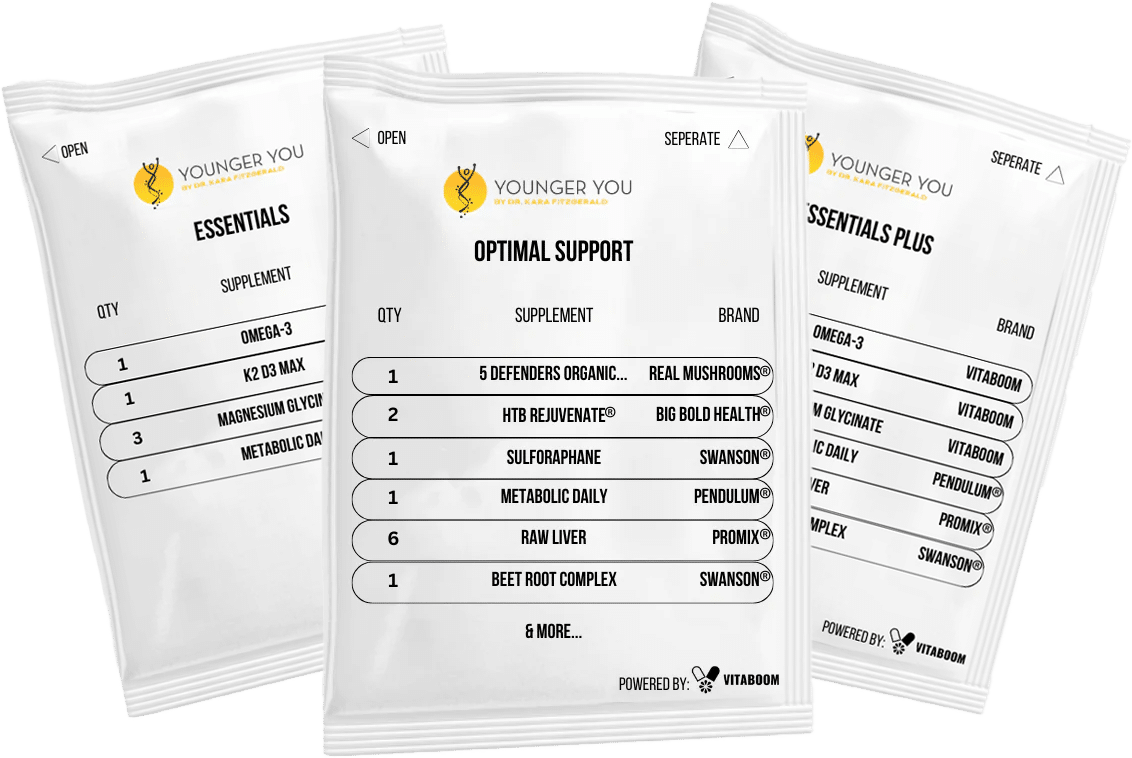
Younger You Daily Supplements are Now Here!
What could be more convenient than having your daily supplements all pre-portioned in one pouch? Choose your level to get the combination of supplements that’s right from you. Monthly subscription available.
(note you’ll be leaving www.drkarafitzgerald.com to go to www.vitaboom.com to complete your purchase)