

The Estrogen Effect Nobody Talks About | Kiran Krishnan

Don’t forget to Become a DUTCH Provider today to gain access to free educational resources about the DUTCH Test, expert clinical support, comprehensive patient reports, and peer-reviewed and validated research! Learn more at dutchtest.com/for-providers.

For 50 years, Biotics Research Corporation has utilized “The Best of Science and Nature” to create superior nutritional supplements, available exclusively to healthcare professionals.

Timeline is a Swiss-born longevity brand founded by scientists, doctors and innovators on a mission to extend healthspan through clinically proven science. At the core is Mitopure®, a pure and patented form of Urolithin A, shown to improve mitochondrial function — a key hallmark of aging.

A modern patient lab testing experience, powered by provider expertise.
This was a particularly meaningful conversation for me. I’ve been referencing Dr. Bill Harris’s work for many years, so it was a real privilege to sit down with him and explore these topics together. What struck me most is the level of precision he brings to an area that many of us have simplified, myself included. We covered a wide range of topics, from the AFib controversy to the vilification of omega-6s to the broader complexity of fatty acid biology.
At one point, we shared a moment of humor around how the neat biochemical pathways we’re taught don’t always capture what’s really happening in the body. It’s a perspective that really stayed with me. This is one of those conversations that encourages a more nuanced lens, and I do think it has the potential to shift how you’re thinking about and applying these concepts in practice.
~DrKF
Seed Oils vs Science: What the Data Shows | Dr. Bill Harris
Fatty acids remain one of the most debated areas in clinical nutrition, yet many widely held beliefs may not fully align with current evidence. In this episode of New Frontiers in Functional Medicine, Dr. Kara Fitzgerald sits down with Bill Harris, PhD, top-ranking researcher, founder of OmegaQuant Analytics and co-inventor of the Omega-3 Index, to examine the role of omega-3 and omega-6 fatty acids in cardiovascular risk, the limitations of prevailing dietary narratives, and how these insights can inform clinical decision-making.
Clinicians will gain a clearer understanding of how to use the Omega-3 Index as a biomarker, interpret atrial fibrillation risk in the context of omega-3 intake, and differentiate between pharmaceutical and dietary interventions. The conversation also explores emerging data on linoleic acid, the limitations of simplified “good vs bad fat” models, and the broader complexity of fatty acid metabolism and signaling. This episode provides practical guidance for evaluating labs, refining nutrition strategies, and making more informed, evidence-based recommendations in patient care.
In this episode of New Frontiers, learn about:
- Omega-3s and sudden cardiac death: Discover how early landmark findings continue to shape clinical understanding of cardiovascular risk and prevention strategies.
- The Omega-3 Index as a clinical biomarker: Learn how to interpret red blood cell omega-3 levels and apply target ranges in patient assessment and care.
- Omega-3 status and chronic disease risk: Explore the clinical impact of low omega-3 levels across cardiovascular disease, diabetes, and all-cause mortality.
- Omega-3s in brain health and cognition: Discover how long-term omega-3 status influences mood, cognitive decline, and neurological outcomes.
- The AFib controversy and omega-3 supplementation: Understand how dose, patient population, and study design influence risk, and how to interpret these findings in practice.
- Pharmaceutical vs dietary omega-3s: Learn when to consider high-dose interventions versus dietary strategies and how each fits into clinical care.
- Omega-6 fatty acids and linoleic acid: Explore why higher levels are consistently associated with better health outcomes and how this challenges conventional thinking.
- Saturated fat and dietary guidelines: Understand the inconsistencies in current recommendations and how to navigate these in patient counseling.
- The oversimplification of fat biology: Explore why “good vs bad fat” models fall short and how to think more accurately about fatty acid interactions and metabolism.
- Mechanisms beyond anti-inflammatory effects: Discover how omega-3s influence membrane function, signaling pathways, and systemic physiology in ways that extend beyond inflammation.
Dr. Kara Fitzgerald: Hi everybody, welcome to New Frontiers in Functional Medicine where we are interviewing the best minds in functional medicine. Today, of course, is no exception. I am here with Dr. Bill Harris. He is a scientist with over 400 scientific papers, he’s a lipidologist extraordinaire, and the co-inventor of the Omega-3 Index. I mean, if you’re thinking about omega-3s, if you’re measuring them in clinical practice, you know his work.
Dr. Kara Fitzgerald: He is the founder of OmegaQuant, which correctly measures the omega-3 index. He put the omega-3 index on the map. We talk about it, we talk about some of his favorite publications, we talk about some of the data on omega-3s and AFib (atrial fibrillation) and why that might be. We also talk about the counter data, and we do quite a dive into the omega-6 seed oil controversy. And let me tell you, it is interesting, it’s extraordinary, and it will quite potentially change your thinking and it’s all evidence-based. I mean, the world of fatty acid biochemistry is far more complex than we’ve kind of reduced it to. Anyway, it’s a far-ranging, fun conversation with Dr. Harris and just I’m delighted that he joined me on New Frontiers.
Dr. Kara Fitzgerald: Dr. Harris, it is an honor to get to sit with you here in the virtual podcast space and to pick your brilliant brain on all things omega-3 fatty acids. We’ll actually hop over to the omega-6s as well. I’m on faculty at the Institute for Functional Medicine and have been citing your work. I specifically lecture in the immune module, where one of my responsibilities is the fatty acid prescription and so I’ve been going through your research for—I’m in my 14th year. So I’ve been talking about you for a long time.
Bill Harris, PhD: Wow. Well, I guess you have. That’s wonderful. That’s great.
Dr. Kara Fitzgerald: It’s just so exciting to get to pick your brain and ask you the questions I’ve always had when prepping my slides over the years. First question: I know you sent me some of your top beloved papers in the omega-3 literature, and I want to talk about those, but I have to throw at you the extraordinary 2002 paper, Albert et al., in the New England Journal of Medicine. I feel like it started the conversation. I still talk about it—90% reduction in sudden cardiac death when circulating omega-3s were, I think, in the highest quintile, if I’m not mistaken, as compared to the lowest. I don’t know if they did quintile or quartile.
Bill Harris, PhD: Yeah, it’s quartile, but that’s okay. Yeah.
Dr. Kara Fitzgerald: It was quartile. Ninety percent risk reduction in sudden cardiac death. So talk about that study. Where were you? What were you doing? It’s a massive finding. Has it held up? Where are you at now?
Bill Harris, PhD: Yeah, actually that was the one that really lit the fuse. The fuse itself was set some six years earlier with David Siscovick, who reported virtually the same kind of relationship between omega-3 index levels—what we call the omega-3 index then, this red blood cell EPA and DHA—and risk for sudden death in a cross-sectional study done in Seattle. And in that study, which was a JAMA paper, what they did was collect blood from people who were having heart attacks. Paramedics would show up, collect the blood, store the blood, and after six or seven years of doing that, they had enough blood samples to compare.
Bill Harris, PhD: Then they drew blood samples from the general community of people the same age, same race, same sex, who were not having heart attacks. It was a case-control study and they found exactly the same thing. In the top quartile of red cell levels, there was about a 90% lower odds of being a case. It’s a fine point. It’s not really lower risk; it’s lower odds of being a sudden cardiac death case. You really can’t do– I mean, in case-control studies it’s pretty hard to talk about risk statistically correctly because you’re not really looking at a whole population. You’re picking people out.
Bill Harris, PhD: In any event, the point was made and I think what you’re saying is right: this is the one that really lit up the scoreboard. To me and to my colleague at the time, Clemens von Schacky—we were at the meeting when Christine Albert presented that paper at the AHA in Chicago—and we really thought that was very cool. That’s what prompted the idea that we ought to create a blood test that could be used clinically because it’s an important marker of risk for an important outcome, which was sudden cardiac death in that case. Then we developed the Omega-3 Index the next year, and then developed a set of laboratories to measure it, and yada yada—here we are.
Dr. Kara Fitzgerald: Yes. It’s such a massive statistic.
Bill Harris, PhD: Yeah, I know. But then subsequent studies were we more properly looked at risk—and we’ll talk about them, I’m sure—90% is extreme. It’s extreme.
Dr. Kara Fitzgerald: Yes. That’s right. I mean, I’ve since moved into a more conservative 30%.
Bill Harris, PhD: That’s reasonable. That’s better.
Dr. Kara Fitzgerald: Okay. So how do you interpret those early studies then?
Bill Harris, PhD: Well, again, when you pick out a group of people who’ve all had a disease, an outcome—a fatal heart attack—and then you go pick another group of people who haven’t— It’s not like 50% of the population actually has sudden cardiac death. It’s not even close so it’s an artificial loading. It’s a great way to find relationships, and it’s an easy way because you don’t have to wait. Well now, Christine Albert waited 17 years in her 2002 New England Journal paper you’re talking about.
Bill Harris, PhD: Those blood samples were not collected when they were having the heart attack. Those blood samples were collected long, long before they had any sign of heart disease at all, when they were still healthy. And she found, again, the same thing that David Siscovick found: those with the highest levels were, in that case, least likely to die of sudden cardiac death over time. His was cross-sectional, but they sang the same song, which was really compelling. So I use that study to tell the story of how we got interested in the Omega-3 Index—how we created it and why we created it. But it’s taken on a life of its own since then.
Dr. Kara Fitzgerald: Yeah. Why don’t we talk a little bit about what the Omega-3 Index is? I’ve been showing the Omega-3 Index in my slide deck for many years, and we’re talking mostly to functional medicine physicians, so I think they’re familiar with it. But give a lowdown for anybody who isn’t—what it is and what we want to achieve.
Bill Harris, PhD: Sure. So the Omega-3 Index is a measure of your tissue levels of omega-3. It’s very much analogous—and I’m sure you use this in your talks—to hemoglobin A1c. It serves the same purpose. Hemoglobin A1c gives you a long-term, stable picture of glycemic status in a patient. The Omega-3 Index does exactly the same thing for EPA and DHA status. They’re both measured in red cells. Hemoglobin and the Omega-3 Index is measured in the membrane of the red cell, which is where the fatty acids are. And again, it’s a stable marker of omega-3 status. It changes very slowly. It’s not perturbed by an acute change in intake in omega-3 like plasma omega-3 levels are; the red cell is not. The Omega-3 Index is expressed as a percent. At least at one time the hemoglobin A1c was expressed as a percent. Sometimes it’s different now.
Bill Harris, PhD: Our percents are the percent of EPA and DHA in the cell membrane fatty acids—so percent of total fatty acids in the membrane that are EPA plus DHA. And it usually ranges from 3% on the low end to maybe 10%, 12%. We’ve seen 16%. Dolphins have 19% and that’s okay. Under 20% for sure—you really can’t get much higher than that. The red blood cell is made in the bone marrow with certain specifications—certain physical properties that, obviously, a red cell has got to have. Very specific properties to be able to squeeze through capillaries, deliver oxygen, pick up CO2, et cetera.
Bill Harris, PhD: So again, the typical American level of Omega-3 Index is roughly around 5%. Vegans that we’ve studied are around 3.5%. US military deployed are around 3.5%, which is terrible. People eating a traditional Japanese diet, around 9 or 10%. We think the target is 8 to 12%. Somewhere in that window is a good place to be.
Dr. Kara Fitzgerald: There are a lot of papers out there on the Omega-3 Index and I just want to hear about some of your favorites. And I know you’ve even accessed specimen to go back and look using the index in other research studies. And I also want to mention so I don’t forget, that we will link to where people can find the Omega-3 Index, how they can order it, et cetera. I know a lot of clinicians are already using it, but we’ll make it available. So yeah—go ahead and talk about some of your favorite papers.
Bill Harris, PhD: Great. Well, I have to start with the first paper which was really the birth of the Omega-3 Index. This is a 2004 paper where we laid out the logic of using red blood cell EPA and DHA, which we named the Omega-3 Index. People complained about it—“It’s not all the omega-3s,” yada yada—I know, I know. But we defined it as EPA plus DHA red cell membrane percent. That paper not only proposed an Omega-3 Index as a marker of risk for fatal heart disease at the time, we also had to pick a target value, a level of what you want to aim for, what’s optimal, bad, good, intermediate. So we looked at the literature that was available at the time, looked at a variety of studies, and looked at the level of what we called the Omega-3 Index that was associated with the best cardiovascular outcomes, and then on the opposite end, the low end, what was the reverse.
Bill Harris, PhD: And it turned out to be under 4% was the bad place to be, 8% and over looked like the sweet spot for these studies, and then in the middle was sort of intermediate, where most Americans are in that 5% to 6% area. So that, I think, laid the foundation for the Omega-3 Index to become a test. My hope had been that it would be picked up by the medical community and used in standard clinical care. Well, it’s happening slowly.
Dr. Kara Fitzgerald: Yeah, very slowly.
Bill Harris, PhD: Very slowly, but it’s happening. The fact that people are paying some attention, whether it’s our test or somebody else’s plasma test or somebody else’s whole blood test—the idea is tracking omega-3 is important. And as you say, it’s easy to move, safe to improve, and cheap. It checks all the boxes for a risk factor that’s modifiable, as far as I can tell.
Dr. Kara Fitzgerald: I’ve seen a lot of imitators. There are. I mean, we’ll use them sometimes. It’s just easy to grab a plasma omega-3 measurement and have insurance coverage on it. It’s just easy in clinical practice. But how reliable is plasma, given how changeable it is—or whole blood—compared to using the red blood cell? The gold standard is red blood cell membrane, I think.
Bill Harris, PhD: Yeah, gold standard is red blood cell. And there’s a hierarchy: whole blood is second best because it’s 50% red blood cells. That’s part of the benefit of whole blood. Plasma is the least optimal, but it’s not terrible. We’ve had to use it in some studies and it’s not bad. What people shouldn’t do is flip from one sample type to another. Stick with plasma if you’re going to do plasma, so you can at least– The challenge is, what’s the healthy target level in plasma or in whole blood? We know what it is in red cells, but in plasma there’s a different percent of EPA and DHA compared to a red cell. Red cells are more concentrated in polyunsaturated fatty acids.
Bill Harris, PhD: Plasma is going to be roughly half or so of the amount of EPA and DHA. Some of the labs that are offering that, I don’t think they’re necessarily using good evidence to set their target levels. Some mistakenly measure whole blood and say the target is 8%. Well, you’re not going to get 8% on whole blood because whole blood is a lower percent omega-3 to begin with. Anyway, I can’t complain too much about it. I’d like to see one uniform method being done, but I’m not in control of that world so we just keep doing our research and hope someday it’ll click.
Dr. Kara Fitzgerald: Yeah, that’s right. They’re labs created by lab scientists. They’re good at developing assays but the reference ranges, to your point, I question them myself. They don’t always appear logical. So gold standard, if you’re new to this everybody, is the red blood cell membrane. And then you developed the risk range, less than 4%, and a massive chunk of the population is within that. And then above eight being optimal. I know for different conditions, like Dale Bredesen, working with individuals with cognitive impairment, shoots for at least ten. And I think there’s some literature out there pushing it higher. What do you see? Give me some data on being in the lowest versus the highest percentile.
Bill Harris, PhD: Right. The number of conditions you’re at higher risk for when you’re in that low omega-3 range is a pretty long list. It starts with cardiovascular outcomes—well, maybe it should just start with death.
Dr. Kara Fitzgerald: Yes.
Bill Harris, PhD: That’s the bottom line. We’ve shown that people with the lowest omega-3 levels, in that lowest quartile, lowest quintile, are at increased risk for premature death from any cause, whether it’s cardiovascular disease, cancer, or the whole kitchen sink of what’s left—the other causes of death. There’s something systemically risky about having a really low Omega-3 Index under 4%. We’ll probably get into talking about mechanisms later, but we’ve observed it for type 2 diabetes, cardiovascular disease, dementia, Alzheimer’s disease. And early onset dementia, a recent paper we did also showed the same thing. Those are the big problems in America, so that’s a potpourri of what you’re at risk for with a really low Omega-3 Index.
Dr. Kara Fitzgerald: And just thinking about all-cause mortality, you also published on suicidal ideation.
Bill Harris, PhD: Yeah, suicidal ideation, right. We just did that, and self-harm. Same story. It gets a little boring after a while, actually, to have to low omega-3, higher risk for fill-in-the-blank. So far, almost nothing has not shown a problem at that level. This most recent paper was in the UK Biobank, a big cohort from the UK, and we did see that same situation of people who reported passive suicidal ideation, is what it is called when you answer the statement “I don’t think life is worth living” in the affirmative. And we found, again, the higher the omega-3, the less likely people were to say yes to that question. Then we also looked at medical records for physical self-harm and found the same thing: people with the lowest levels had the highest reported rates of self-harm. We’d love to do the same study in actual suicides, but at the time we did it there weren’t enough suicides in the UK Biobank to do a statistically sound study.
Dr. Kara Fitzgerald: What about cancer? It’s been a bit of a mixed bag with regard to different types of cancer and omega-3 fatty acids.
Bill Harris, PhD: Yeah. Going back to a paper we did several years ago as part of what’s called the FORCE consortium—a group of maybe 50 or 60 cohorts around the world, like the Framingham study, which most people are familiar with. The same kind of idea has been done everywhere. Many of those studies measured fatty acids at baseline, and then we can look at disease outcomes as a function of fatty acid levels. In the FORCE consortium, we looked at total mortality and cancer mortality as a function of omega-3 blood levels. And we found the same thing: people who had the highest levels were least likely to die of cancer.
Bill Harris, PhD: But you’re right. Cancer is far more heterogeneous than cardiovascular disease is since there’s so many different places, different organs you can develop cancer in. There was a concern 10–12 years ago about increased risk for prostate cancer that got a whole lot of press.
Dr. Kara Fitzgerald: Exactly. A lot of press
Bill Harris, PhD: It was a really crappy study.
Dr. Kara Fitzgerald: And it changed medical practice. I mean, it’s pretty crazy. Yes—go ahead.
Bill Harris, PhD: It is crazy. Right, exactly. That just goes to show you that people are far more concerned about what hurts them than what helps them. I mean, the whole thing plays out with mercury and fish in pregnancy. It’s the same story. I don’t really want to jump ship to far over to that, but we do know now that advice from the FDA and EPA that women should limit fish intake while pregnant had the effect of harming their children because they stopped eating fish. The benefit of eating fish so far outweighed any adverse effect of mercury that women who reported the highest fish intake while they were pregnant, the IQs were five to seven points higher in those kids.
Dr. Kara Fitzgerald: Regardless of the type of fish.
Bill Harris, PhD: Regardless of the amount of mercury—it didn’t make any difference. Conversely, when you avoid fish, you’re doing harm. You’re going to have a lower IQ because you’re afraid of mercury and because you’re afraid of the mercury, you avoid the vehicle. The vehicle is fish and the fish has a lot of good stuff in it. So anyway, it’s a disbalance. It’s the same kind of thing with that prostate study, which was simply observational. There was certainly no intervention involved, and the difference in risk was just absolutely minuscule. But the guys who did that study had a chip on their shoulder about dietary supplements and they had a history of that and so they really wanted to blow it up, even though there were no dietary supplements used in the study.
Dr. Kara Fitzgerald: Yeah. Two comments on that. One: it did occur to me some years ago that if you want to get into a top-tier journal, trash omega-3s and you probably can. If you need a really good publication… Although you’ve been in many, many top-tier journals.
Bill Harris, PhD: Well, we’ve gotten some good ones. And I have to say, are you familiar with the PISCES study? It’s fairly recent in the New England Journal.
Dr. Kara Fitzgerald: Walk us through it.
Bill Harris, PhD: It published last month or two months ago and it was a randomized controlled trial with 2.4 grams of EPA/DHA versus placebo in about 1200 hemodialysis patients at 26 centers. The endpoint was cardiovascular disease, and it was a slam dunk for omega-3 benefit. It was about a three-and-a-half year duration study, but if you look at the event curves—Sometimes in these studies the events go about the same for about a year and then they start to split and separate. Not this one. From day one, the omega-3 group had less cardiovascular events and it continued throughout the whole story. It was a really clear benefit in a really high-risk population. But that’s where you demonstrate proof of principle, is in those kinds of settings.
Dr. Kara Fitzgerald: We will definitely link to that. And to your point, I think top-tier journals are embracing this. I guess I’m going back a few years when it seemed to be the pattern. I know now that pharma is producing omega-3 products. We’re seeing bigger cohorts and bigger publications.
Bill Harris, PhD: This was not a pharmaceutical product. It was not a pharmaceutical study, thankfully.
Dr. Kara Fitzgerald: Interesting. And how many grams was it?
Bill Harris, PhD: 2.4 grams.
Dr. Kara Fitzgerald: 2.4 grams EPA/DHA.
Bill Harris, PhD: Yeah. Not a huge dose. It’s less than the 3.5 grams of EPA/DHA in 4 grams of Lovaza. It was a reasonable dose. Very reasonable.
Dr. Kara Fitzgerald: Yeah. That is. It’s a realistic dose for most people. I just want to go back to that prostate cancer study because I do remember it. The only thing I want to point out, just pointing to the quality is that they reported a protective effect of trans fats in that paper.
Bill Harris, PhD: I think you may be right. It doesn’t make the news. And I don’t know if you want to get into AFib, but we…
Dr. Kara Fitzgerald: Yes. We absolutely will get into AFib, but let me just say—
Bill Harris, PhD: Okay. I’ll hold my ammo for that one.
Dr. Kara Fitzgerald: Yes, absolutely. Because I know you just did a UK Biobank publication looking at AFib, thank God. Let’s put that to bed. And I will say, I was excited—just so I don’t forget about it, thinking of AFib—and this is, of course, coming from the Big Pharma studies where there was that micro association—they did put to bed the bleed risk, which was something we were all concerned about. For many years I would say at the podium, stay tuned, there’s these big investigations coming down the pike and we’ll really be able to see whether there is a reason to be concerned about increased risk of bleeding in any cohort. And indeed that was put to bed, so that was a useful outcome, wouldn’t you agree?
Bill Harris, PhD: I agree, right. And this PISCES study was the same thing. I mean, it showed no increased risk for bleeding in these hemodialysis patients who tend to bleed anyway. But we published many papers showing that there’s no increased risk for bleeding, and nobody listens.
Dr. Kara Fitzgerald: Yes, they were out there, yes. I did report on them early, but we waited and waited for the pharma papers.
Bill Harris, PhD: Yeah. Right.
Dr. Kara Fitzgerald: I guess we might as well flip over to… I want to talk about mechanism of EPA and DHA specifically, so I want to circle back to that. But since we’re talking about these larger pharma papers—By the way, you were always a remarkable spokesperson to kind of tease out these papers, and talk some sense into what was reported and dig into the data deeper. So I just really greatly appreciate it. Again, it’s always informed my thinking and my lectures, because a lot of these papers were sort of dismissed. I mean, even one was stopped early, et cetera. And maybe you’ll have comments on that. But before we do, this also brought the idea of there being an increased risk of AFib and I think mostly the oldest, pre-existing polypharmacy individual.
Dr. Kara Fitzgerald: I should say before that, all of us practicing functional medicine were prescribing omega-3s as an intervention to our AFib patients and so this was a bit of a shocker when they were reporting this as a significant risk. So yeah, talk about it.
Bill Harris, PhD: Yeah, right. So, recent background is that first seen in the REDUCE-IT trial, which is the high-dose EPA, four grams of EPA a day, which was a very successful trial from a cardiovascular outcomes point of view. There’s a little bit of a cloud over it because of the placebo, but we won’t get into that right now. Let’s just take it at face value that it was a very successful cardiovascular risk reduction study.
Dr. Kara Fitzgerald: Right, I remember that. Yes.
Bill Harris, PhD: But they saw about a 1% increased risk for AFib between placebo and active groups. So instead of 2% developing AFib in the placebo group, it might’ve been 3% in the omega-3 group. So 50% increase because we do relative risk, but absolute risk only about 1%, right?
Dr. Kara Fitzgerald: Yeah, but it made the news.
Bill Harris, PhD: That’s what makes the news. And then that was confirmed, that was seen again in the study you just alluded to, the STRENGTH study, which was an EPA plus DHA project that was stopped for futility, meaning it wasn’t doing anything. No benefit, no harm, but there was some increase in AFib in that study too. And so meta-analyses have been done. There was one meta-analysis that included six or seven studies that said, yeah, it looks like there’s a real—it’s a small. It’s a tiny increased risk, but it’s there. We have a paper under revision now in circulation. We’ve got 35 papers as a meta-analysis, and we’ve basically concluded in that thing that yes, in patients with high risk for cardiovascular disease—not high risk for AFib, high risk for CVD, standard high cholesterol, high blood pressure, smoke or diabetes, that kind of thing—those people, given high doses of omega-3 in the 3 grams a day area, that’s where you saw this increased risk in AFib.
Bill Harris, PhD: But if you look at those same high-risk people given a low dose of omega-3, no increase. If you look at people who are not at high risk for heart disease, given a high dose, no increase in AFib. And the low-dose, low-risk group, of course, no increased risk for AFib. Dietary supplements, which are not given typically at levels that high, are not associated with risk for AFib. And then, as you alluded to, a paper we just published looking at blood levels of omega-3 as a predictor of future risk for AFib, and we found the higher the blood level, the lower the risk for AFib. Of course, I think the only way to harmonize those is that high-dose omega-3 intervention studies are getting higher blood levels even than we see in these population studies.
Bill Harris, PhD: Because population studies are not really dealing with people that are taking high-dose omega-3. They’re eating fish. Some of them were taking a few supplements, but not much. So certainly up to an index of 7 to 8%, there’s actually a decreased risk for AFib and a decreased risk for stroke as well, which was also seen in the original study that found the AFib, the REDUCE-IT study, where they saw an increased risk for AFib, they saw a decreased risk for stroke, the primary sequela of AFib. They found lower risk for stroke. So, add all these things up and we’re not really sure why AFib is kicked off. We have a feeling that it may be an activation of vagal tone, which is a good thing many times. But in some people with a tendency to bradycardia, or slow heart rate, if you give them high-dose omega-3, you might slow their heart even more, and if I stimulated vagal tone, that could kick into AFib. That’s one hypothesis.
Dr. Kara Fitzgerald: So that’s interesting.
Bill Harris, PhD: We don’t know. But anyway, I’m not sure if I’ve diverged or what I’ve done here, but I’ve just gotten on a—
Dr. Kara Fitzgerald: No. So for my thinking, the increased risk is very small. The absolute increased risk is very, very small, and it’s in a special cohort. So it’s the people with pre-existing conditions, I believe they were all on polypharmacy, multiple medications, and if I’m not mistaken, correct me if I’m wrong, they were an older cohort.
Bill Harris, PhD: Well, I don’t know that we can say that necessarily. I think what’s interesting in terms of a deeper background is about 15, 20 years ago, there was a study sponsored by a drug company that owned Lovaza at the time, GSK, a study was done to try to reverse AFib. It was a big multi million-dollar study and the reason they did the study was there was enough evidence from the 1990s that omega-3s might actually be helpful in AFib and be an intervention, so this company mounted this big study. The first author was Kowey, it was published in JAMA, and I think they gave a loading dose of like 4-5 grams a day for two weeks in people that had either paroxysmal or persistent AFib. And they were given a high dose of omega-3 for kind of a loading dose, and then it dropped back to about 4 grams of Lovaza for six months after that.
Bill Harris, PhD: Their hope was to forestall the next episode of AFib. That would be their endpoint. If the people who were on omega-3 had their next episode pushed back in time, it would be beneficial. Well, they didn’t see any beneficial effect. They didn’t see any harm either, which is why I say if you’ve got people with AFib on omega-3, omega-3 is not going to hurt them. That study shows it didn’t hurt them. It didn’t increase their risk for more AFib, it didn’t reduce the risk for AFib. But the other benefits of omega-3 in cardiovascular and mental health, et cetera, are still there, and it’s not going to touch the AFib, so I wouldn’t worry. I’m not a medical doctor, so I can’t… and all that. But based on that JAMA study, there really isn’t any good evidence that giving people omega-3 who already have AFib is going to make it any worse.
Dr. Kara Fitzgerald: Right, so the population that we need to perhaps be paying attention to is very specific. I mean, it just makes me think eating a high-fish diet, having a higher omega-3 index, just having high blood levels of omega-3s over the course of your lifetime is, without question, extremely protective.
Bill Harris, PhD: It’s a good thing.
Dr. Kara Fitzgerald: It just makes me wonder that late in life, you introduce into a very vulnerable cohort, EPA and DHA, and that’s a big adjustment to physiology.
Bill Harris, PhD: Fair point.
Dr. Kara Fitzgerald: If you haven’t been exposed to these molecules and the regulatory influence of them, and their pleiotropic, far-reaching benefit, I mean, I don’t know.
Bill Harris, PhD: Yeah, that’s a good point. I agree that the goal is lifetime, lifelong, Or minus nine months on. In utero, let’s get going.
Dr. Kara Fitzgerald: Yeah, that’s right, in utero exposure. But let me ask you this, about those studies where they show the micro amount. I want to reiterate that because when I lecture on this in IFM, people get anxious. Physicians out there are anxious about prescribing. And incidentally, surgeons are still asking us to stop omega-3s..
Bill Harris, PhD: I know. Data doesn’t make any difference.
Dr. Kara Fitzgerald: Right, right, right. I actually had Barry Sears on the podcast a while ago and we talked a little bit about it. It was interesting. So he said the thing about the pharma preparations is that there may be isomers in the mix that we’re just not familiar with. So his argument is, if you’re eating whole food or if you’re taking a fish oil source like cod liver that’s structurally identical to what’s in the fish, you’re not going to see any problem. You’re not going to see AFib. But as we get to these high concentrations where the molecule needs to be modified to achieve those with a reasonable number of capsules, then you’re moving into something that is no longer bioidentical. And he thought that that was the variable in there being any association at all with AFib.
Bill Harris, PhD: Yeah, well, yes and no. I know that in the REDUCE-IT study, it was an ethyl ester. Fine. In the STRENGTH study, where they saw an increased risk, it wasn’t an ethyl ester, but it was an unnatural form. It was a free fatty acid, what they call carboxylic acid. It was just EPA and DHA, not esterified to ethanol like an ethyl ester or not esterified to glycerol like in a triglyceride, just free. We don’t eat free fatty acids, that’s not part of the normal diet. They are known to be irritating to the GI tract, which is why they tried to use an enterically coated capsule in that study. But then it wasn’t very successful because there were a lot more dropouts for GI distress. In any event, those are two very different forms, ethyl esters, free fatty acids, and they both increased risk for AFib.
Bill Harris, PhD: Actually, in one of the studies where there was a small increase for AFib it was done with restructured triglycerides, called Pikasol. It was the OMEMI study and that study was all post-MI people in their seventies. All right… And so I don’t think we can point to a formulation or a chemical form that really is the cause because at the end of the day—and I really like Barry a lot and we’ve worked with him. I don’t know that he has evidence that there are isomeric forms of omega-3 and that would be harmful in pharmaceutical products. Maybe there are. I don’t know. I’m not aware of it.
Dr. Kara Fitzgerald: Well, he didn’t have any evidence, but he said something really interesting, and that was that you could tell the quality of the fatty acid in the laboratory just by the odor of it. I mean, it was interesting. It’s been a minute since I’ve listened to that podcast, but he had an interesting observation around it from his own experience in the lab and working with different structures.
Bill Harris, PhD: Yeah. He’s had a lot of experience with really high-dose omega-3. Really interesting stuff he’s done.
Dr. Kara Fitzgerald: Yeah. What else do I want to say on this topic? I think one of the interesting things, again, referencing you and your work, is that with the STRENGTH trial, they halted it. But you always go back and dive into the data and you find interesting stuff and you report on it. You’re like, if they just hung in there for a little while longer, we were seeing these trends. Or, the AFib gets all of the attention, but there’s always a host of favorable changes either beginning to occur or really have occurred that just aren’t adequately reported on.
Bill Harris, PhD: Yeah, certainly, in ASCEND and VITAL, you know, some of those studies, there were some really good outcomes that got hidden in the composite endpoint.
Dr. Kara Fitzgerald: Yes, that’s right. That’s right, of course.
Bill Harris, PhD: And people feel like they have to bow at the altar of the composite endpoint. They have to be blind to look at any—even if MI levels went down, no, they can’t talk about that because that wasn’t part of the predefined—It’s just ridiculous.
Dr. Kara Fitzgerald: Yes.
Bill Harris, PhD: But, you know, talk about the news. I’ve got to get back to the AFib thing because of this paper we just published. About two years ago, there was a huge flap saying fish oil supplements increased risk for AFib. This was not randomized trials. This was people in the UK Biobank who reported using fish oil supplements. This paper—two papers actually, and there was a huge amount of press and the evening news for crying out loud—increased risk for AFib in people who used fish oil supplements. So we’re talking about really low levels of intake. Well, we went back and repeated that study. We have access to the UK Biobank just like this Chinese group. We have the same access they have to it so we went and looked at their analysis. We repeated their analysis and we got the same effect they did: 10% increased risk in people who were taking fish oil supplements. But we discovered that the reason they got that was they did their statistics wrong.
Dr. Kara Fitzgerald: Oops.
Bill Harris, PhD: Typically, when you adjust for things, adjust for age, adjust for sex, adjust for BMI, things like that—Age and sex is a dichotomous variable—yes/no. Two groups, that’s it. But age is a continuous variable. What they did in their analysis, they adjusted for age as above and below age 65, which is really the wrong way to adjust for age. When you adjust for age as a continuous variable, like you should, there’s no relationship at all between fish oil supplement use and risk for AFib. And that’s what our new paper has shown. They actually misrepresented the truth because they did the statistics wrong. And I’ve written to the journal to retract the paper. I don’t know if it’s going to happen or not, the original paper that we’re refuting.
Dr. Kara Fitzgerald: Good, yeah, good for you. I do remember that UK Biobank paper, yeah. Well, I’ll tell you what, when we drilled into that UK Biobank paper, because I was not too pleased to see it, just the whole reporting structure, really having accurate data. In certain ways, I think the UK Biobank is an extraordinary, extraordinary opportunity and many really good papers have come from it, but it was difficult to really tell where they were getting their data and the quantity. It seemed to me that there was a lot of gray in that analysis from the baseline, just from those data.
Bill Harris, PhD: Yeah, it was very frustrating. There was one adverse outcome and it got all the headlines, and there were five very favorable outcomes. People reporting fish oil supplement use had lower risk for a variety of other cardiac outcomes, but they didn’t mention any of that. I mean, the press report doesn’t.
Dr. Kara Fitzgerald: Right. No, that’s right.
Bill Harris, PhD: So in any event, we’re chipping away with evidence at that problem.
But I still have to say, there’s something going on with high-risk patients on polypharmacy who are taking high doses of omega-3. It’s something about the AFib, but I still think the risk-benefit is still far more in favor of taking the omega-3 than not. I mean, it’s flippant to say it’s better to have AFib than have a heart attack, but in a way, that’s kind of the way you have to think about it.
Dr. Kara Fitzgerald: Yes.
Bill Harris, PhD: You get balanced risk and benefit.
Dr. Kara Fitzgerald: Is there a safe dosage for that population?
Bill Harris, PhD: Sure, I’d say 2 grams and under would be fine. Because again, this showed up when the dose was three to four grams. So if you want to be really safe, I guess starting on that kind of dose, that should be good enough.
Dr. Kara Fitzgerald: So another piece, and I remember just thinking about this at the very beginning of my career, I was in a clinical laboratory for a while, and polyunsaturated fatty acids have lots of double bonds and we were theorizing that if you put that kind of information, if you will, into the body of somebody who’s very inflamed, those double bonds are perhaps less protected than if it’s in an individual who is healthier at baseline. And maybe there’s a place for dialing that population in if they’re willing, improving dietary pattern a little bit, engaging in what we do in functional medicine before introducing the fatty acids. Although I know that you would argue, and fairly, start on a low dose concurrent with the lifestyle interventions. What do you think about that?
Bill Harris, PhD: Yeah, well, that’s been around a long time. People know that in a test tube, a polyunsaturated fatty acids is more easily oxidized than a monounsaturated or obviously saturated fatty acids, which don’t get oxidized at all. But the human body is not a test tube. The human body has huge reserves for antioxidant protection of things. And when we look at levels of omega-3 in the blood and then we correlate it with markers of oxidative damage from urinary analyses, we find the higher omega-3 levels are associated with lower oxidative damage. So it’s easy to become convinced of these kinds of stories if you’re not very sophisticated, if you don’t think about the complexity of what happens inside the body and you’re just looking at chemistry. We’re looking at a metabolic chart and deciding what’s going to happen looking at this chart. Oh, this does that, therefore… I mean, come on. Let’s count bodies. Let’s really do the work of what’s related to health and not worry about… But anyway.
Dr. Kara Fitzgerald: Yeah. That’s right. That’s funny. That’s exactly what we were doing. We were looking at our Boehringer-Mannheim charts and whatnot.
Bill Harris, PhD: Yeah, those are great charts though. Fantastic.
Dr. Kara Fitzgerald: Let’s talk about mechanism then. And then at some point, we need to talk about omega-6s. I’ve had Charles Serhan on this podcast before. I’m such a ridiculously huge fan of his work as well, of course, no great surprise there.
Bill Harris, PhD: Yeah, he’s great.
Dr. Kara Fitzgerald: Of all the specialized, pro-resolving lipid mediators that the omega-3s make, and the omega-6s have a role to play in there as well. So we opened up our conversation talking about the beneficial influence on everything, including all-cause mortality, suicidal ideation, brain health, I mean, cancer, just on and on. Longevity, you know, people live longer with more fish oil, more EPA and DHA in circulation, a better omega-3 index. And they’re pleiotropic. I know you can’t necessarily nail down one mechanism, but what do you think? What’s going on with these?
Bill Harris, PhD: Yeah. Well, I think what Barry would say, what Charlie would say, and many people, it’s anti-inflammatory, which is almost a throwaway term anymore. It’s so nonspecific. It’s just to shut them up, you say it’s anti-inflammatory and move on. But I think that’s true, particularly chronically, decade after decade after decade of your life, if you’re slowing down the rusting process, it’s going to show up eventually as being beneficial for your health. I think it’s far more than just the SPMs. I hate that term. It’s just such a silly term. Tell me a molecule in the body that’s not specialized. I mean, give me a break. They’re all specialized. Water is specialized. Come on. So anyway, they’re pro-resolving mediators. That I like.
Dr. Kara Fitzgerald: Yes, okay.
Bill Harris, PhD: I know there are some supplement products that are providing some SPMs in the fish oil product. I haven’t seen any evidence that that’s more beneficial than just taking fish oil and letting your body make all the SPMs in all the different cell types to certain places at certain times. I’ve never even seen anybody show the blood levels of SPMs are any different. If you’re giving somebody the SPM-enriched product and the same product without the SPMs, I bet you get the same blood levels of SPMs. That would be my bet because there’s tiny, tiny, tiny amounts in these supplements. So I’m not convinced that that really does anything. I think SPMs are doing things in vivo. I’m not sure you need to take them in a pill at this point. I can understand why some companies jump on that bandwagon.
Bill Harris, PhD: And actually they don’t really give you the SPMs. They’re giving you precursors to SPMs, is what’s in the product. So in any event, mechanisms, yeah. Anti-inflammatory, that’s for sure. But they’re also anti-platelet, they, again, will slightly reduce the proclivity of platelets to clot, blood to clot, and I think that’s good in the long term.
Dr. Kara Fitzgerald: Not enough to increase bleed time or bleeding risk.
Bill Harris, PhD: Not enough to increase bleeding time, but like a baby aspirin, that kind of thing, but more natural, I guess you’d say. So I think that’s a part of it. To what extent triglyceride lowering is there, it’s not due to the anti-inflammatory effects of omega-3. It affects the production of triglycerides in the liver. So, yeah, I don’t think triglycerides explain the omega-3 effect by any means. I mean, even though that’s what they’re indicated for, that’s just a game drug companies play to get an indicated drug—to get an indication to lower triglycerides. And we know fish oils do, but I don’t think that’s why they are cardioprotective. I think it’s more of the anti-inflammatory, the improvement in endothelial function, the softening of the blood vessels, the better blood flow that you get partly because of the fluidity changes in the membranes. All those things play into it.
Bill Harris, PhD: On the cellular level, the analogy that I like is, if you think about a single cell being a representative of whole body, cells need to get food into them and they need to get waste out of them. Just like you need to go to the grocery store and buy food and you need to take out the trash at home. And the same thing happens in a cell and there are receptors and there are gates on the membrane of every cell that let good stuff in and make sure the bad stuff gets out. And I kind of flippantly think about the omega-3s as sort of greasing or oiling the hinges on those doors coming in and out and make them move without friction, easy. The doors open to the inside the right way and the doors open to the outside the right way and that keeps the cells healthy. So that image, I think at the very basic membrane level, helps give some kind of idea how the omega-3s are helpful.
Dr. Kara Fitzgerald: Yes. There was a really cool paper, it’s older at this point, but just outlining the pleiotropic effects that I liked quite a bit. And I was just kind of enamored to the idea of the lipid rafts where the omega-3s should be concentrated, and influencing the behavior of toll-like receptors, which will turn on aggressively myriad inflammatory compounds. And just by making sure you’ve got enough in the lipid membrane, you can change that. What do you think about omega-3s potential to interrupt the aggressive arachidonic-acid-derived family of eicosanoids?
Bill Harris, PhD: Mixed. I mean, let’s just start with the omega-6 story. Of course it’s had a bad reputation for 30 years, 40 years, as being the black hat versus the white hat of the omega-3s. All omega-6s are bad, all omega-3s are good. What could be simpler? Make a ratio. There are so many problems with that idea. Number one, the idea that the omega-6s are bad is just simply evidentially wrong. We’re publishing more and more now looking at not only the UK Biobank, but Framingham as well, looking at blood levels of linoleic acid, which is the primary omega-6 essential fatty acid, the main omega-6 in the blood by far, followed by arachidonic acid. It’s the main omega-6 in our diet.
Bill Harris, PhD: Arachidonic acid is maybe 100mg a day, and linoleic acid is like 15,000mg a day in our diet. I mean, it’s huge differences. And people are saying we’re eating too much linoleic acid, and I’m saying, no, we’re not eating enough, because what we see in our studies, we measure blood levels of linoleic acid, which is better than asking people how much they eat, by far. If you rank people from the highest quintile of linoleic in the blood to the lowest quintile and if the theory was right that linoleic acid is bad for you, the people that have the lowest linoleic acid level should have the best health outcomes. And it’s exactly the opposite. Time after time after time, whether it’s diabetes, whether it’s heart disease, whether it’s mortality, in every setting, we see that the higher the linoleic acid, the better the health outcomes. The longer people live, the less heart disease they have, less diabetes they have.
Bill Harris, PhD: Now, the other issue here is linoleic acid is not necessarily like the other omega-6 fatty acids. It’s the biggest one, it’s by far the majority. But when you mix all the omega-6 fatty acids together, you’re assuming that they all have the same kind of physiologic effect. And that’s also an incorrect assumption because we’ve seen in our work, and others have seen this too, linoleic might have a favorable benefit with total mortality, for example. But if you look at the non-linoleic omega-6 fatty acids, they could have either no relation with total mortality or an adverse relationship. But those are not ones that come from the diet. Those are ones that come from metabolism. The one that comes from the diet is linoleic acid.
Bill Harris, PhD: And so higher linoleic, better for you. Higher levels of other non-LA omega-6s might not be good for you. But that’s not something you control other than by taking more omega-3, which will reduce some of those things. But the bugaboo is, you know, seed oils are the concern. Seed oils provide almost all of the omega-6 linoleic acid in our diets, one way or another, ultimately. And they’ve been villainized, and I think inappropriately, because of their content of omega-6 and I’m saying, if you look at the evidence, people who have the lowest levels of linoleic acid in their blood are the people who are the sickest. So why would we want to lower our intake of omega-6 fatty acids? It doesn’t make any sense.
Bill Harris, PhD: We know that higher linoleic also lowers LDL cholesterol, which is nice, and may be part of the benefit but I think there are probably a lot of metabolites made from linoleic acid. For example, most of the nitric oxide in our blood is hooked to linoleic acid. There’s nitrolinoleate, and it carries nitric oxide around. Nobody thinks about that. Well, that’s a good thing. So, the idea that the omega-6s are bad is very sloppy thinking. Number one, it pulls all the omega-6s and calls them all the same thing, and they’re not the same thing. They don’t behave the same. It presumes that they are bad for you, that they’re pro-inflammatory and we published a paper in Framingham showing that the people had the highest red blood cell linoleic acid levels had the lowest levels of 10 circulating inflammatory markers.
Dr. Kara Fitzgerald: Was there an association with the quantity of omega-3s in that population?
Bill Harris, PhD: No, it was independent of the omega-3. So in the model, we adjusted–
Dr. Kara Fitzgerald: Regardless of the…
Bill Harris, PhD: Regardless of the omega-3 level, the higher the omega-6, the lower. So I think EPA, DHA, and linoleic acid are all good, healthy, polyunsaturated fatty acids that we should try to increase in our diet.
Dr. Kara Fitzgerald: Right.
Bill Harris, PhD: Reducing saturated fat is probably a good thing. It gets controversial now with the new dietary guidelines. I mean, they say you should keep levels low and then say, yeah, but you ought to eat more butter and lard. Yeah, okay, well, how does that work exactly?
Dr. Kara Fitzgerald: I do want to talk to you about saturated fat for a minute, but I want to tease this out. I hear you. I mean, I hear you and I’ve definitely brought forward, as you’ve been publishing more on the benefits of omega-6s and the association with risk reduction with higher omega-6s. In IFM, to get your certification, you have to know the polyunsaturated biochemical pathways. You’re familiar with desaturases, elongases, you know that the various eicosanoids that are going to be produced from the 20-carbon-length players and so forth. And so we really learn a lot of this and we definitely think about tweaking dietary intake.
Dr. Kara Fitzgerald: There’s an interesting drama in the influencer online community around omega-6s that we don’t participate in, but that has been our party line for a long time, that if you bump up omega-3–
Bill Harris, PhD: Sure. Understand.
Dr. Kara Fitzgerald: And a way to do this, a way to increase red blood cell omega-3s can be by decreasing omega-6s or tweaking the diet to…
Bill Harris, PhD: Well, it’s actually the reverse is true. You really have a hard time changing your blood arachidonic acid, which is what you’re talking about, probably. Your eicosanoids made from arachidonate. You can raise your linoleic acid intake 1,000%, you can drop it 90%, and it doesn’t change your arachidonic acid levels in the blood at all.
Dr. Kara Fitzgerald: That’s interesting.
Bill Harris, PhD: Another misconception of the omega-6 problem—So arachidonic acid levels are metabolically controlled, and even the tiniest amount of linoleic in our diet will give us enough arachidonic, and the body won’t make any more than it needs. We know now that there are hundreds of metabolites of arachidonic acid. Some of them pro-inflammatory, some of them anti-inflammatory. But to just focus on the anti-inflammatory ones and think that’s the whole story misses the point that there’s a balance going on here. It’s very intricate, right?
Dr. Kara Fitzgerald: No, that is true. That’s right. The first step in sort of the class switch to a pro-resolving state requires the arachidonic-acid-derived lipoxin. So yeah, I hear you.
Bill Harris, PhD: Well, prostacyclin, you know, there’s another.
Dr. Kara Fitzgerald: Right. I think for me, the thinking with the lipoxygenase enzyme just grabbing a polyunsaturated fatty acid from the membrane and shunting it into downstream metabolites. If you’re packed with arachidonic acid would that influence the likelihood of pro-inflammatory compounds versus packed with omega-3s?
Bill Harris, PhD: Yeah, I’ve seen the diagrams too, and they’re cool. They’re pretty, they’re colorful, but they’re way overly simplified.
Dr. Kara Fitzgerald: Right, right, right. I appreciate what you’re saying. It just doesn’t bear out in physiology. There’s other regulators involved.
Bill Harris, PhD: Yeah. I think it’s important to do is look at disease outcomes, not to look at presumed biochemical pathways and nice diagrams of what happens in cells, because what you draw on one of those little diagrams with the cell and the doors coming in and the arrows going over here, that is so elementary to what’s really happening in the cell. Plus it’s all in the dark, for crying out loud. I mean, how does this happen? I mean, all these molecules floating around just by touching each other. I mean, it’s incredible. But we simplify it so much. Yeah.
Dr. Kara Fitzgerald: And the quantity. Yeah, you’re right, you’re right. And why would the body just sort of choose arbitrarily arachidonic acid to cleave and shunt in versus, you know, EPA? Like, I mean, it’s more sophisticated than that.
Bill Harris, PhD: It’s far more. Yeah, and if people want to fix their omega-6/omega-3 ratio, I mean, fine, but there’s only one way to fix it. Only one way to fix it, and that’s to increase your omega-3.
Dr. Kara Fitzgerald: Yes, okay, fair. I mean, there’s no argument that we just need to be packed with omega-3s regardless. But this all goes back really, I would say, Simopoulos and her research kind of put that on the map, and I’m curious about your opinion. It is said and I think Artemis actually did write on this, that we evolved consuming way more omega-3s in our natural dietary pattern, our evolutionary dietary pattern, relative to omega-6. We ate a diet that was closer, perhaps, to a one-to-one ratio of threes to sixes. And then we sort of went through this massive unwitting experiment, where omega-3s were largely ushered out of the diet so that we basically all became deficient, we just didn’t realize it.
Dr. Kara Fitzgerald: We evolved with a lot more information from omega-3 fatty acids and their derivative molecules and then we all became deficient and we had all this follow-up. And I think that’s why you’re shooting in a barrel of fish with some of your publications because of course, when you look at robust amounts of omega-3s, outcomes are incredible because we’re supposed to have those. They’re an essential part of our physiology. And when you look at deficiency, of course you see horrible outcome because you’re lacking an essential part of what we require for healthy physiology. And I think she helped put that message out there on the map.
Bill Harris, PhD: Yeah, she did. Right. And all you have to do is say evolution and you think you’ve explained something. I don’t know. Because, you know, looking at primitive cultures, there are so many, so many differences in lifestyle, in exercise, in the other stuff you eat to fundamentally pin it all on this omega-6 to omega-3 ratio is crazy. And they didn’t live long enough to get these diseases. I mean, they died at 30 or 40, you know.
Dr. Kara Fitzgerald: But we evolved with the information of omega-3 fatty acids and then we largely omitted it from the diet. I mean, do you think that’s…
Bill Harris, PhD: Well, I mean, maybe. Primitive people had to have water. Everybody has to have water, so everybody lived near water. Whether it’s the ocean or a river or something, everybody had to have water and what’s always in water is fish. Right? So fish was a big part of everybody’s diet and they didn’t have processed, concentrated oils. Sure. That doesn’t mean they’re bad, intrinsically.
Dr. Kara Fitzgerald: That’s right. I’m not saying that they’re bad. Your point is very well taken, and I honestly think, having lectured on this topic for many, many years, that we absolutely have to restructure how we’re teaching this information.
Bill Harris, PhD: Yeah. And people put up these graphs from 1909 to 2010 and the amount of linoleic acid in the diet is going up like this. And there are these scare quotes all around it, like, well higher levels don’t necessarily mean bad things. I mean, it could be good things.
Dr. Kara Fitzgerald: Right. The issue is that the omega-3s are–
Bill Harris, PhD: We’re losing omega-3s. Right. And that’s the problem. And so if we can get our focus off of the omega-6s, which is what I think one of the problems in the omega-6 to omega-3 ratio is, it distracts from the real problem, which is EPA and DHA. And it makes you think that, oh, I can just go switch to olive oil, not use my soybean oil, and then I’ll have less omega-6 and I’ll be healthier. I don’t have to do anything with the omega-3s because I’ll just change the numerator, I don’t have to change the denominator. And that’s wrong. Change the denominator, that’s right.
Dr. Kara Fitzgerald: Okay, all right, well said. I mean, that’s good. I’m with you on that.
Bill Harris, PhD: Anyway, that’s what I think, in case you can’t tell.
Dr. Kara Fitzgerald: Yeah, your opinion is clear.
Bill Harris, PhD: Good. You know, that’s the only one I’ve got.
Dr. Kara Fitzgerald: I mean, I think it’s interesting because it really pushes us in this space and functional medicine. And we have fabulous tools to just think a little bit deeper about what’s driving the pro-inflammatory journey from the arachidonic-acid-derived eicosanoids, because that is the first step, really, in arguably all flavors of inflammation coming from arachidonic acid. So it’s simplified, but it certainly makes sense that we were thinking lower arachidonic acid, you’re going to yield some benefit. But yeah, there are plenty of things that are turning on that whole process of eicosanoid biosynthesis and biochemistry, and we can work—
Bill Harris, PhD: Yeah. And let’s keep arachidonic separate from linoleic acid. Two different stories. And the trouble with the omega-6 label is it puts them right together and they’re different stories. And so we need to be a little more nuanced on it.
Dr. Kara Fitzgerald: Right, that’s right, that’s fair. Yeah, and GLA is something I think is kind of interesting, and DGLA of course. Yeah, I agree that we don’t want to vilify all the omega-6s. I mean, and even arachidonic acid. If you don’t have any arachidonic kicking around, you’re not going to really have a decent immune—
Bill Harris, PhD: You’re toast, right?
Dr. Kara Fitzgerald: Yeah, right, of course. Saturated fatty acids, again, going back to my lab days, and I think there’s some science on this, you know, stabilizing the lipid membrane. There’s an association with membrane fluidity and cancer metastasis and so forth. So, I mean, there’s definitely a place for saturates. We make them endogenously. Easily.
Bill Harris, PhD: We make them. There’s a reason for that. Their primary functions are, of course, storage in adipose tissue for energy. But yeah, the body makes a cell membrane in a very unique way. What’s fascinating to me is, as far as I know, if you take a liver cell and then take out each of the organelles inside the liver cell, each membrane—nuclear membrane, Golgi, lysosome, mitochondrial, plasma membrane—they all have a different fatty acid composition.
Dr. Kara Fitzgerald: That’s interesting.
Bill Harris, PhD: We think about membranes as just kind of this generic, little envelope, you know, big deal. But there is a design to the cell that’s just beyond understanding at this point. It’s just so cool. Anyway, saturates play a role and they’re there for a particular functional reason, I’m sure.
Dr. Kara Fitzgerald: Well, and the other thing, just going back to your omega-6 point, is that there are short-chain saturated fatty acids that are extraordinary and unique and just highly important. There are medium chains, you know, and then there are the long chains which seem more associated with cardiovascular disease and metabolic syndrome, diabetes, et cetera. And there are the very long chains that are not, you know, and come from nuts and so forth.
Bill Harris, PhD: Sure.
Dr. Kara Fitzgerald: To your point, they’re all playing different roles.
Bill Harris, PhD: All play different roles. Yeah, it’s a rich field to be studying because there’s a lot—I mean, we’re running out of adjectives is the problem.
Dr. Kara Fitzgerald: Superlatives.
Bill Harris, PhD: Superlatives. Yeah, I mean, really, really long ones in the retina, you know, that are 34, 36, 38 carbons long.
Dr. Kara Fitzgerald: Really? Wow, that is interesting. I did not know that.
Bill Harris, PhD: Yeah, and people are starting to try to create supplements out of this stuff for eye health.
Dr. Kara Fitzgerald: That’s fascinating. Well, you know what? I think it’s fair to consider odd chains. I mean, we were measuring them and we did a pretty comprehensive fatty acid panel when I was in the clinical lab and my teacher, who is the director of our education said this was a sign of bacterial activity, these odd chains, because that’s who’s synthesizing odd chains. We’re not, really. I think we can a little bit, maybe.
Bill Harris, PhD: A little bit.
Dr. Kara Fitzgerald: But anyway, it stands to reason that there could be some physiologically relevant role that they play.
Bill Harris, PhD: Yeah. Again, they’re there, that’s a good start. So there’s probably a reason.
Dr. Kara Fitzgerald: Well, it was really fun to talk to you. We’re going to link to a ton of papers in the show notes, everybody, and we’ll link to OmegaQuant. And again, Dr. Harris, thank you so much for joining me today.
Bill Harris, PhD: Great to talk to you, Kara. Enjoyed it. Thank you.
Dr. Kara Fitzgerald: All right, folks, I hope you enjoyed that conversation with Dr. Bill Harris as much as I did. It was an important discussion and I’m honored that I had the opportunity to pick his brain. So much to offer and so many game changing observations. Of course, always we’re thinking about adequate omega-3s. Omega-6s needn’t be vilified in the way that they have been for so many years. We need to look a little deeper and not lean on our simplified biochemistry pathway charts, and I will implicate myself in that as well.
Dr. Kara Fitzgerald: As always, thank you so much for listening. If this conversation sparked ideas or shifts in how you’re thinking about patient care, I would love to hear you. It’s you, the community that keeps this medicine interesting, that keeps it alive, and that really makes it worthwhile. So do share your thoughts with me. And don’t forget to check the show notes, particularly for this podcast. There are a ton of citations and resource links so hop over to the show notes and we’ll see you next time on New Frontiers in Functional Medicine.

Dr. Bill Harris, PhD, has been a leading researcher in the omega-3 fatty acid field for 40 years. He has more than 400 scientific papers on fatty acids and health, the vast majority on omega-3. He has been on the faculty of three medical schools and has received 5 NIH grants to study omega-3. He was the co-author on three AHA statements on fatty acids and heart health. As the co-inventor of the Omega-3 Index (and other omega-3 blood tests) and founder of OmegaQuant Analytic, Dr. Harris has been ranked among the top 2% of scientists worldwide based on the impact of his research.
Email: wsh@faresinst.com
OmegaQuant Basic Omega-3 Index
Fatty Acid Research Institute (FARI)
Journal Articles Mentioned
Full list Dr. Harris’s publications
Blood Levels of Long-Chain n–3 Fatty Acids and the Risk of Sudden Death
The Omega-3 Index: a new risk factor for death from coronary heart disease?
Blood n-3 fatty acid levels and total and cause-specific mortality from 17 prospective studies
Fish-Oil Supplementation and Cardiovascular Events in Patients Receiving Hemodialysis
Cardiovascular Risk Reduction with Icosapent Ethyl for Hypertriglyceridemia
Blood omega-3 is inversely related to risk of early-onset dementia
People Mentioned
Prof. Dr. med. Clemens von Schacky
Offers for New Frontiers Listeners
Fullscript Journeys: A modern patient lab testing experience, powered by provider expertise. Head to www.fullscript.com to learn more.
Equelle: Trusted multi-symptom menopause relief to support estrogen decline. Visit Equelle.com and use Code DrK20 for 20% off your first one-time purchase of Equelle.
Podcast: Dr. Barry Sears (of Zone Diet Fame) on Lifetime Metabolic Health and Sourcing Omega-3s
Podcast: Specialized Pro-Resolving Mediators (SPMs): As Close to a Panpharmacon as We Can Get?
Podcast: Why Functional Medicine Is the Future of Longevity
Podcast: Are You a Fast Metabolizer of Omega Fatty Acids? Lessons from a Legend.

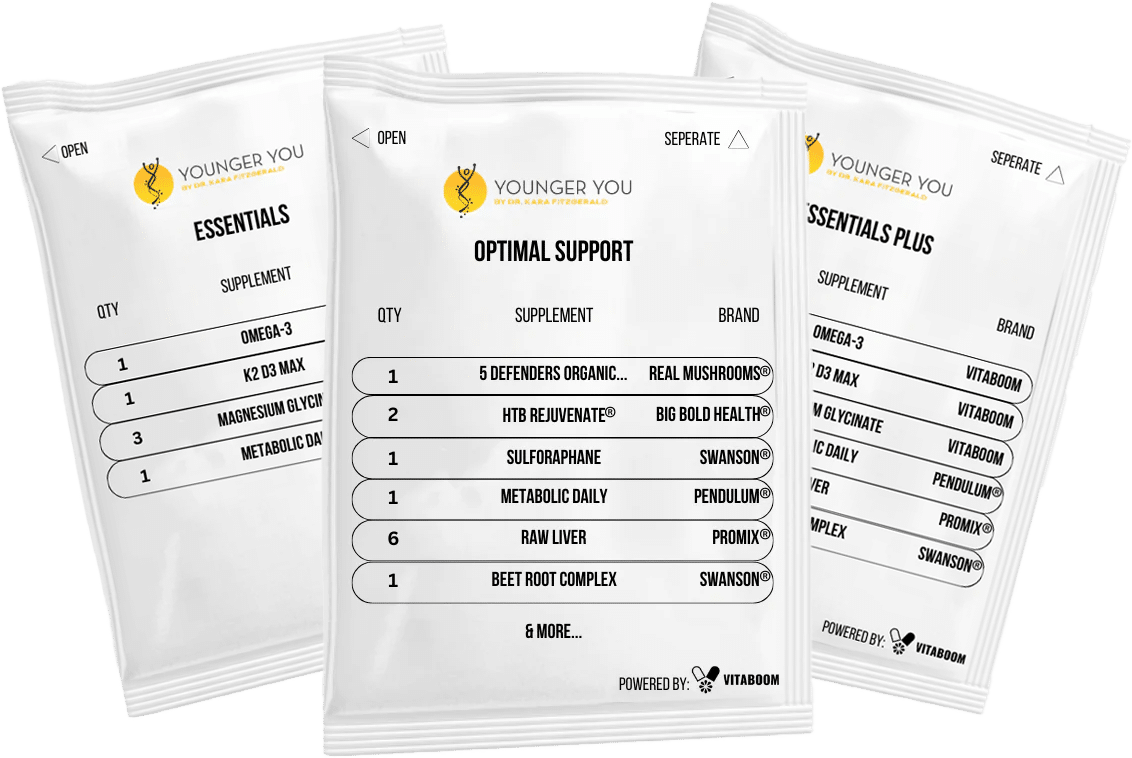
Younger You Daily Supplements are Now Here!
What could be more convenient than having your daily supplements all pre-portioned in one pouch? Choose your level to get the combination of supplements that’s right from you. Monthly subscription available.
(note you’ll be leaving www.drkarafitzgerald.com to go to www.vitaboom.com to complete your purchase)

Related posts