


What New Science Says About Building Muscle | Brad Currier

Don’t forget to Become a DUTCH Provider today to gain access to free educational resources about the DUTCH Test, expert clinical support, comprehensive patient reports, and peer-reviewed and validated research! Learn more at dutchtest.com/for-providers.

For 50 years, Biotics Research Corporation has utilized “The Best of Science and Nature” to create superior nutritional supplements, available exclusively to healthcare professionals.
I was really excited to sit down with Dr. Robert Lustig for this conversation. If you’ve ever thought seriously about sugar, fructose, or metabolic health, his work has probably shaped your thinking in some way. He’s also deeply outspoken, and while we don’t see every issue exactly the same way, I really value conversations like this, especially on the heels of the new USDA dietary guidelines. We talk through what he supports, what gives him pause, and where he thinks the real leverage points actually are, from food policy to ultra-processed foods to the bigger systems driving chronic disease. I didn’t quite know where this conversation would go, but I found it thoughtful, provocative, and grounding, and I think you will too. ~DrKF
New Food Guidelines: Progress or Missed Opportunity? | Dr. Robert Lustig
In this episode of New Frontiers in Functional Medicine, Dr. Kara Fitzgerald sits down with Dr. Robert Lustig, pediatric endocrinologist and leading voice on metabolic health, to examine the newly released USDA Dietary Guidelines and what they reveal about modern nutrition policy, metabolic disease, and the broken food system.
Their conversation explores where the guidelines align with current metabolic science, where critical nuance around sugar, ultra-processed foods, fats, and protein is missing, and why dietary guidance alone often fails to drive meaningful improvements in obesity, diabetes, and cardiometabolic health. Drs. Fitzgerald and Lustig also discuss the systemic forces shaping food availability, industry behavior, and public health outcomes, highlighting why policy, environment, and biology must be considered together.
Listeners will gain a clearer framework for interpreting nutrition guidelines, understanding the metabolic impact of food quality and processing, and applying a systems-based, metabolically informed approach in both clinical practice and everyday decision-making.
In this episode of New Frontiers, learn about:
- Rethinking the USDA Dietary Guidelines: How Dr. Lustig assesses what they get right, where he sees critical nuance missing, and why he questions whether guidance alone changes health outcomes.
- Public Health, Food Addiction, and Personal Choice: A discussion on how food availability, incentives, and sugar addiction may drive eating behavior more than nutrition education alone
- Conflicts of Interest in Nutrition Policy: An examination of how food, agriculture, and commercial interests influence dietary guidelines and nutrition recommendations
- Ultra-Processed Foods and the Global Food System: Why processing itself may not be the core problem and how shelf life, food waste, and feeding a global population complicate solutions
- The Metabolic Matrix and Defining Healthy Food: Unpacking Dr. Lustig’s metabolic framework for evaluating foods based on liver health, gut health, and brain function
- Fiber, the Microbiome, and Gut Health: Dr. Lustig’s critique of how dietary fiber, gut barrier integrity, and inflammation are underrepresented in current nutrition policy
- Macronutrients, Micronutrients, and Metabolic Context: How fats, proteins, iron, amino acids, and nutrient interactions affect metabolic health in ways that defy simple dietary rules
- Fat Quality, Omega-6/Omega-3 Balance, and Food Processing: The role of fatty acid balance, high-heat processing, and unintended inflammatory effects in modern food production
Dr. Kara Fitzgerald: Hi everybody, welcome to New Frontiers in Functional Medicine where we are interviewing the best minds in functional medicine. And of course today is no exception. I am thrilled that I am finally speaking with Dr. Robert Lustig, a name many of you will recognize as one of the most outspoken and passionate advocates for fixing our broken food system. And let me tell you, this is on the day after the release of the USDA food guidelines, so stay tuned and buckle up for what’s really a pretty extraordinary conversation.
Dr. Kara Fitzgerald: If you don’t know Dr. Lustig’s work, he is a pediatric neuroendocrinologist by training, he was at UC San Francisco for many, many years. He is a big voice in the movement against ultra-processed food and added sugar. He’s got many books to his name, directed both at the layperson as well as academic chapters and peer-reviewed research studies. He’s been involved in clinical research around the world and just he’s up to a lot in this space, always with the intention to advocate for fixing our broken food system. I hope you enjoy this conversation.
Dr. Kara Fitzgerald: Dr. Lustig, what an honor it is to get to talk with you today. I have, of course, been following your work for many, many, many years, as really most of us have in functional medicine, and our paths have crossed in conferences and so forth over the years. I was reading your bio and you’ve dedicated your retirement from clinical medicine to help fixing the food supply. I mean, it’s not a retirement.
Robert Lustig, MD: Yeah, and how’s that going?
Dr. Kara Fitzgerald: I want to just say first, what retirement? I mean, you’re as busy as ever. You’re probably more busy than when you were back in academia.
Robert Lustig, MD: Yeah, it’s true. I realized, I guess, early on that I could take care of a million kids easier than I could take care of one.
Dr. Kara Fitzgerald: That makes sense. Okay, all right. Well, before you dive into your thoughts, because I know you got a lot of them, first of all, I just want to thank you for your tireless, energized, inspirational commitment to changing, to fixing the food supply. Your voice, I think, when people think about who’s really had their finger on the pulse of clearly articulating the disaster that is the standard American diet, I think you come to mind. You’re right up at the top.
Robert Lustig, MD: I appreciate that.
Dr. Kara Fitzgerald: So here we are on the heels of the new dietary guidelines from the USDA and many of us, including your dear friend and colleague, Dr. Jeff Bland, many of us are pretty excited. I mean, it’s incredible. But you didn’t… Talk about this from your perspective, from your long history being in this space, to what you see being put out as the new dietary guidelines.
Robert Lustig, MD: So I’m not nearly as excited.
Dr. Kara Fitzgerald: You’ve got to tell me why.
Robert Lustig, MD: Let’s be very clear on this. So first of all, what’s my relationship to these dietary guidelines? The answer is none. And it’s not because I didn’t want to. I was actually a member of the Dietary Guidelines Advisory Committee (DGAC) for an entire two days.
Dr. Kara Fitzgerald: Oh, is that right.
Robert Lustig, MD: For two days. On August 4th, I received a phone call from an Assistant Secretary of HHS asking me if I would be a member of the Guidelines Advisory Committee. And I said, I will do it with one proviso, and that proviso is that RFK Jr. has nothing to do with it and we can present the data as it should be based on the science only. And he said, absolutely, RFK has no interest in politicizing this whatsoever. He wants the science. I said, okay. So I signed up. Two days later RFK unilaterally pulled nine abstracts from three separate meetings that had already been accepted and had not yet been presented from the Dietary Guidelines Advisory Committee that had been administered by my colleague, Dr. Christopher Gardner. And he did it for purely political reasons. And so I quit on August 6th, two days later. So I have had nothing to do with these dietary guidelines. And the sad part is I keep getting emails over the last 24 hours saying, “Congratulations! Wow! That’s great! You must be really excited.” No, I’m not. I’m not excited at all.
Dr. Kara Fitzgerald: Gardner is still a part of it.
Robert Lustig, MD: Yeah, well, I don’t know why. There are several people on the committee that shouldn’t be part of it, but nonetheless. So let’s start with–
Dr. Kara Fitzgerald: Sketch out what the new guidelines are briefly before you criticize them so we’re all on the same page. And we’ll link to the PDF on the show notes, folks.
Robert Lustig, MD: Okay, so the new guidelines are six pages. Six pages. In some ways that’s good because people can actually read them, and in some ways that’s bad because there’s absolutely no nuance to any of it. And the problem with nutrition is it’s all nuance and there’s no nuance in this. The watchword of the entire guidelines is three words. Eat real food. Now, I am totally for that. Eat real food. I’ve been saying that now for basically 17 years. Eat real food. So that’s good. That’s good. Now, what does it mean, eat real food? Because what’s real and, you know, how do you eat real food in this current environment? So now you have to start going into the the details of it.
Robert Lustig, MD: There are two things in the current new guidelines that I actually agree with. One is let’s limit added sugar. I am for that because sugar is a dose-dependent mitochondrial toxin and we have the data to demonstrate and prove that. And the second is to limit the availability and use of ultra-processed food. And I’m for that. Now, does that mean that all ultra-processed food is bad? No, it does not mean that. What does it mean? Well, could ultra-processed food be healthy? Our current ultra-processed food is not healthy. I don’t argue that. But if you just say limit ultra-processed food, that sort of takes away some things that actually might be good.
Dr. Kara Fitzgerald: Such as?
Robert Lustig, MD: Well, for instance, yogurt.
Dr. Kara Fitzgerald: Well, yogurt is in here.
Robert Lustig, MD: Well that gets into, what kind of yogurt? There’s nothing wrong with plain yogurt. There’s a whole lot wrong with strawberry yogurt. So what’s the difference between plain yogurt and the strawberry yogurt? Well, the sugar, but that’s what made it ultra-processed, as an example. Can you make ultra-processed food healthy? That’s a question.
Dr. Kara Fitzgerald: Well, you don’t consider plain yogurt ultra-processed. The variable is the sugar.
Robert Lustig, MD: No, that’s clearly not ultra-processed. That’s right. So the question is, can you make ultra-processed food healthy? Five years ago, a company in the Middle East– It’s kind of the Nestle of the Middle East– The name of it is Kuwaiti Danish Dairy Company, KDD. They make all sorts of ultra-processed food for the Middle East. They make flavored milks, they make frozen yogurt, they make ice cream, they make biscuits, they make confectionary, they make tomato sauce. Like all bad stuff. They came to me during the pandemic and they said, look, we know we’re part of the problem. We want to be part of the solution. Kuwait has an 80% obesity rate and an 18% diabetes rate. We want to be helpful, not harmful. Is there a way that you can help us to somehow re-engineer our company so that we can be part of the solution instead of part of the problem? Can you help us make ultra-processed food healthy? That was the question and it’s formidable question.
Robert Lustig, MD: I ended up convening a scientific advisory team of five people, and we worked two hours at a time, two days a week for three years and we took KDD down to the studs. We basically looked at every ingredient they purchased. We looked at every product they made. We looked at every process in the entire food preparation panoply. We looked at all their vendors. We looked at all of the biochemicals, because we sent everything for analysis at Eurofins, which is a big biochemical analysis company. And when it was done, we came up at the end of three years with a set of precepts on what constitutes healthy. What has to happen for something to be healthy, whether it’s ultra-processed or not?
Dr. Kara Fitzgerald: Yeah, sure.
Robert Lustig, MD: And we call these three precepts, nine words, the Metabolic Matrix. And we published this in Frontiers in Nutrition in March of 2023.
Dr. Kara Fitzgerald: We’ll link to that folks.
Robert Lustig, MD: And the nine words, three clauses are very simple. Protect the liver, feed the gut, support the brain. Any food, any consumable really, that passes your lips, that does all three of those is healthy, whether it’s ultra-processed or not.
Dr. Kara Fitzgerald: So what would fall into that? What would be an ultra-processed food that fits those three?
Robert Lustig, MD: Well, it could be a yogurt, where instead of added sugar, you might have a different sweetener–
Dr. Kara Fitzgerald: Like allulose.
Robert Lustig, MD: Like allulose possibly, and maybe others, like where a fiber has been added. So there are ways to mitigate the negative harm of any individual ultra-processed food. Chocolate milk, okay? We basically replaced the sugar with erythritol, we added omega-3s into that. It’s still ultra-processed, but we’ve actually done clinical trials on these new products. And to KDD’s credit, they have taken 10% of their entire portfolio, 18 out of 180 items, and re-engineered them over the last two years to be metabolically healthy. And we’ve tested them in clinical trials at the Dasman Diabetes Institute in Kuwait to demonstrate their metabolic efficiency.
Dr. Kara Fitzgerald: Are they being adopted? I mean they probably taste a little bit different.
Robert Lustig, MD: Yes. And the most important thing is they’re on the market and there’s no change in sales. People say, oh, if it’s healthy, people won’t eat it because it doesn’t taste as good or they think it doesn’t taste as good. Yeah, you know why? We didn’t tell them. We didn’t tell the public we did it. And the fact of the matter is, there’s been no loss in sales. The track record of these new products is just as good as the old products. So it can be done. You can make ultra-processed food healthy. We just don’t here in the United States.
Dr. Kara Fitzgerald: I want to circle back to the guidelines. I think there is some decent explanation behind them. In fact, we’ll put all of the available science behind the guidelines on our show notes, everybody. So if you haven’t seen it yet, you can go and access those papers. There are quite a bit of citations. I mean, I’ll admit, it just came out, so I haven’t drilled into it as much as I will.
Robert Lustig, MD: I haven’t either.
Dr. Kara Fitzgerald: But at a glance, these guidelines do look like… I mean, you can’t really push back on them, I mean, we’re talking—
Robert Lustig, MD: Oh, you can push back on them.
Dr. Kara Fitzgerald: Let me restate it then. The guidelines that we have been using in the country for many, many, many years with just the slightest of tweaks, all but assured one would go on to develop diabetes, heart disease, you know, the chronic diseases that we are all destined to if we follow the standard American dietary pattern.
Robert Lustig, MD: Agreed.
Dr. Kara Fitzgerald: This dietary pattern, if one were to actually adopt it as it presents on this page, and then there’s information on servings, et cetera, et cetera, right, that gets a little bit different. But it seems to me there’s some sort of a chance here that this could push the boat from the shore, put energy behind your work for the last almost 20 years to actually getting people to think from a different paradigm. But do you think that that will happen? Do you think this has a chance?
Robert Lustig, MD: So let’s be clear. What are the dietary guidelines good for? Are they good for changing American’s behavior? No. What are they good for? They’re good for changing the industry’s behavior.
Dr. Kara Fitzgerald: Right.
Robert Lustig, MD: That’s what they’re good for because the industry has to manufacture products that conform to the dietary guidelines, especially if they’re going to be used in federal programs such as SNAP, such as the National School Lunch Program (NSLP), et cetera. So they force the industry’s hand in terms of reconstituting specific foods and food groups. That’s what they’re good for. They’re not good for telling people what to eat. That’s clear. Now, having done that, there’s no question that the current American diet is a piece of crap. I don’t argue that. I’m totally on board with that. The question is, just because it’s a piece of crap doesn’t mean that altering that piece of crap makes it a better piece of crap or not, you know, or makes it actually good. And that’s where we are right now.
Robert Lustig, MD: Are there things in these new dietary guidelines that are positive? The reduction in sugar, absolutely. The limitation on ultra-processed food, our current ultra-processed food, absolutely. It doesn’t have to be that way. Like I said, we’re doing something different in the Middle East. Could we do that here? Yes, we could. We haven’t. So just because you say get rid of ultra-processed food it doesn’t mean you’re actually making things better. Because after all, we’re going to have to feed 10 billion people by the year 2050, and we’re not going have enough land and ocean to do it. We’re going to need ultra-processed food because we have to do something about food waste. We have to make food last longer. We have to increase shelf life in order to be able to feed 10 billion people. How are you going to do that without ultra-processed food? So there’s economy of scale. It’s a balancing act, to be sure.
Robert Lustig, MD: So that’s one issue. Another issue is fats. They say, eat fat. They say, eat steak. They say, eat butter. Except they also said, don’t go above 10% saturated fat.
Dr. Kara Fitzgerald: Right.
Robert Lustig, MD: How are you going to do that? How are you going to eat steak and butter and not go above 10% saturated fat? That is a dichotomy. That is basically, you know, it’s a loser. It can’t occur, for one thing. Now, the question is, they say eat animal protein. Is it the animal protein or is it the animal fat or is it the animal amino acids or is it the animal iron? What is it about the animal? Because there’s a whole bunch of vegans out there that are screaming bloody murder. So what is it about animals that actually is good or bad? And can we use that information scientifically to actually construct a better dietary guidelines.
Robert Lustig, MD: So let’s talk about that for a minute. With animal fat, saturated fat, there are two kinds of saturated fat. There’s not one, there’s two. There’s red meat saturated fat, which is even-chain fatty acids, C16:0 and C18:0, and there’s also dietary saturated fat, which are odd-chain fatty acids, C15:0 and C17:0. And the dairy ones have phospholipids associated with them because they have to stay in the solution. That’s why milk has fat in it, but the fat doesn’t separate out because it’s emulsified because of the phospholipids. It turns out those phospholipids are actually beneficial. They actually reduce the risk of heart disease and diabetes. Conversely, the red meat saturated fat does not do that. Now, does it make it worse? No, but it doesn’t help. But it’s very clear that those two types of saturated fat are different from each other. Does this dietary guidelines address that? No. Okay, now let’s turn to iron.
Dr. Kara Fitzgerald: Yeah. It does suggest, though, that you should be consuming more dairy than I generally prescribe to my patients. I mean, this set of guidelines is on team dairy, for sure.
Robert Lustig, MD: Yeah, and and RFK wants it to be raw dairy. Now, how smart is that? We’ll all get tuberculosis. Yeah, it’s really brilliant. All right, now let’s turn to iron. You need iron. Where are you going to get the iron from if you’re not going to be consuming animal products? Is there any iron in plant products? Not much. Very little. Most of it’s in animal products. On the other hand, iron is necessary for red blood cells, it’s necessary for enzymes and for electron transport in the mitochondrial electron transport chain. On the other hand, iron is also an oxidative stress. So, it’s both. But if you don’t take iron, what’s that about? You know, what’s going to happen then? Well, we already know the answer to that. We’re going to get very severe anemia and all sorts of brain problems from that, and irritability to boot.
Dr. Kara Fitzgerald: Well, in certain populations. In other populations, we’re going to see iron overload, as we already do, actually.
Robert Lustig, MD: Yeah, as we already do. Okay, and then let’s go to the amino acids. Animal product amino acids– There are 20 amino acids that we need in order to build proteins, except we really only need nine of them, the essential amino acids. What are the essential amino acids that we need? We need tryptophan, we need cysteine, we need methionine, we need lysine. Those are high in animal products, they’re low in plant products. On the other hand, what’s also high in animal products? Branched-chain amino acids leucine, isoleucine and valine. And what are those good for? Well, those are good for building muscle if you’re a bodybuilder. But if you’re not a bodybuilder, what are they good for? All they do is they go to the liver, they get turned into branched-chain organic acids, they enter the tricarboxylic acid cycle, they overwhelm the mitochondria and they end up being converted to fat. That’s where the fatty liver comes from.
Dr. Kara Fitzgerald: You actually think it comes from the consumption of excess branched-chain amino acids?
Robert Lustig, MD: It comes from the consumption of excess alcohol, it comes from the consumption of excess fructose, and it comes from the consumption of excess branched-chain amino acids.
Dr. Kara Fitzgerald: Alright, well let me ask you this before you go on, because I want to hear everything that you’re saying, but I just have to clarify. If you were doing a ketogenic diet, and you’re in ketosis, but you’re doing it with animal proteins, you’re not doing fructose–
Robert Lustig, MD: Yeah, like a carnivore diet.
Dr. Kara Fitzgerald: Yeah, for a finite period. We would not expect to see that transformation into fatty acids, isn’t that correct? It’s the combination of the macronutrients.
Robert Lustig, MD: Yeah, but you’d have no fructose.
Dr. Kara Fitzgerald: Exactly. That’s right. So the fructose is the catalyst to sort of drive that reaction.
Robert Lustig, MD: Yeah. I mean, fructose is the 2,000 pound gorilla in this story. If you get rid of the fructose, the branched-chain amino acids are icing on the cake. It’s nothing. OK.
Dr. Kara Fitzgerald: OK, so it’s the complex of those macronutrients or micronutrients together.
Robert Lustig, MD: Absolutely. So, the relationship of any one individual macronutrient to the others is actually what’s important. Another example of that is omega-6s and omega-3s.
You need omega-6s. Omega-6s are the precursor to arachidonic acid, and arachidonic acid is the precursor to thromboxanes, leukotrienes, and prostaglandins, which are necessary for inflammation. Well, you need inflammation or you’ll be eaten by the maggots. On the other hand, too much inflammation is the source of multiple chronic diseases.
Dr. Kara Fitzgerald: Right.
Robert Lustig, MD: What balances that out is the omega-3s, because the omega-3s are anti-inflammatory. The problem is if the omega-6s crowd out the omega-3s, then you have a pro-inflammatory state. Does this set of dietary guidelines address this issue? No. So, as far as I’m concerned, the whole fat story in these guidelines are a problem.
Dr. Kara Fitzgerald: Wait. I think it could. I mean, wouldn’t you argue that one of the heavy sources of Omega-6s creating that imbalance comes from the ultra-processed food design?
Robert Lustig, MD: Well, soybean oil, I mean, certainly the seed oils. But it’s not even so much the seed oils themselves. It’s the fact that seed oils are in ultra-processed foods because they are heatable. You can heat them because their smoking point is much higher. And so you can put them through extruders. So what’s an extruder? It’s the thing that makes Cheetos. Did you ever wonder how those Cheetos puff up? That’s an extruder. Most ultra-processed foods are heated to very high temperatures, 400 degrees Fahrenheit or greater. And what happens to omega-6s when you heat them to 400 degrees, whether it’s in a frying pan or whether it’s in an extruder, is you flip that double bond in that omega-6 and now you’ve got a trans fat.
Dr. Kara Fitzgerald: Interesting, yeah.
Robert Lustig, MD: So even though they say no trans fats because you didn’t start with trans fats, you made them because you heated them. So this becomes a problem. So the omega-6s are a marker for the heating process and that’s part of the problem as well with ultra-processed food. But that’s not addressed either. So there are a lot of things that are not addressed. The protein issue, they want you to eat more protein. Now, why do they want you to eat more protein? I’ll tell you why. Because number one, sarcopenia is a risk factor for early mortality.
Robert Lustig, MD: Number two, GLP-1s cause wastage of muscle. And so they think, in this dietary guidelines, that if you eat more protein, you can stop that process of muscle loss. Bullshit. Where’d that come from? The thing that makes muscle is exercise. Yeah, you need the substrate, but we’re getting plenty of protein. At 0.8 grams per kilo, which is standard American protein consumption, we’re getting plenty of protein. The point is you’ve got to turn it into muscle.
Dr. Kara Fitzgerald: So you’re not in agreement with their recommendations, which are considerably bumped up.
Robert Lustig, MD: Absolutely not. So there’s a lot wrong with this. The two things that I can say make sense is the reduction in sugar, because sugar is a dose-dependent mitochondrial toxin across the board and it’s not good for anybody, and the limitation on ultra-processed food as it currently stands, even though I think that there’s a way to make ultra-processed food healthier. After that, I think everything in this dietary guidelines report is suspect. And STAT, which is this medical media company out of the Boston Globe, published a paper yesterday looking at the conflicts of interest of everyone on the dietary guidelines advisory committee. And it’s the dairy and meat ranchers across the board.
Dr. Kara Fitzgerald: Is it?
Robert Lustig, MD: It’s just a new political take over, that’s all.
Dr. Kara Fitzgerald: You know, that’s interesting. That was a question I wanted to talk to you about. Because dairy certainly is playing a pretty prominent role. Well, dairy and meat are together. I don’t know that I’ve seen much mention of legumes, although it looks like there could be a picture of one here, maybe in the shape of a peanut.
Robert Lustig, MD: Well, that’s the other thing that’s not mentioned is fiber. They don’t mention fiber at all as a nutrient. They say, use high fiber whole grains. The fact is fiber is its own nutrient. It’s just not a nutrient for you, it’s a nutrient for your microbiome. And it’s what’s making the short-chain fatty acids that are keeping your inflammation down.
Dr. Kara Fitzgerald: They actually acknowledge the microbiome here. But I want to just circle back to conflicts of interest. So, The Boston Globe mentioned that. My team will look for that folks and and link to that exposé in our show notes. But what about the previous guidelines? I mean…
Robert Lustig, MD: They were completely conflicted as well. And by the way, this set of guidelines actually has big pharma as a conflict of interest instead.
Dr. Kara Fitzgerald: Why?
Robert Lustig, MD: GLP-1s.
Dr. Kara Fitzgerald: So GLP-1s, in what way? Link it. What do mean?
Robert Lustig, MD: Well, they want you to use GLP-1s to lose weight and therefore you need more protein, quote unquote.
Dr. Kara Fitzgerald: Huh. That’s interesting. I mean, okay, I hear you. I hear what you’re saying. I think that you’ll get some pushback from people.
Robert Lustig, MD: Bring it on. Bring it on.
Dr. Kara Fitzgerald: I know. I think there’s some reasonable evidence that we can go higher in protein and see it as a net benefit and not–
Robert Lustig, MD: Well, if you’re you’re exercising, absolutely. OK, so right now, previous USDA guidelines before this said you need 0.8 grams per kilo protein. That stood for about 50 some-odd years. That number, 0.8. I learned that in college in 1975 because lower than 0.8 causes muscle wastage and muscle loss. Agreed. You need at least 0.8 and that’s what the guidelines is, a minimum. The question is, what’s the maximum? And the answer is, well, you can go up to 1.5 grams per kilo per day and still be OK. Once you hit two, you start getting into trouble. What kind of trouble? Kidney problems, trouble. And if you go above two, you’re going to end up in chronic renal failure after a period of time. And we did that back in the 1970s. They seem to not care about that because they don’t recognize there’s an upper limit. They’re only talking about the lower limit, but there is an upper limit. So, stuffing our faces with protein just because we can is not necessarily in anyone’s best interest.
Dr. Kara Fitzgerald: I that’s interesting. Well, I think that’s fair, especially if you were involved in some of that research. I think that’s a fair comment to make. Although I do know newer science is pushed against the upper limit. For me, seeing patients in practice, there’s only so much protein one can consume. Protein as the only macronutrient throughout the day is going to create serious imbalance ultimately. There’s other nutrients that we need in our dietary pattern. I’m not a pro-carnivore diet person, unless it’s for a finite period of time. I think you can make some pretty significant—
Robert Lustig, MD: I’m not a pro- anything person. I hope the people who are listening to this understand that I am not for or against any specific diet.
Dr. Kara Fitzgerald: But don’t you think that this is a step ahead or is it so disappointing to you? I mean, we’re focusing on real foods, not in the ratios that you agree with. Perhaps there’s some omissions here, but I guess, just as you said, we’re talking about real food, removing ultra-processed food, lowering the amount of sugar–
Robert Lustig, MD: And stop there. Stop there. You do those three things and then I can get on board.
Dr. Kara Fitzgerald: Do you think that these set of guidelines will change health in the US? I mean, do think these are going to have an influence?
Robert Lustig, MD: That’s a good question. My pessimistic view is that it actually won’t. And the reason is because it’s actually not going to change what’s available on the grocery shelves. And the reason for that is because the food industry is not going to be compelled to change anything. They’ll give the public what it wants, except what it wants is the problem. And that’s because sugar is addictive.
Dr. Kara Fitzgerald: Right.
Robert Lustig, MD: There are two philosophies, if you will, of the food industry. It’s we give the public what it wants, which is reactive. And then there’s if you build it, they will come, which is proactive. Which of those two does the food industry use? Both of them. It does both. And so I think that they will continue to manufacture all the junk and the public, because they’re addicted, will continue to vote with their taste buds.
Dr. Kara Fitzgerald: Unfortunately, I think that there’s a reality in that. Although you’ve talked about this, we did transform the consumption of tobacco. We were able to initiate that. The use of alcohol has dropped considerably.
Robert Lustig, MD: Well, we did that with societal interventions. We didn’t do that with personal interventions, we did that with societal interventions. Rehab and laws. So if you have an addictive and toxic substance, you need both personal and societal intervention, rehab and laws. We have it for tobacco. We have it for alcohol. We have it for opioids. For sugar, we have nothing. This dietary guidelines is not that because it’s not a mandate. It’s a recommendation.
Dr. Kara Fitzgerald: But it is putting into the consciousness, I think more clearly than it has been, right in the second page of the guidelines, the fact that 70% of Americans are overweight or obese. I mean, we know that we’re all on this chronic disease trajectory consuming the standard American diet. So I think this is bringing to consciousness, perhaps for more individuals, that something’s not right. They mentioned gut health on page two.
Robert Lustig, MD: So the question, Kara, is what are the dietary guidelines for? If they’re for sounding the alarm, hey, we’ve been sounding an alarm for a while. The point is to do something.
Dr. Kara Fitzgerald: Right. It feels like it’s been on deaf ears though. I mean, certainly in my career, I’ve been speaking for most of it, and there is a community among us where we do listen to each other. But as far as governmental input, or insight, or attention, it hasn’t been there.
Robert Lustig, MD: Right. What I can say is I’ve already heard from the food industry and they’re not happy. They’re not going to fix it just because it’s good for the American population. It has to be good for them. And they haven’t yet figured out the business model by which it’s good for them.
Dr. Kara Fitzgerald: How they can make money off of a whole foods, low-processed dietary pattern?
Robert Lustig, MD: Exactly. And until they do, they’re not going to play.
Dr. Kara Fitzgerald: That’s interesting. So then you circle back to–
Robert Lustig, MD: Ultimately, they don’t care what they sell, just as long as they sell. But they have to see that that business model still works for them. And right now they don’t see it.
Dr. Kara Fitzgerald: Okay, that’s interesting. We’ll be following this. What about GLPs? You suggest that the pharma could be involved in supporting these dietary guidelines with the high protein recommendation, kind of trying to fight the fallout of using GLPs. What do think about using them? Are they a net benefit or do you see this as a train wreck to come?
Robert Lustig, MD: When it comes to GLP-1s, I wear three hats: I have my clinician hat, I have my scientist hat, I have my public health advocate hat. And how I feel about them depends on which hat I’m wearing at the moment. So let’s put my clinician hat on for a minute. I’m glad they’re here. They work.
Dr. Kara Fitzgerald: Yes.
Robert Lustig, MD: They work. I mean, I can’t discount the data. I can’t discount what we’re seeing in society, especially in Hollywood. We can’t wave a magic wand and say this isn’t true. It’s true. They do work. 16% mean weight loss over a year and that’s not chicken feed. That’s real. And so for patients who are morbidly obese, who are otherwise candidates for bariatric surgery, it makes sense to try a GLP-1 first. I’m for it. I’m not against them, I’m for them because they work.
Robert Lustig, MD: Now, let me put my scientist hat on. Why do they work? They work in two places. First place they work is here, they work on the reward center, to reduce the feeling of reward, which is one reason why people stop eating dessert and that’s good. On the other hand, it also causes depression. It doesn’t cause suicide, but it causes depression. Back in 2006, a drug was released in Europe. I don’t know if you remember this, but it was called rimonabant. The trade name was Acomplia and it was was an endocannabinoid antagonist. It was a CB1 receptor antagonist. It was the anti-munchies drug and it got approved and it got released to the European population and within two months of its approval and dissemination in Europe, there were 21 suicides because it turned off the reward system.
Robert Lustig, MD: And you know what, if you turn off the reward system, life ain’t worth living. And so these people basically cashed it in. And so this drug was immediately withdrawn and we haven’t seen another endocannabinoid antagonist on the market because of it. The reward system matters. You care about reward. It’s what gets you up in the morning. It’s what makes you go to work. This turns off reward. Now, it doesn’t seem to turn it off as bad as rimonabant did, but it turns it off. And there’s plenty of data showing an increase in major depressive disorder. Not suicide, but at least major depressive disorder. Is that a good thing? Not so good.
Robert Lustig, MD: Number two, it works on the GI tract. It delays gastric emptying. The food doesn’t move through the intestine and the stomach as fast. It gets held up and that’s where the side effects come from; the nausea, the vomiting, the pancreatitis, the gastroparesis. 3.4% of all patients who go on a GLP-1 get gastroparesis. Stomach turns to stone. And worse yet, when you stop the med, the gastroparesis doesn’t get better. Now, is that a good thing? Not really. It’s causing a significant amount of morbidity. Mortality, you know, gastroparesis and pancreatitis has a mortality associated with that as well.
Robert Lustig, MD: How else does it work? Well, you lose fat, which is good, but you also lose muscle, like we talked about before. Equal amounts of fat and muscle. You know what else causes the loss of equal amounts of fat and muscle? Starvation. That’s why it works, because you’re starving, because you’re actually eating less, because you can’t get the food through the intestine. So you’re eating less and you lose equal amounts of fat and muscle. Now, is that good? Well, losing fat is good, but losing muscle is not. As we talked about, sarcopenia is a risk factor for early demise. But are you solving that with GLP-1s? No. So they’re saying, OK, eat more protein to try to spare the muscle, except it doesn’t work unless you’re exercising. Well, if you were exercising, maybe you wouldn’t need the GLP-1s in the first place. So that’s an issue.
Robert Lustig, MD: And then finally, let me put my last hat on, my public health advocate hat. 16% weight loss, okay, not bad. It’s good. If everyone in America who qualified for GLP-1 actually got it, that would be 2.1 trillion to the healthcare industry and currently healthcare in this country costs 4.5 trillion. Basically it’s a 50% surcharge over what we’re currently paying. We don’t have the money for what we’re currently paying because Medicare is going to be broke by the year 2029. You want to add a 50% surcharge on top of that for 16% weight loss?
Robert Lustig, MD: Conversely, if we just got added sugar in this country down to USDA guidelines of 12 teaspoons per day, and maybe that’ll go lower with these new USDA guidelines, I don’t know, we’ll see. But if we just got it down to 12 teaspoons per day from its current 19 teaspoons per day, we would get a 29% weight loss and we would save $3.0 trillion. That’s a $5.1 trillion swing per year for a 29% weight loss, which is double the weight loss over the GLP-1. So for individual patients who need it, I’m glad they’re here. For the rest of us–-
Dr. Kara Fitzgerald: Well, to your earlier point and a huge topic of conversation from you has been the addictive quality of said food. So if we’re going to achieve the sugar reduction that you’re proposing to hit some of those stats that you’re throwing out, which are obviously extraordinary, I mean, from your public health perspective, I agree with you. It’s a quick route to bankruptcy using GLP’s to the extent of the obesity epidemic in our country. But if we were to attempt to move away from the addiction, how do we do that? How do we actually achieve what you’re arguing for?
Robert Lustig, MD: That’s a very good question. How do we do this? We have to de-sweeten our lives and we have to de-sweeten our taste buds. Now how do we do that? There are ways, there are ways. It’s complicated. I’m not going to say it’s not. How do we do it?
Dr. Kara Fitzgerald: Have they seen it in Kuwait with the transformation of some of these ultra-processed foods?
Robert Lustig, MD: Yes, we have. So number one, fructose, the sweet molecule in sugar, is a dose-dependent mitochondrial toxin. That’s the thing to remember. It’s causing mitochondria to not work as well. And what happens is the energy comes in, the mitochondria can’t process it to ATP, and so it diverts it to fat. And then that fat lines your arteries or goes to your fat cells and you gain weight. That’s the basic tenet. So anything that reduces that fructose load will be beneficial and we’ve shown that in our studies and other people have shown that in their studies. And we have data now on, for instance, the San Francisco soda tax. By increasing the cost of a can of soda we’ve reduced BMI and waist circumference, and we have reduced the prevalence of gestational diabetes in the city of San Francisco by 77% since the advent of the San Francisco soda tax.
Dr. Kara Fitzgerald: Really?
Robert Lustig, MD: It works. It’s a public health intervention that works. Do you see people buying something else instead? Are they buying Frappuccinos instead? No. They’re just not drinking soda. So this is where the iron law of public health comes in. Reducing the availability of a substance reduces its consumption, which reduces health harms. It was true for tobacco, it’s true for alcohol, and it turns out now it’s true for sugar. So we’ve got to get it down.
Robert Lustig, MD: Now, are there people who are addicted? Yes, 20% of the US population is addicted to sugar. Same way that 20% of the US population is addicted to alcohol. It might even be the same 20%. So let’s look at alcohol for a minute. 40% of Americans are tea totalers, never touch this stuff. 40% are social drinkers and can pick up a beer, put it down, I’m in that category. 10% are binge drinkers and 10% are chronic alcoholics. What’s the treatment for them?
Dr. Kara Fitzgerald: For an alcoholic there’s all sorts of treatment opportunities.
Robert Lustig, MD: There’s personal intervention, rehab, and there’s societal intervention called laws, like alcohol taxes, which make it oppressively expensive to consume. Does it work? Yeah, it works. We have the data to show that it actually works. For example, in 1977, three countries, Norway, Sweden, and Denmark, had a huge alcohol problem. It was causing problems on both sides of the ledger. It was causing some problems on the positive side of the ledger in terms of productivity, people calling in on their benders. And it was causing problems on the negative side of the ledger in terms of car accidents and cirrhosis of the liver. And, you know, Norway, Sweden, Denmark, are big alcohol consumers because it’s damp and it’s cold, and back in 1977, no Netflix. And so what do people do? They drank themselves to death.
Robert Lustig, MD: So these three countries, in 1977, banded together and passed two pieces of coincident legislation that were tied together. First, they nationalized all the liquor stores in all three countries. So every liquor store sold the same fare at the same price. You couldn’t go someplace else and buy it cheaper. And the second thing they did was they taxed high-alcohol spirits and they used the money from the tax to subsidize low-alcohol beer. So it was a zero sum game for each country. They just diverted the monies that were collected from the high-alcohol tax and used it to subsidize low-alcohol beer.
Robert Lustig, MD: And slowly but surely, all three countries moved away from high-alcohol spirits to low-alcohol beer. If you ever go to those countries today, those laws are still in place today because they worked. And what happened? Productivity went up and cirrhosis and car accidents went down over a 20 year period and then they stabilized and they’re still working because the iron law of public health is a law. And so you reduce the effective availability of the substance with the tax, and you see reduction in consumption. We can do the same for sugar here if we want to.
Dr. Kara Fitzgerald: Using alcohol as an example, the amount that we’re drinking in the US has dropped to, you know, maybe not quite all time low, but it’s considerably dropped and I don’t–
Robert Lustig, MD: Well, that’s because the younger generation has decided that they have other ways to mollify their pain.
Dr. Kara Fitzgerald: I mean, think a piece of it. So, you’re talking about just marijuana becoming legal? Is that what you’re suggesting?
Robert Lustig, MD: Yeah, marijuana is the main one.
Dr. Kara Fitzgerald: There also is, I think, some awareness, and you can tell me if you think that I’m incorrect, on the part of Americans that alcohol isn’t so healthy. I mean, there’s some awareness that has occurred. I mean, might the dietary guidelines have some influence on that? Might this begin to compel some awareness?
Robert Lustig, MD: Yes, there’s awareness, and yes, dietary guidelines can help with that awareness. I don’t argue that. That’s true. Just remember, though, that education alone has never solved any substance of abuse. Did Nancy Reagan’s Just Say No work? You know, we still have an opioid crisis.
Dr. Kara Fitzgerald: Yeah, we have a pretty remarkable opioid crisis that continues still.
Robert Lustig, MD: Yeah. So knowledge is not action. You need both. You need education and you need implementation. You need both. So educating our way out of this is not going to work. Education’s necessary, it’s just not sufficient.
Dr. Kara Fitzgerald: Right. So where are we now? You’ve raised some good points. You’re on board with lowering the sugar, and the whole foods. I hear you around the GLP conversation. That makes sense. If you were able to design these dietary guidelines then what would they look like? I’m thinking you might have a space for ultra-processed health foods, and I don’t know, what would the distribution look like.
Robert Lustig, MD: I don’t think the dietary guidelines are what need fixing. I’ll tell you what I think needs fixing. The subsidies. Because the subsidies are what make cheap food available. Cheap, dangerous food available.
Dr. Kara Fitzgerald: Yeah, for sure.
Robert Lustig, MD: We subsidize the four things that kill us. We subsidize corn, wheat, soy and sugar. Those are the four things that basically kill us. The farm bill, 192 billion at the last count, all to subsidize those four crops. Those are the four crops that we shouldn’t be subsidizing. Those are the four crops that ought to be deep-sixed. Corn, wheat, soy and sugar.
Dr. Kara Fitzgerald: Has that shifted at all in this administration, with this awareness?
Robert Lustig, MD: Not a bit. Not a bit. So to me, those subsidies distort the market.
Dr. Kara Fitzgerald: The fundamental ingredients of the chronic diseases that we suffer from.
Robert Lustig, MD: And the fundamental ingredients of ultra-processed food. Ultra-processed food wouldn’t be cheap if all of a sudden those four commodities actually had to find their own price point because the subsidy ended. So to me, that’s where the action really needs to be. And no one’s talking about that. So, what would happen to the price of food if we got rid of all food subsidies? It has to be all of them, because they distort the market. Let the market work. So what would happen to the price of food? People say, well, the price of food would go up. Actually, turns out, no, that’s not true.
Robert Lustig, MD: The Giannini Foundation of Agricultural Economics at UC Berkeley did this exercise many years ago and showed that if you got rid of all food subsidies– it has to be all– the price of food actually would not change except for two items, corn and sugar, which is what we would want to change. Those would go up. So that would reduce effective availability of this dose-dependent mitochondrial toxin. So to me, that’s what needs to happen. But the dietary guidelines aren’t affecting that in any way, shape, or form. So I actually think this whole argument, this whole DGAC business is actually the wrong target. That’s not what’s going to change things.
Dr. Kara Fitzgerald: What about– this is a little tangential and then I want to ask you for your overarching thoughts, because we’re kind of heading into the home stretch here. We make GLP at the behest of our microbiome in response to certain nutrients that we consume. And so this epidemic of GLP deficiency, if you will–-
Robert Lustig, MD: There is no GLP deficiency.
Dr. Kara Fitzgerald: Well, if we have these unhealthy guts that don’t have the microbiome necessary to stimulate—
Robert Lustig, MD: The GLP-1 is not being made by the microbiome. The GLP-1 is being made by the L cells of the intestine
Dr. Kara Fitzgerald: That’s correct. They’re being made by the L cells at the behest of, you know, akkermansia is there, I think there’s Clostridium butyricum. The microbiome plays a role, and the microbiome, of course, is responding to what we’re eating to stimulate L-cell production. So I think that our current dietary pattern does put us in a state of damaging that symphony of connection, if you will.
Robert Lustig, MD: I don’t argue that. That’s absolutely true. We have many things going on in our intestine that are a problem. Think of it this way: Our intestine is a sewer. I mean, the definition of a sewer is a pipe with shit in it. That’s a sewer, right?
Dr. Kara Fitzgerald: Yeah, a pretty sophisticated sewer, but okay, fair.
Robert Lustig, MD: Yeah, right, because it extracts certain things, but it keeps the shit in the pipe. Okay, there are three ways to keep the shit in the pipe: There is a physical barrier, there is a biochemical barrier, and there is an immunologic barrier. The physical barrier is called the mucin layer. It lines the intestinal epithelium and prevents the bacteria from being able to appose onto those in order to prevent gut inflammation and ultimately systemic inflammation. That mucin layer is essential. Well, it turns out that the microbiome can chew through that mucin layer in about a nanosecond if it’s not being fed. If you don’t feed your microbiome, your microbiome will feed on you. It will eat that mucin layer right off your intestinal epithelial cells and promote inflammatory bowel disease, irritable bowel syndrome, leaky gut, and systemic inflammation.
Dr. Kara Fitzgerald: Endotoxemia.
Robert Lustig, MD: So how do you fix that? Well, you give the microbiome what it wants. It’s called fiber. Number two, the biochemical barrier. In the intestine, you have proteins that hold the intestinal epithelial cells together. They are called tight junctions, the most famous of which is zonulin. That’s what goes wrong in celiac disease. So the zonulins have to be working in order to keep the barrier intact. If the zonulins fail, then the intestine becomes permeable and the shit basically can enter the bloodstream. Well, those zonulins are ATP-dependent, so anything that reduces ATP generation inside your intestinal epithelial cells will cause transient dysfunction of those zonulins, of those tight junctions leading to leaky gut and systemic inflammation. What does that? Sugar.
Dr. Kara Fitzgerald: I know you’ll say fructose.
Robert Lustig, MD: Sugar, fructose, right, because it’s a dose-dependent mitochondrial toxin.
Dr. Kara Fitzgerald: Yeah. I think there’s a lot of things that are mitochondrial toxins, but, yeah, fair.
Robert Lustig, MD: Indeed. And then finally, we have the immunologic barrier. TH17 cells, which make a cytokine called IL-17, is the primary one. These are known as Peyer’s patches in the intestine and they’re basically looking for foreign invaders. They’re on the lookout. Turns out that if you go on a ketogenic diet, the TH17 cells are still working. If you go on a cafeteria diet, if you go on a standard American diet, the Th17 cells are all wiped out and you get Th1 cells instead. The IL-17 disappears and you don’t have that immunologic barrier anymore and all sorts of stuff gets in. So the three barriers are completely dependent on the kind of food, the presence of fiber and the overabundance of sugar. So if you solve the sugar and fiber, which is called real food, you basically make the barrier work. To me, that’s what’s important. And that’s why real food works and processed food doesn’t.
Dr. Kara Fitzgerald: In these closing moments, I’m curious what you’re up to these days. What work you’re doing, where you’re focusing your attention. Do you think that you might get involved in some capacity with governmental things? I mean, you have a long history of being involved.
Robert Lustig, MD: I’m not going to be involved in this administration at all, on purpose. I have been asked four separate times to serve in this administration and I have said no each time. And the reason is because I don’t trust them. I don’t trust them. I have integrity and they don’t and they’ve shown it countless times. I will not do that. Maybe when the administration changes in 2028, maybe we can discuss it. But for right now, I’m more valuable and more effective and happier on the outside, pressuring from the outside in, than I would be on the inside, basically, taking the hits. In addition, no one survives this administration with their integrity intact. No one. So I’m going to stay out and do my work outside.
Robert Lustig, MD: So what am I doing? Well I’m still doing research, I’m still consulting, I’m still writing policy, I’m still involved in multiple ways. We’re suing the food industry in various venues. I am the chief medical officer and co-founder of a fiber company which can be added to ultra-processed food to make it actually act in the intestine like it’s real food. Because there’s the carbohydrates, the glucose, the fructose, the sucrose, the simple starches. It’s called Biolumen and the product itself is called Monch Monch. You can find it on monchmonch.shop. It’s available for sale.
Robert Lustig, MD: We’re working with companies now to get it into ultra-processed food so that we can mitigate the metabolic harm risk reduction of ultra-processed food. Not because I’m a fan of ultra-processed food, but we have to do something to reduce the risk. Kind of like giving clean needles to drug addicts during the AIDS epidemic. You don’t condone the behavior, but you try to reduce the harm.
Robert Lustig, MD: Another thing I’m doing is I am the chief medical officer of an Alzheimer’s prevention company focused around improving mitochondrial function and it’s called Snap Recall. Basically, we have an AI platform to tell us what’s going wrong in the mitochondria and therefore how to fix it in an attempt to try to mitigate dementia and cognitive decline. That’s pretty cool.
Dr. Kara Fitzgerald: That sounds really interesting. Yeah, sounds really cool.
Robert Lustig, MD: It’s based on mitochondrial energetics. And I am still working with KDD. I’m going to Davos next week to interview Yuval Noah Harari, the historian and we’re going to have a session called the Agricultural Revolution to the Metabolic Revolution. Because after all, agriculture is what got us into this mess. The question is how to get out. It should be interesting.
Dr. Kara Fitzgerald: Yeah, it will be, I’m sure.
Robert Lustig, MD: Yeah. So, I’ve got several irons in the fire, but all around the notion that our food supply is contaminated and we need to fix it in order to ultimately not just improve metabolic health, but mental health, societal health, and planetary health.
Dr. Kara Fitzgerald: Well, on that note, I just want to thank you for your time. I know you’re a busy guy. It took us a while to track you down and get you on our podcast. Thank you so much for joining me, Dr. Lustig. Hopefully I’ll see you soon, maybe at PLMI this year. Thank you.
Robert Lustig, MD: No doubt. Pleasure.
Dr. Kara Fitzgerald: I hope you enjoyed my conversation with Dr. Lustig. It was interesting, wasn’t it? At a glance, I think a lot of us have been wowed by the new USDA food guidelines, and I am hopeful they’re going to inspire some changes. Dr. Lustig, not as excited about them as I was, and obviously we spent a lot of time talking about why. I think he makes some incredibly good points to be a little bit more nuanced. We’ll see how these shake out over the months and years to come over the next administration, et cetera, et cetera.
Dr. Kara Fitzgerald: I think his central thesis of lowering sugar and just the idea of perhaps transforming ultra-processed foods into healthier versions, there may be a place for that. I think he makes a decent argument. And of course, his discussion on what they’ve been doing over in Kuwait is compelling. Anyway, he’s up to lots of really cool work. As you heard, think he continues to be an important, nuanced, and outspoken voice in this space. I hope you enjoyed it.

Robert H. Lustig, MD, MSL, is Emeritus Professor of Pediatric Endocrinology and a member of the Institute for Health Policy Studies at the University of California, San Francisco. A neuroendocrinologist with deep expertise in obesity, diabetes, metabolism, and nutrition, Dr. Lustig has been a leading voice in shaping how clinicians and the public understand the metabolic effects of sugar and ultra-processed foods.
After retiring from clinical medicine, Dr. Lustig has focused his work on improving the food system to reduce human suffering and environmental harm. His approach centers on a unifying vision of metabolic health: protect the liver, feed the gut, and support the brain. He is the author of Fat Chance, The Hacking of the American Mind, and Metabolical, and serves as Co-Founder and Chief Science Officer of the nonprofit Eat REAL. Dr. Lustig also holds leadership roles with Biolumen, SnapRecall, and Perfact, and is a member of the American Dental Association’s Nutrition Task Force.
Website: Robertlustig.com
Email: rlustigmd@gmail.com
Exclusive Offers for New Frontiers Listeners
Find out why MitoQ’s mitochondria-targeting is a critical step for your healthspan and longevity strategy.
Books and Publications by Robert H. Lustig, MD, MSL
Perfact – a personalized food-filtering technology platform developed with Dr. Robert Lustig
Monch Monch Fiber Supplement
Dietary Guidelines for Americans
Scientific Report of the 2025 Dietary Guidelines Advisory Committee (DGAC Report)
Dasman Diabetes Institute in Kuwait
Panel behind new dietary guidelines had financial ties to beef, dairy industries
The Giannini Foundation of Agricultural Economics at UC Berkeley
Journal Articles
Obesogens: a unifying theory for the global rise in obesity
The battle over “food addiction”
People Mentioned
Blog: Ultra-Processed Foods Spell Disaster for Longevity
Blog: Avoiding Toxic Food Chemicals Just Got a Bit Easier: New Laws & What You Need to Know
Podcast: Why Aging Is Not a Fat Problem — A Muscle-Centric Approach to Longevity with Dr. Gabrielle Lyon
Podcast: The Oral Microbiome: The Hidden Biomarker Driving Aging, Fertility & Systemic Inflammation

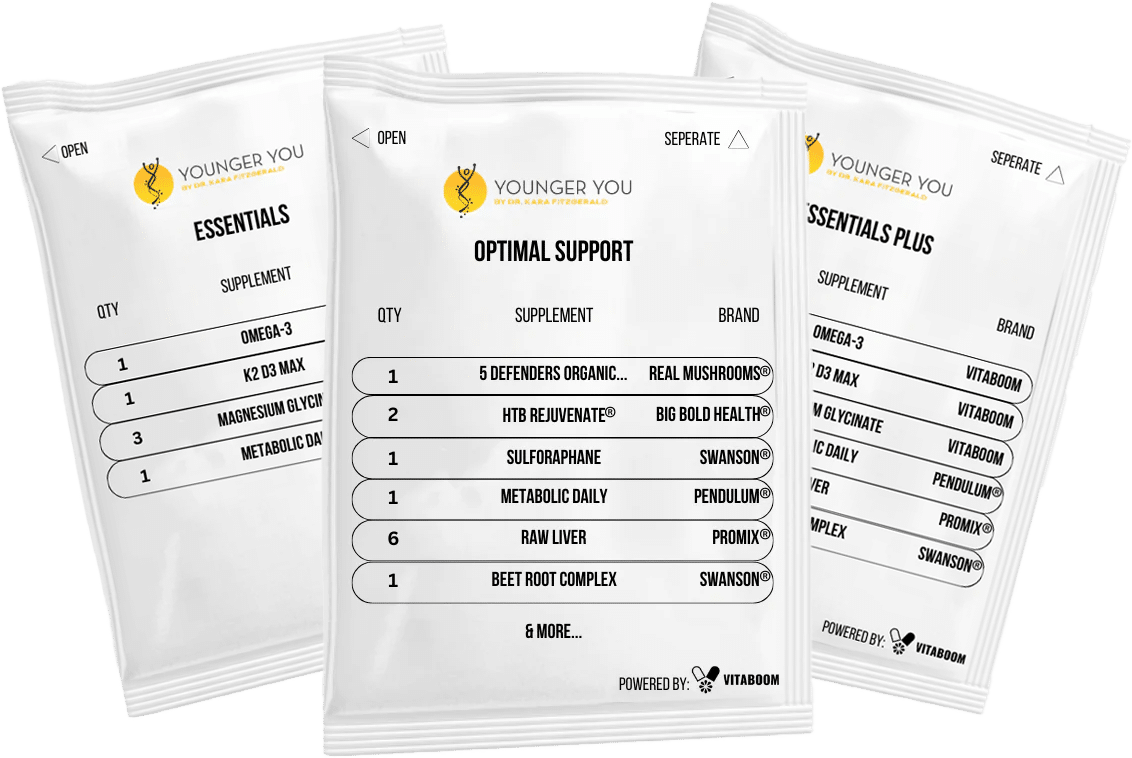
Younger You Daily Supplements are Now Here!
What could be more convenient than having your daily supplements all pre-portioned in one pouch? Choose your level to get the combination of supplements that’s right from you. Monthly subscription available.
(note you’ll be leaving www.drkarafitzgerald.com to go to www.vitaboom.com to complete your purchase)