
The Epigenetic Impact of Younger You – A New EWAS Study


Practitioners, you can sign up to become a MitoQ Partner, access wholesale rates, and unlock cellular health for your patients by going to mitoq.com/partner
Key Takeaways
- Mitochondrial dysfunction may connect seemingly separate conditions. Chronic mitochondrial oxidative stress may contribute to resistant hypertension, diabetic heart dysfunction, and persistent fatigue.
- Standard care remains essential. Mitoquinol targets oxidative stress within mitochondria and is being studied as a complement to existing treatment.
- The evidence varies by condition. Research suggests potential vascular and cardiac benefits, while findings in fibromyalgia and ME/CFS remain mixed.
- Earlier intervention warrants further study. Emerging research includes populations with mild metabolic risk markers and vascular aging, but broader clinical applications need more evidence.
- Practitioner access: Mitoquinol is available in practitioner-only doses of 10mg and 20mg through the MitoQ® website or Fullscript.
Every clinician has patients who don’t fit the textbook. The hypertensive patient whose blood pressure won’t budge despite a full medication ladder. The patient with relentless fatigue that no bloodwork explains. On the surface, these look like unrelated puzzles – underneath, they may be pieces of the same one.
The common thread is mitochondrial. Every cell produces energy through mitochondria, and every unit of energy they make comes with a small cost: reactive oxygen species generated as a byproduct of the process.
In a healthy system, this is background noise, and the cell clears it as fast as it produces it. But under chronic stress (think toxin overload, poor sleep, ultra-processed foods, or ongoing emotional stress), clearance can’t keep up, and the excess damages mitochondria, disrupting communication elsewhere in the cell and the wider body. This can show up in patients as an inability to bounce back from illness or injury, slower recovery from exercise, and waking up tired no matter how much sleep they got.
Which tissue feels it first depends on where that mitochondrial machinery breaks down: a blood vessel that can’t relax, a heart that can’t keep up with its own demand, or a body that runs out of usable energy altogether.
Mitochondrial Oxidative Stress and Nitric Oxide Signaling in Hypertension
Medications like ACE inhibitors and calcium channel blockers are the default response to a high blood pressure reading. Yes, these medications work, but they act downstream, forcing dilation chemically or reducing the volume the vessels have to contend with. None of them restore the vessel’s own ability to dilate; that ability depends on nitric oxide (NO).
Healthy endothelial cells produce NO on demand, signaling the surrounding smooth muscle to relax. In hypertension, mitochondrial oxidative stress in the vessel wall degrades NO, impairing the vessel’s ability to dilate at the cellular level long before a prescription enters the picture.
This is where mitochondria-targeted antioxidants can be integral, protecting the NO that’s already being made. Mitoquinol concentrates specifically inside mitochondria, clearing the oxidative burden at its source before it degrades NO signaling.
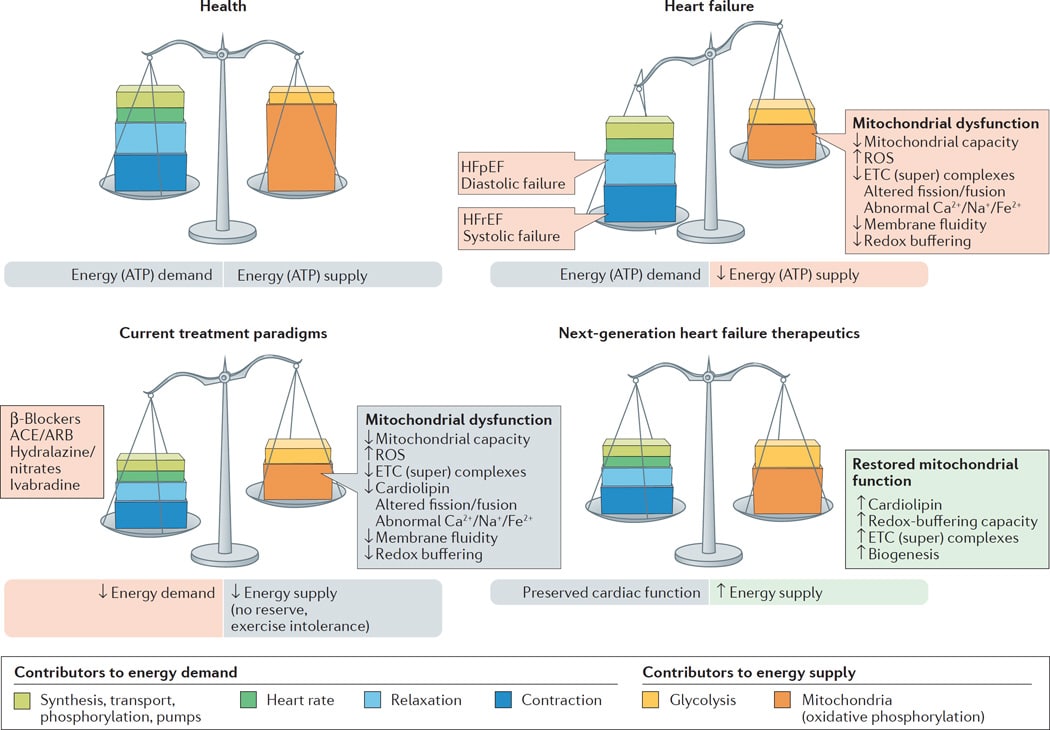
Brown et al., 2017 illustrates the need for medications that target root causes, rather than downstream effects
Mitoquinol and Vascular Health: Evidence From Human Studies
- Flow-mediated dilation (FMD) measures how well a blood vessel widens in response to increased blood flow and serves as a marker of endothelial health and one of the best predictors of cardiovascular risk. Multiple human studies show Mitoquinol improves FMD, particularly in populations with underlying vascular dysfunction.
- In a randomized, placebo-controlled trial in older adults, six weeks of Mitoquinol supplementation increased brachial artery FMD by 42%, alongside reductions in oxidized LDL cholesterol and arterial stiffness, indicating improvements in both endothelial function and vascular oxidative stress.
- Similar benefits have been observed in postmenopausal women and patients with peripheral artery disease, suggesting that targeting mitochondrial reactive oxygen species may represent a novel strategy for supporting vascular health, preserving nitric oxide signaling, and mitigating vascular aging.
- Beyond disease populations, Mitoquinol has also shown benefit in healthy adults with only mild metabolic markers. A 12-week trial in 179 healthy Chinese adults (average age: 36 years) found that 20mg/day Mitoquinol significantly reduced systolic and diastolic blood pressure, alongside improvements in liver enzymes and lipid profiles.

Figure from Mitchell et al, 2026. Mitoquinol effects on ALT and blood pressure.
Mitoquinol and Exercise: Exploring the Combined Cardiovascular Benefits
Exercise is already first-line advice for hypertension, and most prescription medications practitioners might add alongside it don’t meaningfully improve on exercise alone – but this is where Mitoquinol stands out.
- Masoumi-Ardakani (2022) found the largest reduction in blood pressure and the biggest improvements in cardiac function and oxidative stress markers in the group combining Mitoquinol with exercise.
- Exercise drives mitochondrial renewal through its own adaptive burst of ROS. Mitoquinol clears the ROS load already in the vessel wall, but without dampening the beneficial signal exercise is trying to create, which is likely why the combination outperforms either intervention alone.
- Hypertension suppresses two microRNAs needed for vascular repair and mitochondrial renewal (miR-126 and miR-222). Both exercise and Mitoquinol help normalize these markers.
Beyond Glucose Control: Mitochondrial Dysfunction in Diabetic Cardiomyopathy
Standard diabetes management focuses on glucose – HbA1c, fasting glucose, insulin sensitivity. But even well-controlled T2D patients can develop diabetic cardiomyopathy – which is heart muscle dysfunction that occurs independently of coronary artery disease or hypertension. Cardiomyopathy is a distinct risk factor for heart failure in its own right, not just a downstream effect of vascular damage.
Cardiomyocytes have some of the highest energy demands of any cell in the body, contracting roughly once a second for life without rest. Mitochondria make up around 40% of a cardiomyocyte’s volume, reflecting how central continuous ATP supply is to the cell’s basic structure and function.
In diabetes, excess glucose and fatty acids overload this energy-producing machinery, generating oxidative stress as a byproduct. Relaxation between beats often suffers first – because it’s an active, energy-dependent process, it slows before the heart loses any actual contractile strength. Left unaddressed, the same oxidative burden drives the structural changes behind diabetic cardiomyopathy – wall thickening, fibrosis, and stiffening – often years before symptoms appear.
Mitoquinol in Type 2 Diabetes: Early Evidence on Cardiac Function
- A trial of 70 people with T2D (without established heart failure) gave 40mg/day Mitoquinol for four months on top of standard care and found a ~15% improvement in cardiac energy efficiency, both at rest and during exercise.
- Myocardial relaxation was measurably faster, demonstrating early evidence of stiffness reversal.
- No change in heart structure, and no adverse effects reported.
Mitochondrial support here isn’t targeting diabetes itself; it’s targeting a downstream cardiac vulnerability that standard glucose management doesn’t touch, and doing it early enough that the changes still appear reversible.
Chronic Fatigue and Mitochondrial Dysfunction: Exploring the Connection
Unrefreshing fatigue in fibromyalgia and ME/CFS often tracks with measurable ATP production deficits – showing up as exhaustion, brain fog, and muscle pain that doesn’t resolve with rest.
- A 2016 patient-led crossover study found an interesting split: Mitoquinol reduced pain and improved memory in fibromyalgia, but showed no benefit beyond placebo in ME/CFS.
- A third, uncontrolled arm in the same study (mostly ME/CFS taking Mitoquinol with no placebo) reported large gains in energy, sleep, and mental clarity.
This split suggests the two conditions may not share the same mitochondrial picture, and shows how much study design shapes what a trial can tell us.
Two parallel cases make the underlying mitochondrial biology clinically relevant:
- Floxxing: fluoroquinolone antibiotics directly damage mitochondrial DNA and electron transport chain complexes I/IV, producing a fatigue, fog, and pain picture that closely mirrors ME/CFS, with a known mitochondrial cause.
- Long COVID shows the same signature – impaired ATP production, elevated lactate, overlapping fatigue, and post-exertional malaise. Some researchers now group ME/CFS, fibromyalgia, and long COVID as “low-energy-availability disorders.”
Note: We have an upcoming long COVID study that will be published in 2027 through the Mitochondrial Collaborative Research Program.
Final thoughts
Resistant hypertension, diabetic heart changes and unexplained fatigue may look like separate problems, but they share a common driver: mitochondria under chronic oxidative stress, unable to meet the energy demands of the tissues they serve. Standard care remains essential, but it largely works downstream.
Mitoquinol works upstream, reducing oxidative stress inside mitochondria, and the evidence suggests it complements existing treatment rather than replacing it. In practice, clinicians may consider it alongside current management for patients with elevated blood pressure (especially combined with exercise) or type 2 diabetes. It may also suit patients with early or subclinical risk, including those with mildly elevated liver enzymes or lipids, midlife and postmenopausal women experiencing vascular aging, and patients with chronic low-grade oxidative stress and inflammation. Mitoquinol is available in practitioner-only doses of 10mg and 20mg via the MitoQ® website or Fullscript.

Author Bio
Tyla Cornish | Translational Science Specialist, BNatMed (Naturopath)
Tyla Cornish is a qualified naturopath and the translational science specialist at MitoQ, where she translates mitochondrial research into practical resources for healthcare practitioners and their patients. Drawing on her clinical training, she supports the clinics and practices that recommend MitoQ with the scientific context and tools they need to apply the evidence with confidence. Through her practice, she brings this evidence-informed approach to women’s gut and hormone health. Learn more at wellnessbytyla.com or follow along on Instagram @wellnessbytyla.
Related posts